Technology and communication are constantly evolving, and new buzzwords emerge all the time. One such term is “prtech,” which has been gaining attention recently.
Today, brands deal not only with journalist inquiries but also with an overwhelming volume of social media comments demanding quick responses. While companies could afford to wait before addressing negative feedback 10–15 years ago, a single PR mistake can now result in lasting damage to a brand’s reputation and revenue.
What is PRtech?
“PRtech” is a combination of two words: “public relations” and “technology.” It signifies the convergence of these two domains and the transformative impact of technology on public relations. In essence, Prtech involves the use of sophisticated technological tools and strategies to improve and simplify public relations efforts.
To understand PRtech fully, we must first take a brief journey through the history of public relations. Traditionally, PR professionals relied on conventional methods, such as press releases, media outreach, and events, to manage their clients’ reputations. However, technological advances have dramatically changed this landscape.
PRTech lets you adopt various types of technologies to drive better business results. Adopting here means not buying but using it as a solution to a need. For starters, that can mean researching new platforms and learning new skills. To others, the goal is to drive business results.
When a tree falls in a forest, and no one hears, does it make a sound? The same story here. No matter how loud you inform, persuade or motivate your audience to take action, the result is zero if the message doesn’t reach it. Instead, you can give your PR campaign the boost it needs by adopting technology.
The good news is that you don’t have to reinvent the wheel. The new normal is already a part of PRTech today, and you can’t help but use it. Here are some tried and proved PRTech solutions for doing business today. Which one will work for you best?

Key PRTech tools
The number of communication channels increases directly with the number of new tasks. To avoid being overwhelmed by the flow of information and to make strategic decisions quickly, PR Tech technologies are essential. These modern services facilitate database and mailing management, team organization, campaign evaluation, task automation, and resource optimization (including human resources). Now, let’s take a look at the key PR Tech tools.
Tracking the media landscape
To avoid wasting time scrolling through endless social media feeds and opening dozens of browser tabs (and most likely missing important messages!), it is worth automating your search for information. For example, you can connect to brand monitoring, which the PR manager will configure according to market needs, channels, and keywords.
Media and social listening is one of the most widely used PR tech applications today. Modern PR teams across Europe use monitoring platforms like Meltwater, Cision, Brandwatch, and Talkwalker to track brand mentions in real time.
These tools enable companies to swiftly identify what is being said about them across online news outlets, social media platforms, blogs, forums, and broadcast media. Rather than manually searching for mentions, PR professionals can set up keyword-based alerts and dashboards that offer a comprehensive view of the media landscape.
Media monitoring is a crucial tool for understanding your reach and brand impact. When you track stories as they unfold, you know when a story breaks, peaks, and the factors that will influence coverage. That is a great way to ensure that the right message is shared at best possible time. Being up to date with recent events ensures that the content you publish is relevant and adds value to the current news scene. As a result, it has a better chance to be covered by reporters.
The list of the best media monitoring tools is large, including free and premium ones. The choice often depends on the layer of complexity and the media type you’re focusing on. Think on your feet and marketing goals to ensure you go for the right option.
Media publishing
To make sure you put your offer on the table, it’s smart to stick with tried-and-true approaches. For that, you need to adopt various PRTech tools to distribute your pitches and press releases to ensure maximum exposure and coverage. That can be artificial intelligence programs that do all the difficult tasks for you and save time. As a result, you expand your database with a few clicks instead of hours of research.
Brands looking for more flexible content placement options can access thousands of online media outlets worldwide through services such as PRNEWS.IO. As a global PR marketplace, PRNEWS.IO allows companies to quickly publish sponsored articles in industry-specific, regional, or international publications without the need for lengthy outreach campaigns.
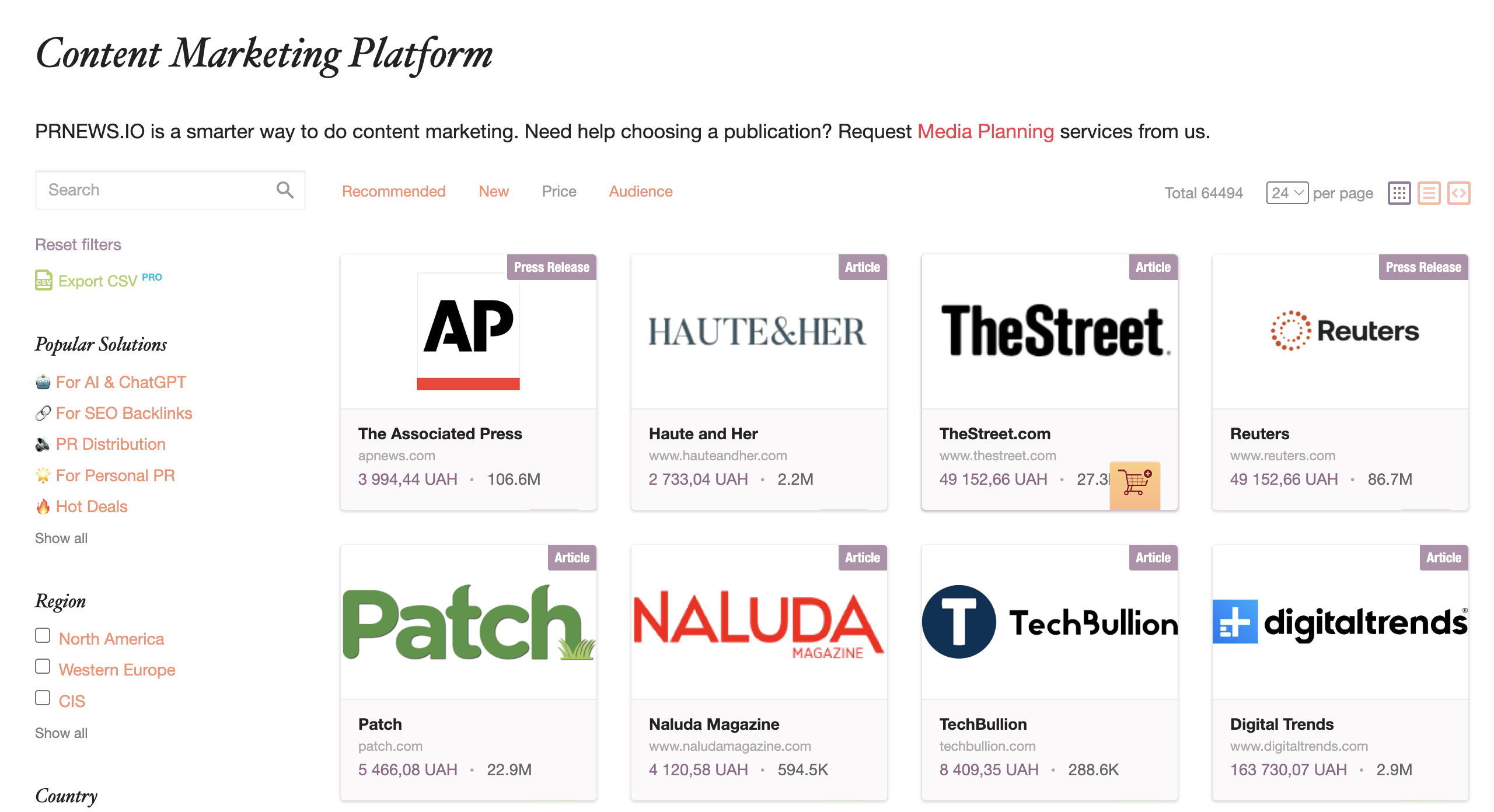
It’s a great PRTech solution to skip press release writing hassle. Also, it will help you distribute it and find people subscribing to your content without you lifting a finger.
Cooperation with journalists
One of the core responsibilities of any PR manager is the distribution of timely and relevant content, such as product announcements, thought leadership articles from industry experts, official company updates, and industry news.
To build relationships with new media outlets, PR professionals are increasingly relying on digital communities and journalist request platforms as an alternative to direct pitching. These services connect reporters with experts, enabling brands to contribute valuable commentary without large publishing budgets.
For instance, platforms like Qwoted, and ResponseSource are popular in the US and Europe for securing earned media coverage with expert quotes and timely insights.
How to deal with PRtech in Modern PR
One of the primary aspects of PRtech is its extensive use of data analytics. PR professionals now have access to a wealth of data, including social media metrics and website traffic analysis. Leveraging these insights allows them to make informed decisions, tailor their campaigns, and measure the impact of their efforts more effectively.
AI and chatbots
AI-powered tools and chatbots have quickly become essential to modern PR workflows. ChatGPT Plus, for example, is a widely used platform for brainstorming, generating content ideas, and editing press materials. Meanwhile, solutions such as Microsoft Copilot help automate routine tasks and streamline internal processes, although the technology can still feel imperfect in practice.
Beyond writing support, PR teams are increasingly adopting AI-based tools for specialized needs. Services like Rev assist with transcription and translation, making it easier to repurpose interviews or multilingual communications. For media monitoring and measurement, Meltwater remains a popular platform for tracking brand mentions across social and traditional media despite the learning curve that comes with complex systems.
Additionally, PR specialists are turning to AI-driven tools to enhance their outreach and pitching efforts. PodPitch, for example, has become a game-changer for podcast and media pitching. It allows teams to automate parts of the outreach process and scale communication efforts faster.
Writing assistants, such as Grammarly, also play an important role by helping professionals maintain clarity, tone, and credibility, which is especially important in industries where frequent pitching can impact writing quality over time.

Reputation measurement and smarter analytics
Modern PR technology goes beyond counting mentions or impressions. Now, many organizations are seeking tools that help establish a broader baseline of corporate reputation across multiple touchpoints. Although media monitoring platforms are still useful, surveys and reputation-focused analytics offer deeper insights into how audiences perceive a brand.
Some advanced communications teams build custom monitoring dashboards that combine Meltwater data with information from other sources to create a more tailored view of performance and risk signals.
CRM and marketing automation integration
In today’s world, effective communication cannot happen in isolation. Public relations (PR) programs are increasingly integrated with marketing systems to track impact better and demonstrate business results. HubSpot and Salesforce, for example, provide essential CRM infrastructure, and marketing automation platforms like Marketo and Pardot help connect PR activity with lead generation, nurturing, and targeted outreach.
Benefits of PRtech
- Streamlines PR workflows by automating routine tasks and saving time.
- It reduces manual work through automated reporting and data-driven insights.
- It allows PR professionals to focus more on strategy and relationship-building.
- It enables precise audience targeting for more effective communication.
- Delivers the right message to the right people at the right time.
- It supports faster crisis monitoring and response in high-risk situations.
- It protects brand reputation by detecting and addressing issues early.
PRTech Solutions that Enable Efficient Communication
Be smart. Use the right PRTech tools.
#1 Unwilling Victims of Visual Storytelling
The power of visual storytelling surprises. The reason for that boils down to the simple fact – fantasy novels’ authors. It turns out, before to start writing, they draw first. That’s easy; our brain processes images n-times faster than text, so that’s where the creative side of writing begins.
Done well, it catches the user’s attention quickly. To start telling visual stories, you need a toolbox full of tools. Everything needs to be at your fingertips, imagery, formats, programs, and platform.
And then comes authenticity into a play. Need ideas? Below is one of the latest marketing campaigns of the Mexican beer brand Corona.
Fear not to destroy stereotypes. Put your audience a center stage and get them involved with your brand. A good slogan is good, but the one that makes it stick is far better. How to understand you did it right? You’ll see an increase in user interactions.

#2 Influencer Outreach Promises Big Results
Monopolized once with Instagram, today’s “shoppable” commerce content market has emerged vastly. New social networks are now poised to get a larger piece of that pie, and no wonder why. That’s no better way to improve PR or market goods and services. And influencers are key mouthpieces for that.
Though not ‘celebrities’ in the traditional sense, they are the source that wields a lot of selling power. Sure, some influencers will charge for collaboration opportunities. And then comes the million-dollar question: does it work? You bet it does.
If you think that you don’t have money to shell out for an influencer marketing campaign, then think again. Once you find a partner that fits well with your business, expect to get a return on investment 11 times higher than through any other traditional digital marketing method. And that doesn’t need to be a celebrity. Recent data shows better engagement rates for smaller influencers than for larger ones. The key is to find a person who shares your passion, whose content resonates with the micro masses.
#3 Prioritize Smart Channel Choices to Make Your News Popping
Practice sending mass emails to journalists and hoping for the best doesn’t work anymore. It is great to gain access to a wider audience, but it also doesn’t bring the desired results. One way to do this is by serving the right people.
The last thing you want is to create content that nobody sees. Yet, the thing you need is to capture your target audience’s attention. For that, you need a content distribution tool that works cohesively with your entire marketing strategy.
People consume media in different ways and on other platforms. If you randomly share content on different channels, your results will be significantly lower than expected. To do it effectively, it’s smart to mix platforms. That is a way to stay competitive and grow your influence. The catch is that it can take time.
PRTech tools come in handy to get your content in front of the right audience. PRNEWS.IO is a noteworthy tool in this respect. It can save a ton of a great deal for you by amplifying visibility. With the focus on content distribution, it lets you gain media coverage and increase pickup.
#4 Extend Your Email Campaign
Email isn’t dead. And it is still the king of all PR and marketing channels even in 2022. Need proof? Cision’s State of the Media report says that a whopping 92% of journalists prefer it. So, for every dollar spent, you make- $44 in return. Not bad, right?
On the other side, journalists’ boxes have become a swamp of unsolicited emails. It’s no longer just a matter of automating email marketing campaigns but a matter of worth. Yet, a clear subject line with data can add a benefit to your email. Tell the truth and offer value right off the bat to catch attention. That is the best practice to outshine your targeted, automated, and hyper-relevant email. Otherwise, ready to be left out completely.
#5 Analyse Reports and Test out Theories
While coming up with the right PRTech solution is important, reviewing and analyzing reports is necessary.
Whatever you do, prove worth, create a buzz, or reach, you come with crunching the numbers at the end of the day. And you can see some patterns that reveal possible theories on how to reach out to really good coverage for your brand. Adopt technology to see an actual picture of what is going on. Then you can test your theory and analyze results.
The best thing is that the right PRTech tool lets you adapt your message to various audiences. Some will be more effective and demand the bulk of your time; others won’t give you much. Anyway, that may mean ramping up your social media activity to reach the new and hungrier active users in many cases.

Ethical сhallenges in PRtech
PRtech relies on large volumes of data, raising privacy concerns. Companies must balance effective media monitoring with respect for individuals’ data rights and regulations such as the GDPR.
Automation and AI can also create challenges regarding authenticity. Despite having advanced tools at their disposal, PR professionals must maintain genuine human communication and trust.
Because PRtech evolves quickly, staying updated on new platforms and strategies requires constant learning.
Finally, reputation management is always a team effort. During crises, communication teams must work closely with top management, legal experts, and other departments to provide quick, consistent responses.

Frequently Asked Questions
What is PRtech?
PRtech combines public relations and technology. It encompasses digital tools and platforms that help public relations (PR) teams automate workflows, monitor media, distribute content, and measure the impact of their communications.
Why is PRtech important for modern PR?
In an environment where reputation can change instantly, PRtech helps brands respond faster, manage multiple communication channels, and make data-driven decisions.
What are the most common PRtech tools?
Popular PR tech solutions include media monitoring platforms such as Meltwater and Talkwalker, outreach tools such as Cision, and AI writing assistants such as ChatGPT and Grammarly. CRM systems such as HubSpot and Salesforce are also popular.
How does PRtech support crisis management?
PRtech allows for the real-time monitoring of brand mentions and sentiment. This helps PR teams detect issues early on and respond quickly before crises escalate.
Does PRtech replace traditional PR work?
Not entirely. While technology supports PR professionals, strong relationships, strategic thinking, and human judgment are still essential.
How can PRNEWS.IO support PRtech strategies?
PRNEWS.IO pairs PRtech by offering a faster, more scalable way to share branded content with trusted media outlets. Rather than relying on pitching alone, PR teams can use the platform for guaranteed placements, boosted visibility, and support for reputation-building campaigns as part of a data-driven PR workflow.