Public relations has shifted from a tactical support function into a core strategic discipline that shapes how organizations are perceived, trusted, and remembered. A PR campaign is no longer defined by press releases alone—it is a coordinated, long-term communication system designed to influence perception, manage reputation, and align public understanding with business objectives.
This guide explains what a PR campaign is, how it works, and how to run one step by step, using modern frameworks, real-world examples, and current best practices for 2026 and beyond.
What Is a PR campaign?
A public relations campaign is a structured, time-bound strategic communication initiative aimed at influencing how specific audiences perceive an organization, its actions, or its values. Its purpose is not immediate sales, but long-term reputation building, trust creation, and narrative alignment.
At its core, a PR campaign does three things simultaneously:
- Evaluates public attitudes toward an organization or issue
- Aligns organizational behavior and messaging with public expectations
- Executes communication tactics that earn understanding, legitimacy, and acceptance
PR campaigns operate across multiple stakeholder groups: customers, investors, employees, regulators, journalists, and society at large. Success is measured not only by visibility, but by sentiment, credibility, and sustained influence.
Unlike advertising, which relies on paid placements and full message control, PR works through third-party validation—journalists, creators, analysts, communities, and increasingly, AI-driven discovery systems. The value of a PR campaign lies not in exposure alone, but in trust transfer.
Core characteristics of a PR campaign
- Strategic (not reactive or ad hoc)
- Narrative-driven (not promotional)
- Multi-channel (integrated across platforms)
- Measurable (linked to outcomes, not vanity metrics)
- Reputation-focused (long-term value over short-term clicks)
A successful PR campaign earns attention rather than buying it—and converts that attention into authority.

PR vs advertising vs marketing: strategic differences
Although often used together, PR, advertising, and marketing serve distinct roles.
Advertising is a paid, controlled communication tool designed to prompt action, usually in the short term. Marketing is the broader commercial system responsible for identifying customer needs and converting demand into revenue. Public relations, by contrast, exists to manage perception and legitimacy.
PR relies on earned attention rather than purchased space. This lack of control is not a weakness—it is the source of its power. When a message comes from an independent journalist, analyst, or community voice, it carries authority that paid media cannot replicate.
In integrated communication strategies, PR typically establishes trust first. Advertising and performance marketing then capitalize on that trust to drive engagement and conversion. Without a credible reputational foundation, paid efforts become more expensive and less effective.
| Attribute | Public Relations | Advertising | Marketing |
|---|---|---|---|
| Primary goal | Reputation & trust | Sales activation | Market growth & ROI |
| Media type | Earned & owned | Paid | Integrated |
| Message control | Low | High | Moderate |
| Credibility | High | Lower | Variable |
| Time horizon | Long-term | Short-term | Mid–long term |
| Key metrics | Sentiment, SOV, authority | CTR, conversions | Retention, CAC |
PR creates belief, advertising drives action, and marketing aligns both into revenue systems. High-performing organizations treat PR as the foundation—not the afterthought.
Trust is the primary currency of public relations. Research consistently shows that audiences place greater confidence in information delivered by independent sources than in brand-controlled messaging.
This is why PR outcomes cannot be reduced to impressions or reach alone. A single credible feature in a respected outlet can outperform hundreds of paid placements in terms of long-term influence. PR campaigns succeed when they shift how people feel, talk, and decide about a brand, not just how often they see it.
The PESO model: the operating system of modern PR campaigns
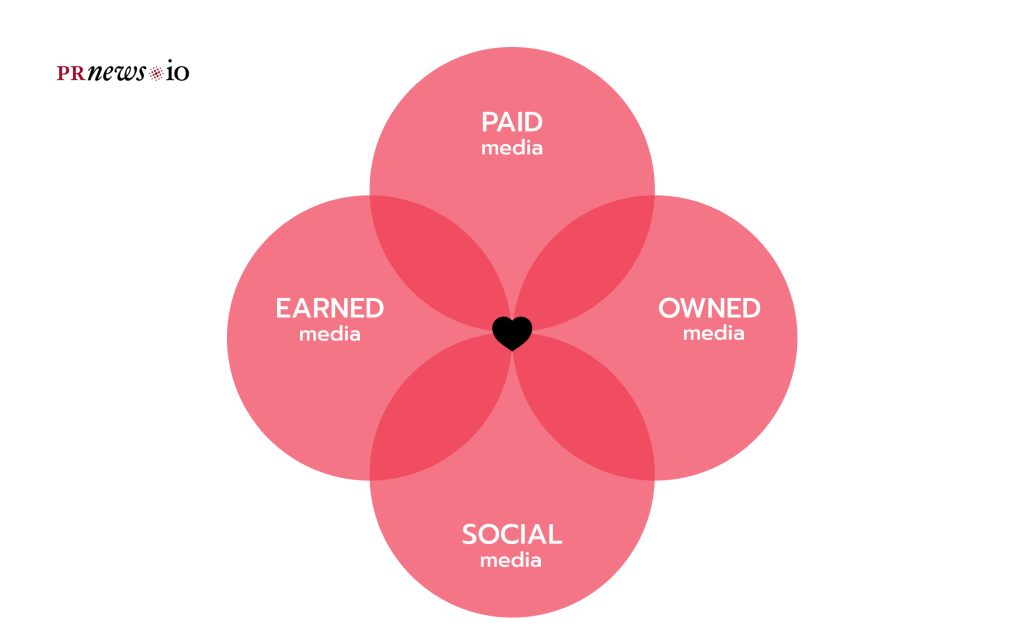
Modern PR campaigns operate through the PESO framework: Paid, Earned, Shared, and Owned media. This model reflects the reality that reputation is built across interconnected channels rather than isolated tactics.
Paid media in PR campaigns
Paid media in a PR context supports visibility rather than replacing credibility. It is used to amplify proven narratives, distribute high-value content, and ensure reach in saturated information environments. Native advertising, sponsored articles, and promoted social posts are typical examples.
Examples:
- Sponsored editorial placements
- Native advertising
- Boosted social posts
- Promoted LinkedIn thought leadership
Paid media ensures reach and targeting but does not replace trust.
Earned media: the credibility core
Earned media includes journalistic coverage, expert commentary, reviews, and organic mentions. It remains the most influential and unpredictable element of PR. Its value lies in perceived independence and editorial judgment.
Examples:
- News articles
- Interviews
- Reviews
- Expert commentary
- Analyst citations
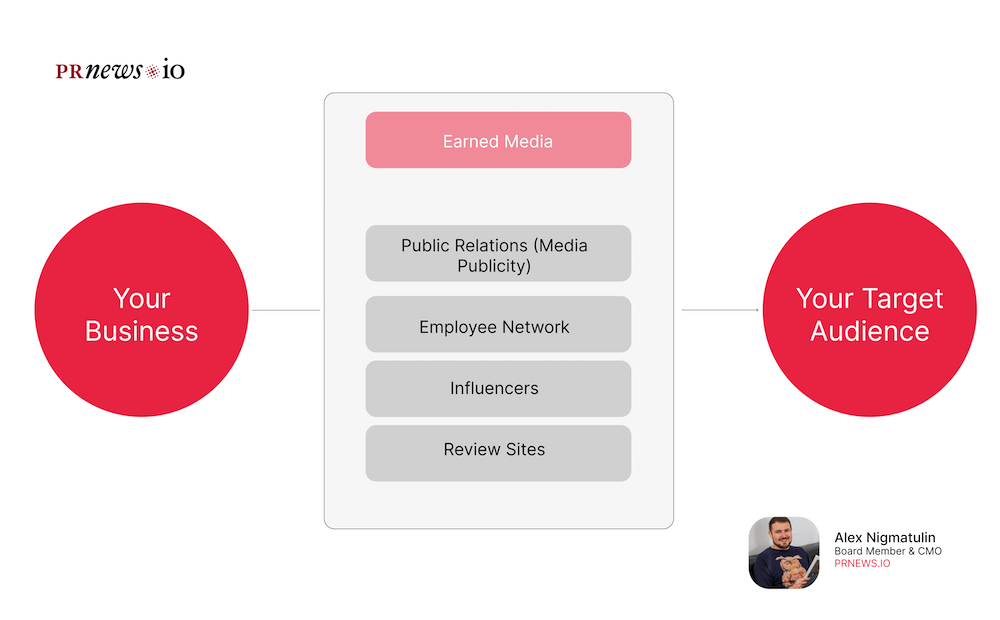
This is the most persuasive channel—and the hardest to control. Its strength lies in independence.
Shared media: dialogue and amplification
Shared media refers to audience interaction across social platforms. It enables two-way communication, community building, and real-time feedback. However, it also exposes brands to rapid escalation of negative sentiment when mismanaged.
Examples:
- Shares, comments, reposts
- User-generated content
- Community discussion
Shared media creates dialogue and feedback loops, but also accelerates risk if sentiment turns negative.
Owned media: the strategic anchor
Owned media—websites, blogs, newsletters, reports—forms the structural foundation of any PR campaign. It ensures message continuity, provides authoritative reference material, and supports both search visibility and media relations.
Examples:
- Website
- Blog
- Research reports
- Newsroom
- Email newsletters
This is where narratives live permanently and where AI systems increasingly source authoritative information.
The strength of the PESO model lies in orchestration. A campaign might begin with a research report published on owned channels, gain traction through social sharing, be amplified via paid promotion, and ultimately attract earned media coverage. Each layer reinforces the others.
How to plan a PR campaign: strategic architecture
Effective PR campaigns begin long before the first pitch is sent.
Research and situation analysis
Planning starts with a communications audit and sentiment analysis. Understanding how the brand is currently perceived establishes a baseline and reveals vulnerabilities, opportunities, and narrative gaps.
A strategic review typically includes:
- Media coverage analysis
- Audience sentiment mapping
- Competitive positioning
- SWOT analysis
Without this foundation, campaign objectives risk being disconnected from reality.
Setting SMART objectives
PR goals must translate into measurable objectives. Vague ambitions like “increase awareness” are insufficient. Effective objectives are specific, measurable, attainable, relevant, and time-bound.
A strong objective links communication outcomes to business impact, such as improving sentiment, increasing share of voice in a strategic category, or strengthening executive authority.
Example:
Increase positive brand sentiment from 62% to 75% within 9 months, measured via monthly sentiment analysis.
Objectives should connect directly to business outcomes—not activity volume.

Audience definition and narrative design
PR campaigns succeed or fail based on relevance. Audience segmentation determines not only what is said, but how and where it is said.
Investors, regulators, customers, and employees interpret the same information differently. A PR narrative must adapt tone, evidence, and framing without losing consistency.
Narrative development combines:
- Clear positioning
- Factual credibility
- Emotional resonance
- Cultural and contextual awareness
PR storytelling is not fiction; it is structured truth designed for human and algorithmic interpretation.
Different stakeholders require different stories.
- Investors → data, growth, governance
- Customers → benefits, experience, values
- Media → relevance, timing, insight
- Regulators → compliance, responsibility
A PR narrative blends:
- Facts (proof)
- Emotion (meaning)
- Context (why now)
Execution: core PR campaign tactics
Media relations and pitching
Media outreach remains central to PR execution. Effective pitching is personalized, timely, and grounded in editorial value. A pitch is not a sales message; it is an invitation to tell a relevant story.
Strong pitches demonstrate:
- Clear newsworthiness, “why now”
- Relevance to the journalist’s audience
- Supporting data or expert access
Press releases as digital assets
Press releases remain essential, but their function has expanded. They now serve journalists, search engines, and AI systems simultaneously.
A modern press release is concise, scannable, and structured for discoverability. It prioritizes clarity over promotion and evidence over adjectives.
Press releases remain essential—but only when optimized for digital discovery.
Best practices:
- 300–500 words
- Inverted pyramid structure
- Search-friendly headline
- Clear lead paragraph (5Ws)
- Real human quotes
- Multimedia assets
- Structured subheadings
Press releases now serve journalists, search engines, and AI systems simultaneously.
Thought leadership and newsjacking
Thought leadership positions executives as credible experts through analysis, commentary, and original insight. Newsjacking leverages real-time relevance, but only works when the contribution adds genuine value.
Poorly executed newsjacking appears opportunistic; well-executed contributions position brands as informed participants in public discourse.
Events and influencer collaboration
Events create moments of concentrated attention, while influencer partnerships extend credibility into niche communities. Authentic alignment matters more than reach. Trust transfers only when values align.
Crisis management
PR campaigns are not only about promotion. They are also about protection.
Crises expose organizational values under pressure. Speed, transparency, and accountability determine whether trust erodes or strengthens.
Effective crisis response follows a clear architecture:
- Immediate acknowledgment
- Centralized communication
- Honest disclosure
- Visible corrective action
Organizations without crisis plans often lose control not because of the event itself, but because of delayed or defensive communication.
Every organization needs:
- A crisis communication plan
- Defined roles
- Pre-approved frameworks
- Rapid response protocols
Most crises escalate due to delay and deflection, not the incident itself.
AI, GEO, and the future of PR campaigns
Search behavior has shifted toward answer-based discovery. AI-generated responses increasingly replace traditional search results, reducing clicks but increasing the importance of being cited rather than ranked.
Generative Engine Optimization (GEO) focuses on authority, entity clarity, and evidence-led content. PR plays a decisive role here, as AI systems prioritize reputable editorial sources and consistent public narratives.
PR campaigns now contribute directly to algorithmic visibility by:
- Supplying authoritative data
- Reinforcing entity associations
- Maintaining consistent messaging across trusted sources
Measuring PR campaign effectiveness: beyond vanity metrics
Modern PR measurement follows the Barcelona Principles 3.0, which emphasize outcomes and impact over superficial reach.
Effective evaluation distinguishes between:
- Outputs: what was produced
- Outcomes: how audiences responded
- Impact: what changed long term
Qualitative context matters as much as quantitative scale. Sentiment, message pull-through, and reputational movement provide deeper insight than impressions alone.
Conclusion: PR campaigns as strategic infrastructure
A PR campaign is not a tactic. It is an infrastructure for trust, legitimacy, and long-term influence.
Successful campaigns integrate research, narrative discipline, channel orchestration, and measurement into a coherent system. They adapt to algorithmic discovery without abandoning human relevance. They treat crises as strategic moments, not anomalies.
Organizations that master PR campaign architecture do more than communicate. They shape how they are understood, remembered, and trusted—by people and by machines alike.
Best PR campaigns from experts
Behind every successful PR campaign lies a talented team of professionals who understand the intricacies of strategic communication and brand management. To shed light on the secrets of their success, we had the privilege of interviewing some of the top PR experts in the field. Their invaluable insights and experiences provide a glimpse into the artistry and strategy that underpins the best PR campaigns.
Through our interviews with these seasoned PR professionals, we uncover the driving forces behind their remarkable achievements, the challenges they faced, and the strategies they employed to triumph. Get ready to embark on a journey through the realms of exceptional PR campaigns, where creativity meets strategy, and communication reigns supreme.
PR campaign #1. The Thought Leadership Journey
Lexie Smith, Founder & CEO at THEPRBAR Agency

One of the most successful campaigns we’ve recently executed at THEPRBAR Agency was a thought leadership campaign for our client and sister company, Ready Set Coach. We strategically pursued digital press opportunities to showcase my co-founder and I’s expertise in publications such as Create & Cultivate, Business Insider, and NASDAQ. When curating pitch topics, we focused on highlighting educational themes that cater to the search habits of the Ready Set Coach target audience – professionals, consultants, and business owners seeking guidance to launch a coaching business or side hustle.
These intentional press placements have not only generated trackable highly qualified leads for the program but also provided niche content and notable coverage showcasing our authority. To further maximize impact, we shared the digital placements with our newsletter subscribers and across all social media channels for both companies. Additionally, we leveraged the logos of each publication across our website and marketing materials to further solidify our brand’s expertise and credibility.
PR campaign #2. Pawsitive Press: Tail-Wagging Connections
Bryan Clayton, CEO at GreenPal

My name is Gene Caballero, and as co-founder of GreenPal and the person responsible for our PR initiatives, one campaign that has been successful for over 5 years and counting is our dog bone campaign. This unique approach has played a significant role in our successful launches across hundreds of markets, driving media coverage and generating buzz for our brand.
The idea behind the dog bone campaign is simple yet effective. We identified local reporters who mentioned having dogs in their bios or social media profiles and sent them personalized dog bones as a gesture of appreciation and of course, mentioning our launch into the area. By leveraging this personalized outreach, we aimed to capture their attention and establish a genuine connection based on their shared love for their furry companions.
The impact of this campaign has been outstanding. It has contributed to over 100 successful launches in new markets, resulting in extensive media coverage and increased brand visibility. Reporters have responded positively to our thoughtful approach, often covering our launch into the area and creating a positive buzz around GreenPal.
What makes this PR project particularly successful is the emphasis on building genuine relationships with journalists and standing out amongst the thousands of other pitches they get daily. By understanding their interests and tailoring our outreach to their personal preferences, we demonstrate a genuine commitment to fostering strong connections and we can garner their attention. This approach has allowed us to stand out from traditional PR methods–unlike cold emails–and create a lasting impression.
The dog bone campaign exemplifies our dedication to exceptional customer service and attention to detail. It showcases our ability to think outside the box and deliver memorable experiences. By going the extra mile and customizing our approach, we have been able to create meaningful connections and foster positive relationships with the media.
In conclusion, the dog bone campaign has been a cornerstone of our PR success. Its personalized and thoughtful nature has garnered significant media attention and played a vital role in our overall growth and expansion. As we continue to expand into new markets, we remain committed to innovative and tailored PR approaches that set us apart and resonate with our target audience.
PR campaign #3. Scented Splendor: Igniting Exclusivity
Christopher Gillispie, CEO & Head of PR of Red Heifer Media

I recall a defining moment in my PR career when my boutique agency embarked on an exhilarating journey with a luxury perfume brand. Entrusting us with their first true product launch, they had a clear vision in mind. Our task: to locate, transform, and pack a lavish venue in NYC and replicate the experience in four other key cities, all within a month.
Despite being a smaller agency, we united our team, working tirelessly to bring their “luxury speakeasy” concept to life. Collaboration became our guiding principle as we closely aligned with the brand’s objectives. Round the clock; we poured our hearts and souls into this project while continuing to serve our other valued clients. The pressure was immense, but our shared passion and dedication fueled us forward.
Taking a bold approach, we decided to engage organic influencers and press who resonated authentically with the brand and asked them to embargo any news until the night of the event. By nurturing genuine connections, we ignited a wave of excitement that rippled through social media and traditional platforms. The exclusivity of the event became a talking point, heightening the allure and ensuring its resonance lasted long after the event.
As the campaign unfolded, media outlets eagerly shared their experiences and thoughts on this new fragrance. The press coverage surpassed our expectations, with respected publications and journalists clamoring for a chance to capture the essence of the sensorial brand.
This campaign remains a defining moment in my professional journey, a testament to the power of collaboration, attention to detail, and the ability to create unforgettable brand experiences. It serves as a reminder that when passion and expertise converge, remarkable achievements are within reach. The perfume brand continues to thrive, forever grateful for our unwavering commitment and dedication.
PR campaign #4: Resilience in a Shifting Market
Kyle N Heise, Director of Public Relations at Scrib3

With the crypto industry reeling from the collapse of FTX and the unraveling of the largest Ponzi scheme in the history of the United States, With a backdrop of crypto collapses, our success story with Gains beat all odds in an unfavorable market. At Scrib3, we helped Gains Network capture immediate market share with its multichain expansion through timely and smart PR initiatives coupled with strategic social media amplification.
With the bear market staring gTrade’s multichain expansion in the face, Scrib3 Marketing and PR teams capitalized on hot industry narratives by leveraging social media conversations around the instability of foreign exchange markets, the growing crises between Centralized and Decentralized exchanges following the FTX fiasco, plus the emergence of Layer-2 DeFi as a growth catalyst.
The decentralized leveraged trading platform hit $2M in January’s earnings on Token Terminal’s 30D earnings leaderboard, behind only Ethereum and OpenSea. Over back-to-back weeks in January, gTrade saw over $1 billion in trading volume through 10,888 total unique addresses.
How did we help Gains Network?
Leverage specialized influencers and thought leaders to amplify established partnerships with key KOLs & media outlets to reach a broader audience and build credibility
Built trust and credibility through transparent and consistent long-form pieces
Maximized ROI with highly intentional paid and earned media efforts by staying ahead of the latest industry narratives like the instability of foreign exchange markets and growing crises between centralized and decentralized exchanges
To date, Scrib3 helped Gains Network grow its Twitter following by over 500%, increase trading volume by over 80% on a month-by-month basis (+$28B Trading Volume), and increased new users by 148%. Gains Network’s story was picked up and featured in dozens of major crypto news publications, including CoinDesk, Blockworks, The Defiant, and more.
PR campaign #5. Yo: The Viral Revolution
Motti Peer, Co-CEO & Chairman at ReBlonde

If you’ve seen HBO’s Silicon Valley, there’s an episode about an app called “Bro” that lets you send the word “bro” to everyone else who has the app. Well, that app was based on a real app called “Yo,” which our PR agency, ReBlonde, won awards for promoting.
It all started when the app’s creator introduced Yo to our team for the very first time. He told us he wasn’t sure what the app was for or whether it had any chance of success. The one thing he did know? It was the most viral and addictive app he had ever seen. And virality is exactly what we leveraged in our PR efforts. We understood that our objective was to position Yo in such a way that it could spark a PR storm across the tech blogosphere, mainstream media, and social media.
Strategy:
With Yo, simplicity really was the highest form of sophistication—the app’s only feature was the ability to send a notification with the word Yo to a contact. When Yo was first developed, it was given to a few team members to test and it quickly spread virally to their community of friends and family. We created a campaign that would leverage the app’s viral nature by focusing first on direct and targeted outreach to key influencers who would in turn spread the app in the interconnected community of Silicon Valley insiders.
We started by strategically targeting Robert Scoble, who back then was one of the most significant players in the tech industry with a massive social presence of millions of followers across Facebook, Twitter, and Google+. We arranged for Scoble to meet the creators of Yo, and see the app demonstrated in person. Scoble’s influence was a critical component of the first phase of our strategy and allowed us to reach our exact target audience of influencers. We also prepared a second phase to our campaign, a media outreach phase, where we would declare to the world that this app that had one function, had raised an incredible $1 million.
Lights, camera, action:
After Scoble saw Yo in person, he wrote on Facebook (where he’s followed by over 600k fans): “I just got the stupidest but most addicting app ever. Name? YO.” From there, we used various social platforms such as Facebook, Twitter and Product Hunt (a products discovery platform) to push the message to other key influencers in Silicon Valley.
It worked. Who wasn’t tweeting about Yo? We also got tons of votes on Product Hunt by major Silicon Valley figures.
After the app caught the attention of key influencers, we moved on to pitching actual publications. We leveraged the $1 million funding round that Yo had secured to land an interview with the Financial Times—and then another publication, and another. The beauty was even if reporters thought Yo was the dumbest app they’d ever seen, they had something to say about it. That translated well over social media.
Results:
Beyond the Silicon Valley parody it inspired, the coverage of Yo was overwhelming. We’re talking about 3,600 unique posts across the tech media, mainstream publications, and TV shows like The Colbert Report. Our outreach was so successful that Yo’s story overshadowed the launch of Amazon’s Fire smartphone. Yo also achieved a record one million downloads in just 48 hours.
PR Campaign Example to Inspire
Scaring your fans to death sure can be an interesting approach if done right. To help you see how far you can get with your creativity, enjoy the PR campaign below.
The Walking Dead Scary Shelter – Sky
Humor is one of the most tried and tested PR strategies used by brands. With an appropriate humor spin, your message can stand out and be meaningful. And this terrifyingly impressive advert for the new season of The Walking Dead is proof of that.
The augmented reality has gone one step further because the ad has been superimposed over the actual street. People at the bus shelter saw dead people walking towards them through the AR experience on the screen. That made the fusion of the real world with the virtual world. The result? This video achieved around 15.5 million video views and 320,00 shares on social networks. That constituted a new dimension of the effect of out-of-home productions.
Industry experts about PR campaign tips & tricks
Jim Reynolds, Owner of Sofia Marketing

My client works in marketing and does a ton of outreach for his business and clients. He provided the following insight from his personal experiences on completing media outreach:
“My biggest tip on completing creating a PR campaign is to be consistent and persistent in your efforts. Public Relations is not easy and is all about quantity, so set up a process where you are consistently creating campaigns, sending pitches, finding new contacts, and tweaking things in order to make the most out of your efforts.
It cannot be completed in a week (or even a month) with the results you desire. You need to do it consistently with new campaigns to see the real results and gauge success levels.”
Oberon Copeland, Owner & CEO Of Veryinformed.com

A PR campaign is only as effective as the planning that goes into it. Before launching a campaign, take some time to research your audience and your goals. What kind of messaging will resonate with your target audience? What are you hoping to achieve with the campaign? Once you have a clear understanding of your audience and your objectives, you can start to develop tactics that will help you achieve your goals.
Some tips for developing an effective PR campaign include:
– Keep your messaging consistent across all channels. Your target audience should be able to easily recognise your brand, no matter where they see it.
– Make sure your website is up-to-date and informative. Include a media section where journalists can easily find press releases and images.
– Develop relationships with key influencers in your industry. These individuals can help spread the word about your campaign and amplify its reach.
By taking the time to plan and execute an effective PR campaign, you can dramatically increase your chances of success.
Thomas Hawkins, CEO at Electrician Apprentice HQ

Set Your Goals First
Before starting your PR campaign make sure you have your goals in place. Is it to increase sales? Drive website traffic? Something else? It’s the answers to these questions and more that will make your PR campaign successful.
Choose Platforms Wisely
Some PR campaigns are suited more towards Facebook, while others are with Twitter. Another campaign may be by email, text, or some other method. Choose your method carefully (in some sense based on your goals) to get the best results.
Track Results
Most campaigns can be tracked by Google Analytics. If that’s not an option, figure out a way to track your results. That will allow you to adjust/alter your campaign for better results.
Adam Berry, Founder, and Consultant of the tech-based company AdamBerrySEO.

PR campaigns are an attractive way to promote the product. Still, to have a stronger impact, the company can take the help of digital influencers. In today’s socio-technical world, people are addicted to looking forward to their favorite creators.
PR agencies can take advantage of this and promote their products. These influencers have a huge fan following. If half of their followers use their product, the campaign is successful. Also, the influencers are hungry for brand and promotions. Therefore, they will be delighted to advertise and enhance the PR campaign.
Andrew Macfarlane, Founder of WeLoveBrum.co.uk

In my experience, the most effective PR campaigns are those that are rooted in a genuine desire to help your target audience.
PR is about building relationships with people, and there’s no way to do that without being honest about what you’re trying to accomplish. If you can come up with a campaign idea that helps your audience solve a problem they have, or provides them with something they want, you’re more likely to win their trust and earn their attention than if you’re just trying to sell them something.
The key here is that it’s not enough just to be honest; you need to be clear about what your intent is—and why your company is uniquely qualified to provide it.
JJ Lee, Digital PR Executive at Digital Funnel

what journalists you’re targeting, what topics they generally cover and what they’re writing about now. For example, we recently launched a Halloween-themed press release around how to keep your pumpkins fresher for longer, the campaign was a huge success with around 200 placements worldwide – I would attribute this to the fact that we put time & effort into building a specialised mailing lists and didn’t just randomly assault journalists’ inboxes with an unwanted press release.
We first examined Ireland, UK & Western European marketed and compiled a fairly comprehensive list of Journalists & Bloggers that have covered gardening-based stories in the past 6 months, these journalists worked across a slew of different publications and outlets – newspapers, blogs, magazines, online-only news sites, radio and television stations. We secured some fantastic coverage within the first week and had open rates of around 65% with our release – why? Because it was relevant, the information was useful and it was being sent to the right inboxes. If you’re spamming a Political correspondent with a press release about garden care you’re speeding down a fast track to getting your email address blacklisted and your releases ignored. Always do your research and keep things relevant!
Angel Martins, marketing specialist at one of the UK’s leading digital marking agencies, Finsbury Media

Tips & tricks on how to make PR Campaign effective:
When it comes to marketing, the public perception of a brand is extremely valuable. Today’s consumers are much more aware and concerned in regard to brand identity and having a negative public perception can truly destroy a brand’s success. Luckily, PR campaigns can help. PR campaigns work by strategically shaping the identity and message of a brand. Effectively releasing an optimised PR campaign can build loyalty among consumers and boost sales for a brand.
The first step to launching an effective PR campaign is to identify your target audience and clearly define your public relations goals. Once your audience has been identified and your goals have been defined, you can begin to create a PR strategy optimised to reach your specific audience and achieve your desired outcome.
By building relationships with media outlets and regularly engaging in PR, brands can make some serious enhancements in terms of their public perception. Brands should also have management in place for a crisis situation. By staying prepared brands can quickly respond to any negative elements hitting their reputation.
Additionally, Social media has become a great place for brands to work on their relationship with the public. Brands can communicate directly with the public and address any issues. Along with expanding their reach and making a greater impact.
When implemented correctly, launching a PR campaign can effectively shape your public perception and positively enhance your brand’s identity.
Brett Robinson at Head of Content & Marketing for Wired Clip

Don’t underestimate the impact of local support on your PR campaign. While it can be tempting to market your materials to the whole world straight away, only focusing on going viral through Twitter or TikTok, you will have a much more solid launch (and a larger audience base at the early stages of your campaign) if you make an effort to target local areas and businesses.
This can be done in conjunction with more large-scale campaign efforts, but the more emphasis you put on surrounding communities, the more likely it is that you will get into your local newspaper – which can then be picked up by larger media outlets.
Kevin Miller, digital marketing expert, former Google employee, entrepreneur, angel investor, “Entrepreneur of the Year” in the 2021 American Business Awards

Cultivate media relationships over time so there’s no scramble to find the best media outlet when you launch your campaign. Media relationships are central to PR and digital PR. The rule of thumb is that better access to the media and the people will grant your campaign better results in the long run.
Nurture relationships with journalists who write in your industry or for publications in which you want to be featured. Not every business can pitch to Forbes and succeed on day one, but if you work with a journalist a few times a year, they might be more likely to bite when you ask for their help.
PR, like many industries, is fueled by connections. If you get to know the right people for the job, it is incredibly beneficial to maintain these connections to achieve mutually fruitful goals.
Alice Rawling, a Hair Stylist and Chief Editor at Hairdo Hairstyle in Los Angeles, U.S.A

Running an effective PR campaign is crucial for business transformation. Creativity and the message are vital factors for the campaign to be successful. First, setting goals and objectives is vital to determine the endgame of the campaign. The goals should be specific to help in determining the approach to achieve them.
It’s also crucial to know your target audience for the PR campaign to be effective. Understanding your audience helps in designing the message accurately for their needs. The time and attention of the campaign are on the audience, hence guiding in media, timing, and wording for your message.
Effective PR campaigns also need the right platform choice which you have to decide. The target audience is the best determinant of the most effective platform. It should be where they spend most of their time. With the right platform, you can create consistency in feeding new information and making business updates.
Another tip is to find a creative angle for your campaign. Look at the message from the public’s point of view and decide their interest in creative message design to grab their attention. Finally, you need to track the campaign progress to establish areas that need changes and strong selling points. It helps see what is working and what is not working in the campaign.
Teri Shern, Cofounder of Conex Boxes
The best thing that you can do if you want to make your PR campaign effective is to focus on the value that you’re adding to your audience’s lives. One of the mistakes that I see a lot of companies making is they focus too much on their business and business growth. While there are some people who will appreciate this, a majority of your audience is going to prefer to see content that impacts them in some way.
For example, rather than speaking about how we’ve grown and are bringing out new containers for a new industry, we’ll adjust this type of content slightly and focus on how the new containers that we’re bringing out will benefit a specific audience, how they can use the containers, and what features impact the way those containers might benefit different audiences.
Do you see the difference here? It’s all about consumer-focused PR as opposed to focusing on yourself and your achievements as a business. So, next time you’re planning a PR campaign, think to yourself; “What value does this campaign add to my customers’ lives?”
FAQ: PR Campaign
How to create a PR campaign?
To start, focus on setting up a sharp, clearly defined goal, including strict deadlines and dates. Consider what you want to achieve and then commit to it. Creating a message that targets the right audience is quite a challenge. Yet, a fresh approach and a unique angle can help your pitch to stand out.
How to measure the success of a PR campaign?
PR campaign is a numbers game. For 72% of PR pros, measuring business impact is currently the top challenge facing the industry. Without metrics, you can’t receive the full picture of your campaign’s performance. To be effective, measure progress as you move toward your process goals.
How YouTube could be used for a PR campaign?
YouTube has a massive user base, just waiting to be tapped into. It is an efficient advertising platform, used by 62 percent of businesses. Whether you want to collaborate with influencers or interview journalists, the choice is yours. You can even create your own YouTube series. Take care of your company’s YouTube presence. The sooner, the better.