Guest posting has evolved from a simple tactic for acquiring backlinks into a critical component of strategic content marketing and digital public relations. In the current digital ecosystem, brands are judged not only by the content they produce but by their verifiable expertise, authority, and trustworthiness (E-E-A-T). Done correctly, guest posting drives SEO improvements, builds brand credibility, and opens doors to new audiences.
Guest posting can help you build your brand, get more website traffic, and earn high-quality backlinks.
Though guest blogging may seem pretty straightforward, it still has some peculiarities you should know to succeed.
Here’s a checklist you should use to run a successful guest posting campaign:
- Define the goals you want to achieve.
- Find relevant websites to post on.
- Outreach to blog owners.
- Create superior content.
- Promote your post and engage with readers.
This article provides a detailed, step-by-step guide for businesses and marketers looking to start leveraging guest posting effectively.
What guest posting is
Guest posting involves writing and publishing content on a third-party website or blog. Typically, the process starts with pitching a topic to the editor or site owner. Once approved, the content is written to align with the host site’s editorial style and published with an author bio, often containing a backlink to the contributor’s site.
The objectives are twofold:
- Audience Expansion: Introducing your brand to a broader, relevant readership.
- SEO Benefits: Securing high-quality backlinks that signal credibility to search engines and improve search rankings.
Google emphasizes E-E-A-T, meaning that merely posting content is insufficient. Guest posting on reputable, relevant platforms validates your expertise and authority, building topical authority and trust in your niche. High-quality placements are crucial; recycled content or low-relevance links reduce both SEO and reputational value.

Define the goals you want to achieve
First, define your goals and decide whether guest blogging can help you achieve them or not. If you want to increase brand awareness for your business, position yourself as an expert, drive traffic, increase sales, and build high-quality backlinks, guest posting is what you need.
The main goals for guest posting are:
- to improve yourself as a writer;
- to establish or enhance your domain authority, use external links to high-authority domains;
- to drive huge organic traffic back to your site;
- increase their brand credibility and awareness;
- an opportunity to interact with influencers in your niche and build relationships with peers in the industry.
Then you need to find websites you will post on.
Identify high-quality sites for guest posting
Many low-quality sites look for free content by offering to accept guest posts. These are not the sites you want to guest-blog on.
The number one aspect of a good target for a guest post is traffic. Without traffic, there’s no benefit to posting.
The second aspect is that a significant amount of traffic must be generated by your target audience. Otherwise, no one will care about your post, no matter how good it is.
In general, there are two types of quality sites to target:
- Broad authority sites. These sites are often household names (think Forbes, The Huffington Post, or Business Insider). They have tons of traffic, and even if only a small percentage of that traffic is your target audience, it’s worth it.
- Leading industry blogs. These blogs are much more niche-specific, but they are mostly made for your target audience. But don’t post too frequently, as most of these readers will already know you.
Effective guest posting starts with rigorous site vetting:
- Quantitative Metrics: Target domains with a Domain Rating (DR) of 50+ and monthly organic traffic exceeding 10,000 visitors. Use tools like Ahrefs, Semrush, or Moz to verify authority and audience reach.
- Qualitative Metrics: Assess editorial standards, author credentials, and overall content quality. Confirm that the site publishes original, high-value content.
- Contextual Relevance: A lower-traffic niche site may deliver better engagement and SEO benefits than a high-traffic, generic site. Prioritize alignment with your industry and audience.
Avoid sites with high spam scores or manipulated metrics. Combine automated checks (Spam Score, Trust Flow) with manual assessment of engagement and editorial integrity. Ensure any paid placements comply with Google’s guidelines using rel=”sponsored” or nofollow tags.
Find websites to guest post on
Here are some ideas for finding blogs in your niche:
Google Search Tricks. Just replace “keyword” with keywords from your industry and use Google to find websites for guest posting: keyword “submit a guest post”.
Twitter search tricks. To find blogs for guest posting, use the Twitter search term “keyword + guest post.”
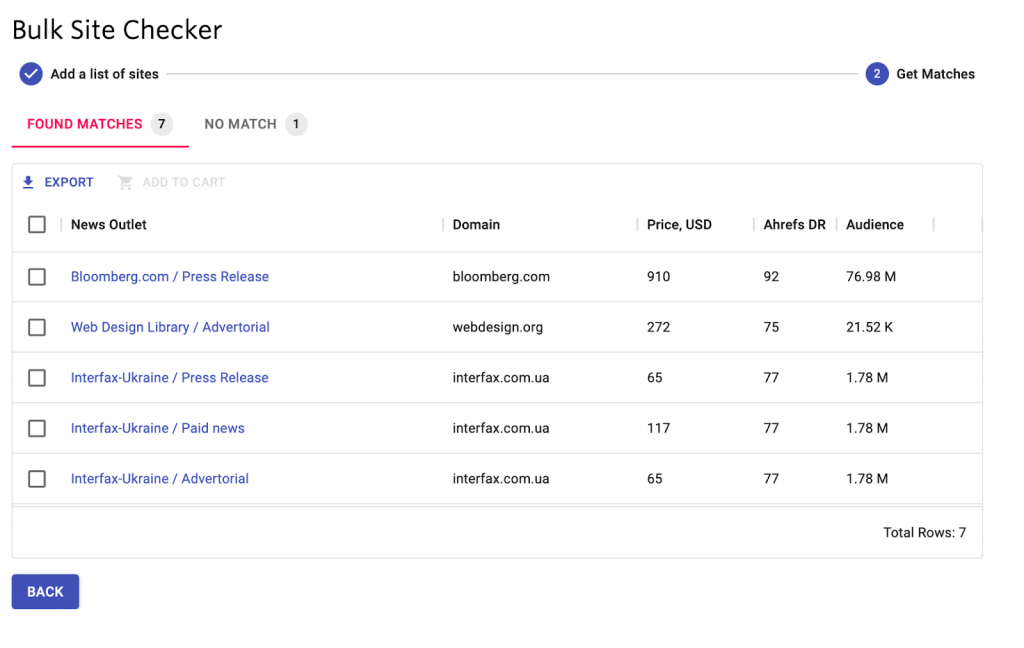
Competitor backlinks. Start with a backlink research tool like Ahrefs. After uploading the list of domains you are interested in into Bulk Site Checker, you will receive data on the cost of placement on each site, audience size, and SEO characteristics of the resource. All this you can download to a separate CSV file for further analysis and database work.
Prolific guest bloggers. Another hotshot idea for finding tons of qualified guest posting websites is following the prolific guest bloggers in your industry.
Free guest posting sites. Check all lists of free guest posting sites.
Social media accounts. For example, LinkedIn is the perfect professional space where you can find many bloggers and webmasters in your niche who allow guest posts on their websites.
Community. I’m sure you’re aware of one or two excellent blogs in your field. Take a look at the comments and the people commenting. Some of them will surely be running their blogs.
Alltop. Alltop collects “the headlines of the latest stories from the best sites and blogs that cover a topic.” It helps you discover stories and blogs in your field of interest.
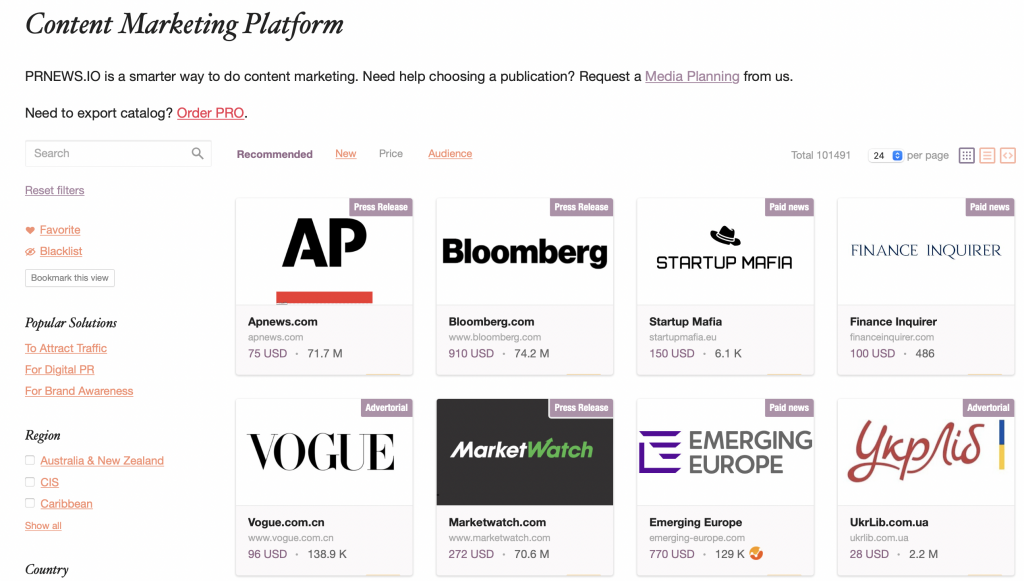
Use PRNEWS.IO! PRNEWS.IO is a platform for guest blogging that publishes articles and connects advertisers with influential news outlets. Our expert team assists your company by publishing your guest posts in influential press outlets around the world. We are experienced in digital marketing, link building, and providing high-quality content that is published on portals around the world.
Use filters in the PRNEWS.IO catalog to find sites relevant to your niche.
How to write a high-quality pitch?
Blogging is a very hard scene to break into. So, here’s the reason guest blogging should be a need of yours if you are serious about building your name.
Blogs that invite guest posts, get a lot of emails from people like you. So, to stand out from the crowd, be extraordinary.
How do you write a high-quality pitch?
- Show up on the blogger’s radar. Join blog groups on social media and leave relevant comments.
- Personalization is a must. You should customize your letters as much as you can.
- Your focus should be on the blogger’s benefit. Ensure you’ve included all the advantages of your post, or give them a free trial of your service.
Do a brief SEO audit of the website you want to pitch your guest post to.
Debashri Dutta, Founder & Content Writer at dmdutta.com
One of the problems that blog owners face is that they get repetitive guest post pitches – it’s the same topic or approach in many posts. However, if you use a tool like Ahrefs and do a content gap analysis, you can easily find topics that add variety to their existing content. Doing keyword research and a content audit will help you pitch topics that add to their topic cluster. This then builds their authority on their subject, drives more traffic to their site, and supports other posts. What blog owner wouldn’t love that? Make your pitch personalized and your content relevant by doing SEO audits when reaching out. It increases your pitch acceptance rate dramatically.
Produce Epic Content for Your Guest Post
You sent out a few pitches, and one of the sites you approached told you to go ahead and write your post—success!
Now you need to deliver.
An epic post for a particular site is better than 95% of other posts published earlier. In other words, epic is relative.
- A guest post should funnel people toward an outcome, not a home page.
- A guest post should mention famous bloggers in your niche.
- A guest post should be followed up by sister posts.
- A guest post should be aimed at ten years of results, not 10 hours.
- Each guest post should be part of an anchor text strategy.

Measuring success: ROI and metrics
Track guest posting performance using:
- Referral Traffic: Unique visitors driven to your site.
- Lead Generation: Conversion rates from guest post traffic (benchmark: 2-3%).
- SEO Authority: Long-term effects on Domain Rating and keyword rankings.
- Cost Efficiency: Cost per new customer, calculated as total spend divided by acquired customers.
Backlink Monetary Value (BMV) quantifies a backlink’s financial impact:
High BMV relative to placement cost justifies the investment. Note that even if links are rel=”sponsored” or nofollow, non-SEO benefits like referral traffic, brand validation, and AI search authority remain significant.
Track referral traffic and Domain Rating uplift for at least six months. Monitor brand mentions and social engagement as secondary indicators of growing authority.
What has changed in the approach to guest posting in SEO in 2025-2026
By 2026, guest posting will no longer be a widely used SEO tool for links. The approach that worked five to seven years ago—sending hundreds of cold emails offering free articles—either doesn’t work today or requires a disproportionate amount of effort.
Guests posting for free is a thing of the past
Most high-quality websites no longer publish guest posts for free. Payment for placement has become the norm, with prices ranging from $75–$300 for publication on niche resources to over $1,000 for publication on authoritative platforms. While this does not mean that guest posting is “dead,” it is no longer cheap or scalable.
Mass outreach no longer works
Sending mass template emails to website owners is a dead-end strategy. It either yields no results or exhausts teams without providing a tangible return on investment (ROI). In 2025, manual, targeted outreach works:
- Carefully select websites.
- Personalized emails
- Focus on the real value of the content for the platform’s audience.
A small number of high-quality contacts (10–15 per week) often yields better results than hundreds of automated email campaigns.
Backlinks are less powerful for seo, but still relevant
Although backlinks are still important, their role in ranking has significantly decreased, and they are no longer among the top three key SEO factors. Additionally, Google is increasingly regulating paid and unpaid links.
- Paid links must be marked with rel=” sponsored.”
- Free guest posts often receive nofollow or sponsored tags, which negates their direct SEO effect.
Therefore, in 2025, guest posting solely for SEO links is not the most efficient use of resources.
Links are secondary — audience value comes first
Today, the key question is not “Will this generate backlinks?” but “Does this site have a valuable audience?” Guest posting makes sense if:
- The platform’s audience is relevant to your product.
- The platform’s audience is relevant to your product.
- The content can generate real traffic, leads, or brand awareness.
- The publication reinforces your image as an expert rather than just adding another link.
Outreach alone doesn’t work, but citability does
Today, the most natural links with high DR do not appear because of cold outreach, but rather because of content that people want to quote themselves:
- Original research and data
- Tools, calculators, and services.
- In-depth guides and expert materials.
This is why, by 2025, guest posting will increasingly be combined with digital PR, partnerships, and the creation of linkable assets.
First, expertise, then outreach
An effective strategy starts with creating an SME (subject matter expert) persona and establishing a foundation of high-quality content on your website. This simplifies agreements with the media, partners, podcasts, and professional communities, making guest posting a natural extension of your expert presence rather than a separate SEO tactic.

Marketplaces for scalable guest posting
Platforms like PRNEWS.IO streamline the guest posting process by automating outreach, vetting, and placement. Benefits include:
- Efficiency: Directly purchase placements without lengthy negotiations.
- Global Reach: Access to over 100,000 media outlets in 175 countries and 77 languages.
- Data-Driven Selection: Filter by authority metrics, niche relevance, and regional audience.
- Content Solutions: Professional article writing services aligned with host site requirements.
- Risk Management: Money-back guarantees protect financial investment, while compliance with rel=”sponsored” ensures Google-friendly placements.
Automation allows marketing teams to focus on content quality, ROI tracking, and strategic promotion while scaling guest posting campaigns globally.
The rise of micro and niche guest posts
Recent Google updates favor a topical focus and consistent reputation, putting micro and niche websites in a stronger position than broad, general publications.
The update was mostly focused on large authority sites that initially built trust in a particular niche but later grew rapidly into unrelated topics when they realized they could rank for almost anything. Consequently, many of those off-topic pages have experienced a drop in visibility, particularly when the content does not align with the site’s original area of expertise.
Conversely, niche sites that maintain a tight focus and publish genuinely useful and engaging content for a clearly defined audience are more likely to be rewarded with stronger rankings. Google can more easily assess a site’s topical authority and relevance when a site consistently covers one subject area.
For example, a site that ranks for “SEO agency NYC” can naturally extend its authority to closely related terms, such as “SEO expert NYC.”
Micro and niche guest posts are effective because they:
- Appear on sites with a clear topical identity
- Reach audiences already interested in the subject
- Contribute to real topical authority rather than diluted link equity
A contextual mention or citation on a niche website that focuses on a specific topic often carries more long-term value than a generic guest post on a large publication that covers dozens of unrelated topics. Platforms like PRNEWS.IO facilitate this change by enabling brands to identify and publish on niche websites that have established topical authority in particular industries or regions. With PRNEWS.IO, guest posting is no longer about mass placement. It becomes a controlled process in which you can:
- select media outlets based on niche relevance, geography, and audience profile
- secure contextual mentions within content that aligns with your expertise
- focus on real visibility and brand exposure, not just link acquisition
Best Practices Checklist
| Step | Action | Key Tip |
|---|---|---|
| Site Vetting | Evaluate DR/DA, traffic, spam score, and editorial quality | Target DR 50+, traffic 10k+ |
| Outreach | Personalize pitch, highlight reader value | Reference editor’s content and data gaps |
| Content Creation | Produce exclusive, original content | Include 1-2 high-value backlinks |
| Link Compliance | Use rel=”sponsored” for paid placements | Ensure Google compliance |
| Promotion | Share post across social media, newsletters | Amplify referral traffic |
| Measurement | Track referral traffic, conversions, BMV | Monitor for at least six months |
| Relationship Management | Maintain contact with editors | Professional follow-ups increase future opportunities |
Does a guest post still work?
Most certainly still works…!
Guest posting is no longer just a link-building tactic; it’s a strategic tool for establishing credibility, authority, and trust in your niche. By combining meticulous site vetting, personalized outreach, high-quality content, compliance with search engine policies, and measurable ROI tracking, organizations can transform guest posting into a scalable, high-value marketing channel. Automation platforms such as PRNEWS.IO further enable efficiency, global reach, and data-backed decision-making, making guest posting a cornerstone of modern digital PR and content marketing strategies.
The future of guest posting integrates E-E-A-T, AI search optimization, and strategic content leveraging. Success is defined not by the quantity of posts but by the measurable impact on authority, conversions, and long-term brand recognition. Starting today with a structured, step-by-step approach ensures every guest post contributes to sustainable growth and competitive advantage.

Frequently Asked Questions
Should I write for SEO or for brand building?
In 2026, this is no longer an either-or question. Guest posts created primarily to secure backlinks often have limited SEO value, especially since many links are now marked as “nofollow” or “sponsored.” A more sustainable approach is to write for the brand and its audience first and use SEO as a supporting layer. Content that demonstrates real expertise, aligns with the host site’s niche, and resonates with its audience builds topical authority, brand trust, and long-term visibility.
How to find relevant sites for publications in 2026?
Begin by determining if a site consistently covers topics closely related to your niche. If its content frequently strays into unrelated industries, its authority is probably diluted, even if the domain metrics appear strong. Focus on sites that:
- have a clear topical focus and consistent content themes
- attract an audience that matches your ideal customer or reader
- publish original, non-generic content with real engagement
- already mention or link to similar tools, brands, or concepts
- niche newsletters, blogs, and industry publications
- podcasts and expert roundups that publish show notes with links
- professional associations, partner pages, and curated resource lists
What mistakes should to avoid when guest blogging?
One of the biggest mistakes in guest blogging is to treat it solely as a link-building tactic. Other common mistakes include:
- Targeting sites with weak or unfocused topical relevance.
- Relying on mass, automated outreach instead of personalized communication.
- Publishing thin or AI-generated content that adds little value to readers.
- Ignoring proper link attributes (nofollow or sponsored) when required.
- Prioritizing domain metrics over audience quality and context.
How many publications are optimal to make per month?
There is no one-size-fits-all number for every brand. For most businesses, publishing two to six high-quality articles per month on relevant, niche-focused websites is enough to build visibility and authority without compromising quality. If you are just starting, publishing 1–2 strong articles per month can be effective if the content is highly relevant and well-placed. The key is prioritizing impact over output and treating each publication as part of a long-term brand and topical strategy rather than a numbers game.
How to use PRNEWS.IO for guest posting?
PRNEWS.IO simplifies the guest posting process, helping you focus on relevance instead of volume. Instead of spending weeks on manual research and outreach, you can quickly identify media outlets that match your niche, location, and target audience. Using PRNEWS.IO, you can:
- filter websites by industry, geography, language, and audience profile
- choose platforms that already align with your topical expertise
- secure contextual placements within relevant content
- plan publications as part of a broader brand or PR strategy