The modern media landscape moves fast. Stories break, trends shift overnight, and audience attention is fractured across dozens of platforms simultaneously. In this environment, winging your publishing schedule is not a strategy — it’s a liability. That’s where the content calendar comes in.
Whether you’re running a digital newsroom, managing a brand’s editorial output, or building a content marketing engine from scratch, the content calendar is your most powerful operational tool. This guide breaks down everything you need to know: what a content calendar is, how it works, and how to turn it into a genuine competitive advantage.
What is a content calendar?
A content calendar is a master planning document that maps out every piece of content your organization intends to publish — what it is, when it goes live, who’s responsible for it, and where it will be distributed.
At its most basic, it’s a schedule. But for professional media teams, it functions as something far more significant: the operational backbone of the entire editorial process, connecting daily story decisions to long-term strategic goals.
Think of it as the difference between a newsroom that reacts to the world and one that is prepared for it.
Content calendar vs. editorial calendar vs. social media calendar
These terms are often used interchangeably, but they describe distinct tools with different scopes:
| Tool | Primary Scope | Strategic Purpose |
|---|---|---|
| Content Calendar | Master plan covering all channels and formats | High-level orchestration of total media output |
| Editorial Calendar | Written content — articles, whitepapers, press releases | Detailed management of the long-form production pipeline |
| Social Media Calendar | Platform-specific posts — LinkedIn, Instagram, TikTok | Real-time engagement and platform-native content |
| SEO Content Calendar | Keyword clusters and topical authority building | Long-term organic search growth |
A mature media operation integrates all four. The social team references the editorial calendar to promote major releases; the content strategist ensures everything maps back to business objectives. Without this alignment, you get the “silo effect” — disjointed messaging that dilutes brand recognition and confuses your audience.
Why every media team needs one
The business case is clear: organizations that publish consistently generate up to three times more traffic than those with erratic output. Search engines reward sites that update regularly with high-quality content, and audiences form habits around reliable sources.
Beyond traffic, a well-structured content calendar delivers:
Workload visibility. Editors and managers can see, at a glance, who is working on what and when it’s due. This prevents burnout and eliminates the last-minute scramble that produces rushed, low-quality work.
Strategic alignment. Every piece of content has a purpose tied to a business goal — whether that’s ranking for a target keyword, nurturing leads through the funnel, or establishing authority in a new market.
Gap analysis. By tagging content with metadata (topic, format, audience persona, funnel stage), you can quickly identify if you’re over-indexing on certain subjects while neglecting others that matter to your audience.
Team accountability. When everyone can see how their deadlines affect the rest of the pipeline, ownership becomes tangible, not theoretical.
The anatomy of a professional content calendar
A basic calendar lists what’s being published and when. A professional-grade editorial calendar captures the full strategic context of every asset. Here are the essential fields:
- Slug / Unique Identifier — A concise reference name that keeps stories organized across multiple systems
- Topic and Working Title — The subject and a headline aligned with SEO goals
- Content Type and Format — Article, video, infographic, podcast, newsletter, etc.
- Target Audience / Persona — Who this piece is for, including their consumption habits and pain points
- Funnel Stage — Awareness (TOFU), consideration (MOFU), or decision (BOFU)
- Primary and Secondary Keywords — The search terms the content is optimized for
- Owner and Assignee — Who is accountable, and who is actually doing the work
- Workflow Status — Pitching → Accepted → In Draft → In Review → Scheduled → Published
- Distribution Channels — Website, newsletter, LinkedIn, press syndication, partner sites
This metadata doesn’t just keep you organized — it becomes the raw material for performance analysis. Every entry in the calendar is a data point you can analyze to improve future strategy.
Planning horizons: how to think across time
Effective editorial planning works across three distinct time frames, each requiring a different level of detail.
The 90-day strategic horizon
This is where you set the “big rocks” — the content pillars that will define your quarter. These themes should connect directly to business objectives and audience interests. For a B2B software company, pillars might be “team productivity,” “leadership development,” and “remote work culture.” For a news publisher, it might be the major ongoing stories, seasons, or verticals you plan to own.
The 90-day view also accounts for seasonality. By mapping major industry events, holidays, and product launches well in advance, your content arrives prepared — indexed and ranking — before the audience starts searching.
The 30-day tactical horizon
This is where strategy becomes execution. Content briefs are written, assignments are made, and production capacity is assessed honestly. Research shows that content produced with a complete brief requires 60% fewer revisions — so investing time here pays dividends downstream.
A critical lesson here: a realistic schedule of two high-quality posts per week consistently outperforms an ambitious five-post plan that collapses under pressure. Match your scheduling density to your actual capacity.
The 7-day operational horizon
Daily publishing lineups are confirmed, and the reactive content slots are managed. Professional newsrooms typically reserve 15–20% of their capacity for reactive coverage — breaking news or trending topics that demand a fast response. This keeps the team agile without sacrificing strategic direction. A weekly 30-minute check-in to review blockers and adjust the schedule based on the latest performance data is a best practice worth institutionalizing.
Editorial workflow: from pitch to publication
The value of a content calendar depends on the workflow it supports. Without a documented process, bottlenecks accumulate invisibly — deadlines slip, quality suffers, and no one knows exactly who dropped the ball.
A professional editorial workflow typically looks like this:
| Stage | Role | Time Required |
|---|---|---|
| Ideation & Pitch | Strategist / Contributor | Ongoing |
| Brief Creation | SEO Lead / Strategist | 1–2 hours |
| Drafting | Writer / Journalist | 3–8 hours |
| Editorial Review | Editor | 1–2 hours |
| Multimedia Production | Designer / Videographer | Variable |
| Revision & Final Polish | Writer / Editor | 1–3 hours |
| Scheduling & Promotion | Manager / Social Team | 30 minutes |
Visual cues help here. Color-coding entries by role — pink for editors, purple for writers, blue for scheduled posts — increases at-a-glance readability and makes team accountability visible at every stage.
Where do topics come from?
Maintaining a content calendar demands a constant supply of high-value ideas. Top media and marketing organizations go beyond brainstorming sessions to build a structured ideation engine:
The Revenue Team Model. A weekly meeting between sales and content teams, focused on the questions real buyers are asking. Sales reps interact with prospects daily — their input should directly populate the editorial backlog. The best content calendars are built around the questions your audience is already searching for answers to.
Keyword Research. Tools like SEMrush or Answer the Public surface what your audience is searching, at what volume, and how hard it is to rank for those terms.
Competitor Gap Analysis. Look at what competitors are publishing and identify the angles, depth, or topics they’re missing.
Customer Support Input. The most common questions handled by your support team are a goldmine of “how-to” article and FAQ content.
Audience Behavior Data. Your existing analytics tell you which topics resonate most. Iterate on what’s working.
Content calendars and SEO: building topical authority
For digital publishers, the content calendar is the primary execution vehicle for SEO strategy. Modern search engines don’t just reward individual pieces of optimized content — they reward sites that demonstrate comprehensive expertise across a subject area, known as topical authority.
The editorial calendar enables teams to plan around “topic clusters”: a central pillar page supported by a series of subtopic articles that link back to it. Sequencing these pieces strategically — publishing the pillar before the supporting articles — strengthens internal linking and signals authority to search engines.
Seasonal planning is equally critical. By using Google Trends to predict when search volume will spike for relevant topics, smart teams publish content several weeks in advance, ensuring it’s indexed and ranking by the time audiences begin searching.
Choosing the right tools
The right tool depends on your team’s size, budget, and workflow complexity. Here’s a snapshot of the leading options in 2025–2026:
| Tool | Best For | Key Strengths |
|---|---|---|
| Kordiam | Professional newsrooms | CMS integration, multi-platform coordination |
| CoSchedule | Marketing teams | All-in-one calendar, social automation |
| Sprout Social | Enterprise social teams | Deep analytics, unified inbox |
| Airtable / Notion | Collaborative media teams | Flexible database, multiple views |
| Google Sheets | Startups and solo creators | Free, real-time collaboration |
| Trello | Visual workflow management | Kanban-based story tracking |
There’s no single right answer. Many teams use a combination — a dedicated editorial system for production tracking and a social media scheduler for distribution.
The distribution gap: your calendar’s missing layer
Here’s a challenge every content team eventually faces: you’re publishing great work consistently, but your brand isn’t breaking through. You’re earning traffic on your own domain, but you’re invisible on the high-authority platforms where your target audience actually reads and trusts content.
This is the distribution gap — and it’s where most content strategies stall.
Traditional PR can help close it, but the process is slow, expensive, and unpredictable. Cold outreach to journalists, waiting weeks for a response, negotiating placements, hoping the editorial fit is right — it’s a bottleneck that no amount of content calendar discipline can fully solve.
How PRNEWS.IO closes the distribution gap
This is exactly the problem that PRNEWS.IO was built to solve.
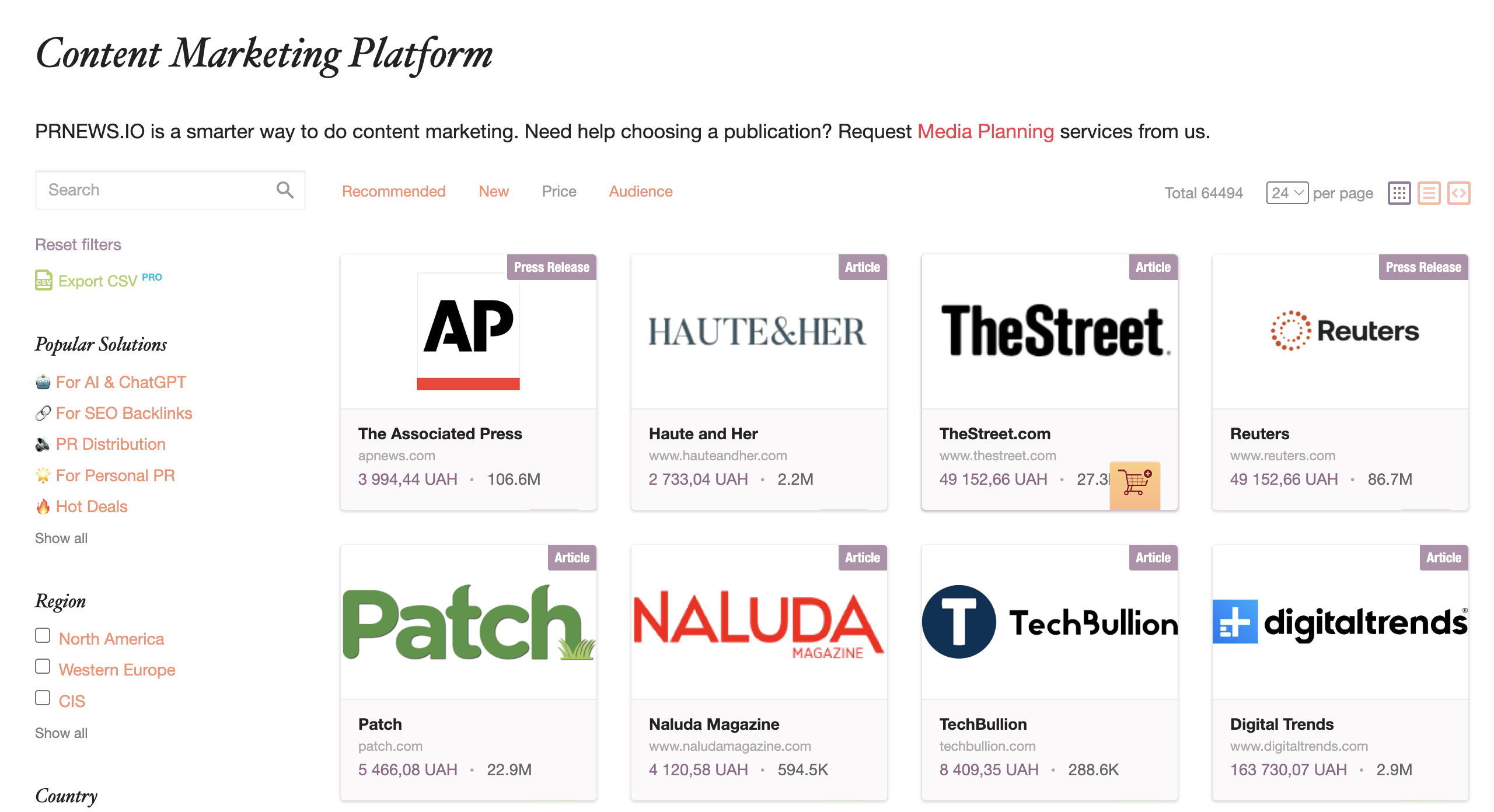
PRNEWS.IO is a media placement marketplace that gives brands and publishers direct access to more than 100,000 media outlets across 175 countries and 77 languages. Instead of the traditional PR hustle, you browse an “online store” of real media properties, filter by the metrics that matter to your strategy — Domain Rating, audience size, geography, language, topic category — and purchase placements directly.
The result: your content appears on the authoritative sites your audience trusts, with the speed and predictability your editorial calendar demands.
What PRNEWS.IO Delivers for Your Content Strategy
SEO and link building at scale. Filter specifically for outlets that provide dofollow links, the currency of domain authority. Consistent placements on high-DR sites compound over time, lifting your entire domain’s search visibility.
AI Search Optimization (AEO). AI platforms like ChatGPT, Perplexity, and Google’s AI Overviews pull from authoritative news sources when formulating answers. By securing placements on reputable outlets through PRNEWS.IO, your brand becomes part of the source material these systems reference — a crucial advantage as AI search becomes the dominant discovery channel.
Reputation and narrative control. Need to push positive, authoritative coverage to the top of search results? PRNEWS.IO lets you strategically place content on leading media sites, giving you a proactive tool for brand narrative management rather than a reactive one.
Global reach, on your timeline. Whether you’re launching in a new market or sustaining a long-term authority-building campaign, you can select placements that match your geographic and demographic targets — and schedule them in sync with your editorial calendar.
Advanced Features for Power Users
The PRNEWS.IO PRO account adds tools designed for serious media strategists:
- Bulk Site Checker — Upload up to 5,000 domains at once to check placement costs, audience metrics, and SEO data simultaneously. Ideal for competitive analysis and rapid campaign planning.
- Media Planning Services — For teams that want expert guidance on where to publish for specific goals — traffic, links, or brand awareness — PRNEWS.IO offers dedicated media planning support.
- Sensitive Topics Catalog — Unlocks access to publishers who accept content in specialized verticals including cryptocurrency, finance, health, and politics.
Measurement and the iterative loop
A content calendar is not a one-time setup — it’s a living system. The best media teams build a regular cadence of performance review into their editorial process:
- Monthly reviews to assess which topics and formats are driving the most engagement, traffic, and conversions
- Quarterly audits to realign content pillars with evolving business objectives
- Ongoing keyword performance tracking to identify when to double down on topics and when to pivot
This data-driven refinement cycle is what separates organizations that continuously improve from those that repeat the same strategies and expect different results.
And don’t underestimate the human side of this loop. Celebrating completed milestones and sharing performance wins with the team creates a sense of momentum. Content marketing is a long game; sustainable output requires recognizing progress, not just measuring shortfalls.
The bottom line
A content calendar is the difference between a media operation that merely survives and one that consistently builds authority, audience, and business impact. It turns the chaotic daily news cycle into a structured, strategic growth engine.
But the calendar only works if your content reaches the right audiences at scale. Publishing consistently on your own domain is necessary — it’s not sufficient. The brands and publishers that win in today’s media environment combine disciplined internal production with strategic external distribution.
That’s the combination that PRNEWS.IO makes possible: the planning discipline of a world-class editorial operation, powered by the reach of a global media network.
Ready to close your distribution gap? Explore the PRNEWS.IO marketplace and start building the external media presence your content strategy deserves.