Whether you run a single boutique or a multinational retail chain, your brand’s reputation is decided in the court of public opinion — not at the point of sale. This comprehensive guide covers every dimension of retail PR: strategy, technology, crisis management, case studies, and how to get your brand in front of the right audiences at the right moment.
What Is Retail PR?
Retail PR (public relations) is the strategic discipline of managing how a retail brand is perceived by its full ecosystem of stakeholders — consumers, journalists, investors, employees, regulators, and the communities where stores operate. It goes far beyond issuing press releases about new products; effective retail PR builds the trust that makes every other marketing investment more effective.
In practical terms, a retail PR professional might spend a Monday drafting a crisis response to a viral customer complaint, a Tuesday briefing a lifestyle journalist ahead of a flagship store opening, a Wednesday consulting on ESG messaging for an annual report, and a Thursday coaching the CEO for a CNBC interview. The discipline is simultaneously reactive and proactive, operating across earned media, owned channels, and increasingly, AI-indexed content ecosystems.
Retail PR: A Working Definition
Retail PR is the ongoing, strategic process of earning positive visibility, managing reputation, and building trusted relationships between a retail brand and every audience that influences its long-term success — from shoppers and journalists to legislators and investors.
Unlike advertising, which buys attention, retail PR earns it. A feature in Vogue, a glowing mention from a micro-influencer with 40,000 engaged followers, or a CEO op-ed in the Financial Times carries a credibility premium that no paid placement can replicate. That credibility translates directly into consumer trust — and consumer trust translates into revenue.
PR vs. Marketing in Retail: Understanding the Distinction
The boundary between retail PR and marketing has blurred significantly over the past decade, but the two disciplines retain fundamentally different orientations. Understanding where one ends and the other begins helps retail teams allocate budgets, set realistic KPIs, and avoid the costly mistake of expecting marketing outcomes from PR investment — or vice versa.
| Dimension | Retail Marketing | Retail PR |
|---|---|---|
| Core Objective | Drive sales and conversion | Build trust and manage reputation |
| Primary Audience | Existing & prospective customers | Media, investors, regulators, employees, public |
| Communication Style | One-way, transactional messaging | Dialogue-based, relationship-driven |
| Media Type | Paid (advertising, sponsored content) | Earned (editorial, news, organic mentions) |
| Success Metrics | ROAS, revenue, sales volume | Share of voice, sentiment, media impressions, trust scores |
| Time Horizon | Short-term, campaign-driven | Long-term, brand equity building |
| Control Level | High (you write and place the ad) | Lower (earned media is editorially independent) |
| Credibility Weight | Lower (audiences know it’s paid) | Higher (audiences trust editorial over advertising) |
Marketing efforts are frequently ineffective if they lack a foundation of consumer trust. A campaign for a new product may struggle to gain traction if the parent brand is mired in a reputational crisis or lacks baseline brand awareness. PR is the scaffolding on which marketing is built.
Integrated Marketing Communications — Industry Consensus, 2025The most forward-thinking retail organizations have moved beyond the marketing-vs-PR debate entirely. They now operate under integrated communications models where both teams share creative briefs, KPI dashboards, and editorial calendars. The result is messaging that is both resonant (PR’s contribution) and conversion-oriented (marketing’s contribution) — a combination that consistently outperforms either discipline operating in isolation.
Why Retail PR Matters More Than Ever in 2026
The retail sector is operating in what analysts are calling a “polycrisis” — a simultaneous convergence of geopolitical disruption, inflationary pressure, AI-driven consumer behavior change, and evolving regulatory requirements. In this environment, reputation is not a soft asset; it is a balance-sheet driver.
| Dimension | Retail Marketing | Retail PR |
|---|---|---|
| Core Objective | Drive sales and conversion | Build trust and manage reputation |
| Primary Audience | Existing & prospective customers | Media, investors, regulators, employees, public |
| Communication Style | One-way, transactional messaging | Dialogue-based, relationship-driven |
| Media Type | Paid (advertising, sponsored content) | Earned (editorial, news, organic mentions) |
| Success Metrics | ROAS, revenue, sales volume | Share of voice, sentiment, media impressions, trust scores |
| Time Horizon | Short-term, campaign-driven | Long-term, brand equity building |
| Control Level | High (you write and place the ad) | Lower (earned media is editorially independent) |
| Credibility Weight | Lower (audiences know it’s paid) | Higher (audiences trust editorial over advertising) |
Three structural shifts make retail PR uniquely critical right now:
The Trust Deficit
Global trust in institutions, media, and corporations continues to erode. Shoppers are increasingly skeptical of advertising claims and instinctively gravitate toward brands that demonstrate authentic values. PR — with its emphasis on earned credibility, transparent communication, and community engagement — is uniquely positioned to bridge this trust gap in a way paid media cannot.
The AI Information Revolution
As consumers increasingly use AI-powered search tools like ChatGPT, Perplexity, and Google’s AI Overviews to research products and brands, the question of which sources those AI systems cite has become a critical competitive battleground. Retailers with strong earned media footprints — high-authority press coverage, credible industry mentions — are increasingly visible in AI-generated answers. Those without are invisible. This makes traditional retail PR media relations more valuable, not less.
The Social Accountability Shift
Modern consumers hold brands accountable for environmental impact, labor practices, diversity commitments, and community involvement. ESG (Environmental, Social, and Governance) communication is no longer optional — it is a commercial necessity. Retail PR teams are now the primary architects of ESG narratives, responsible for ensuring that corporate commitments are communicated authentically and verified by third-party validators.
Core Pillars of a Retail PR Strategy
A robust retail PR strategy is not a single campaign — it is an always-on operational framework built on five interconnected pillars.
Pillar 1: Media Relations
The bedrock of retail PR. This means building genuine relationships with journalists, editors, and producers who cover retail, lifestyle, business, and consumer sectors. Effective media relations involves pitching tailored story angles (not generic press releases), offering exclusive access, providing credible data and commentary, and being a reliable source even when you have nothing to promote. The return is earned coverage that carries editorial credibility — the highest-value currency in retail PR.
Pillar 2: Brand Storytelling
Retail brands with compelling founding stories, clear values, or distinctive cultural identities consistently outperform those that communicate only on product attributes. Your PR strategy must articulate why your brand exists, not just what you sell. This narrative must remain consistent across press releases, executive interviews, social content, in-store signage, and packaging — a total brand voice that consumers encounter cohesively across every touchpoint.
Pillar 3: Executive Thought Leadership
Retail consumers and B2B partners increasingly scrutinize the people behind the brand. Positioning your CEO, CMO, or category directors as credible voices in industry conversation — through op-eds, conference keynotes, podcast appearances, and LinkedIn publishing — builds the kind of authority that translates into consumer confidence and partnership opportunities.
Pillar 4: Crisis Preparedness
In retail, crises are not hypothetical — they are scheduled surprises. Data breaches, product recalls, viral social media complaints, executive misconduct, and supply chain failures are not risks to prepare for; they are eventualities to plan for. Every retail brand needs documented crisis communication protocols, pre-approved response templates, a designated spokespersons hierarchy, and a dark-site holding page ready to activate before any incident occurs.
Pillar 5: Community & Purpose
Purpose-driven retail PR connects the brand to social causes, local communities, and cultural conversations that matter to its audience. This encompasses charitable partnerships, environmental initiatives, local event sponsorships, and user-generated content programs that turn customers into advocates. Authentic community engagement consistently generates the highest-quality earned media — because journalists and influencers want to cover brands that are genuinely making a difference.
Get Your Retail Brand Into Premium Publications
PRnews.io is the distribution platform trusted by retail brands worldwide to place press releases, product launches, store opening announcements, and crisis communications in the publications that actually move the needle — from niche trade journals to top-tier business media.
- Direct access to 100 000 media outlets across retail, lifestyle & business
- Guaranteed placement in high-authority publications
- Full-service press release writing by PR specialists
- Analytics dashboard to track reach, impressions & pickup
- Rapid turnaround for time-sensitive retail news
- Multilingual distribution for international retail expansion
The Phygital Revolution: Where Physical and Digital Retail PR Converge
One of the most significant structural changes reshaping retail PR is the rise of phygital retail — environments and brand experiences where physical and digital channels are so seamlessly integrated that consumers move between them without friction or loss of continuity.
For retail PR, this creates both an enormous opportunity and a significant complexity. Your brand story must be architecturally consistent whether a customer encounters it on TikTok, at a pop-up activation in Shoreditch, via a QR code on product packaging, or through a personalized email triggered by an in-store purchase. Any discontinuity in voice, visual identity, or value proposition represents a PR failure — because inconsistency is itself a reputational risk.
| Phygital Touchpoint | PR Application | Strategic Benefit |
|---|---|---|
| QR Code Integration | Product labels linking to brand origin stories, sustainability reports, or how-to videos. | Deepens brand storytelling at the precise moment of purchase. |
| AR/VR Activations | Virtual try-ons, interactive storefronts, and immersive product demonstrations. | Drives media coverage as a novelty; significantly increases customer dwell time. |
| Unified Commerce | Consistent messaging and service standards across app, web, and physical store. | Builds consumer trust through predictability and cross-channel reliability. |
| Digital Receipts & CRM | Post-purchase journeys that continue the brand story via email or app notifications. | Extends the PR narrative beyond the point of sale into long-term loyalty. |
| In-Store Digital Displays | Dynamic content showing real-time social proof, press mentions, and user-generated content (UGC). | Reinforces earned media credibility at the point of the final decision. |
| Geotargeting | Directing nearby digital users to physical store locations based on stock availability. | Bridges online brand awareness and physical footfall effectively. |
Physical retail spaces are no longer just distribution points — they are live storytelling environments. Nike’s AR-powered House of Innovation, Glossier’s Art Deco-inspired pop-ups, and IKEA’s social-media-native communications all demonstrate the same principle: the store is a PR medium. Every square foot should be considered from the perspective of what story does this tell, and would a journalist or customer want to share it?
The shift from ‘sales per square foot’ to ‘experiences per square foot’ is not just a retail trend — it is a PR mandate. Physical retail must earn its coverage by being genuinely, memorably worth visiting.
Experiential Retail Industry Analysis, 2025Retail PR for Product Launches & Store Openings
No moment in a retailer’s calendar generates more concentrated PR opportunity — or more concentrated risk — than a product launch or new store opening. The brands that execute these moments brilliantly follow a disciplined three-phase approach.
Phase 1: Pre-Launch (6–12 Weeks Out)
The objective of pre-launch PR is to build anticipation without revealing everything. This is the “slow burn” phase where you plant seeds in editorial and influencer communities, create controlled leaks that generate organic conversation, and brief key media and retail analysts under embargo. Tactics include:
- Exclusive embargo briefings with tier-one journalists (Vogue, WWD, Business of Fashion, Retail Week, etc.)
- Influencer seeding with early product access — prioritizing authentic fit over follower count
- Teaser content on owned channels that builds intrigue without full disclosure
- Submission to industry awards and “ones to watch” roundups
- Analyst and investor briefings if relevant to a publicly listed entity
Phase 2: Launch Day & Week
Launch day should feel like a coordinated media event even if there is no physical event. On this day, you want simultaneous coverage from multiple credible sources landing at once — creating the perception of industry consensus about your launch’s significance.
- Embargo lift synchronized across all participating journalists and influencers
- Press release distributed via high-authority newswire services (PRnews.io, PR Newswire)
- Executive interviews conducted and published in real time
- Social media “go live” moments with product/experience reveals
- Experiential media events or pop-up experiences in key markets
Phase 3: Post-Launch Momentum (Weeks 2–8)
Most retail PR teams declare victory at launch day and move on. The brands that win long-term do the opposite — they amplify the launch into a sustained narrative arc that keeps the product relevant through reviews, customer testimonials, usage stories, and data storytelling.
| Launch Phase | Key PR Activities | Target Outcome |
|---|---|---|
| Pre-Launch (6–12 wks) |
Embargo briefings, influencer seeding, teaser campaigns, and trade media outreach. | Anticipation, an informed media community, and an early advocate base. |
| Launch Day | Embargo lift, newswire distribution, CEO interviews, social reveals, and experiential events. | Peak media volume, broad awareness, and consumer excitement. |
| Post-Launch (wks 2–8) |
Customer testimonials, review amplification, sales milestone announcements, and second-wave media pitches. | Sustained relevance, social proof, and long-tail SEO and AI citation value. |
Influencer & Media Relations in Retail PR
The influencer landscape in retail PR has matured dramatically. The era of paying any influencer with a large following for product placement has given way to a more strategic, credibility-focused approach where relevance and authenticity consistently outperform reach.
Tier-Based Influencer Strategy
Effective retail PR now employs a tiered influencer approach that balances mass reach with community depth:
- Mega-influencers (1M+ followers): Used sparingly for mass brand awareness moments — major launches, seasonal campaigns. The trade-off is lower engagement rates and higher skepticism from audiences.
- Macro-influencers (100K–1M followers): Strong for category authority — a beauty macro-influencer who has built genuine expertise over five years carries significant purchase influence.
- Micro-influencers (10K–100K followers): The sweet spot for retail PR. Micro-influencers typically have highly engaged, niche-specific audiences and are perceived as peers rather than celebrities. Their recommendations carry genuine trust weight.
- Nano-influencers / Brand Ambassadors (<10K followers): Increasingly valuable for hyper-local retail PR — particularly for regional store openings and community-focused campaigns.
Earned vs. Paid Influencer Coverage
The most valuable influencer coverage in retail PR remains earned — the organic post, the unsolicited TikTok review, the Instagram story shared without compensation. The Stanley Tumbler’s transformation from a niche outdoor product into a cultural phenomenon began with a single organic TikTok from a customer whose car had burned down but whose Stanley survived. The brand’s response — gifting the creator a new car and tumbler within 48 hours — is textbook retail PR: swift, authentic, and wildly amplifiable. No paid campaign budget could have achieved what that organic moment generated.
Media Relations: Pitching for Retail Coverage
Journalists covering retail receive hundreds of pitches per week. The ones that earn coverage share five characteristics:
- Relevance: The pitch is tailored to that specific journalist’s beat, audience, and recent published work — not a copy-paste blast to 200 contacts.
- Newsworthiness: There is a clear reason why this story mattersnow— a trend, a data point, a cultural moment, a controversy, or a genuine first.
- Data: Exclusive consumer research, sales figures, or industry data dramatically increase pitch success rates.
- Access: An offer of executive interview access, exclusive product samples, or early event invitations adds tangible value beyond the pitch itself.
- Brevity: The pitch email is scannable in 30 seconds and does not bury the lead. Subject lines are specific and compelling, not generic.
Crisis Communication for Retail Brands
Retail organizations face a uniquely diverse crisis landscape. Unlike professional services or technology companies, retailers are exposed to product safety failures, in-store incidents, employee relations crises, social media viral moments, supply chain disruptions, data breaches, and regulatory actions — often simultaneously, and often with very little warning.
The Golden Hour Principle
In retail crisis communications, the first hour — and certainly the first 24 hours — are disproportionately important. Research consistently shows that organizations that acknowledge a crisis quickly, even before they have all the facts, preserve significantly more trust than those that delay for the sake of a complete information picture. Silence is not neutral; it is interpreted as guilt, incompetence, or indifference.
The effective crisis response framework for retail brands follows four non-negotiable principles:
| Principle | What It Means in Practice | What Happens Without It |
|---|---|---|
| Speed | Initial statement within 2–4 hours, even if it only acknowledges awareness of the situation. | Media fills the vacuum with speculation; social amplification accelerates. |
| Accuracy | Never state as fact anything you cannot verify; prefer “we are investigating” over incorrect specifics. | Corrections undermine credibility more than the original crisis. |
| Transparency | Disclose what you know, when you knew it, and what actions you are taking. | Perceived cover-up becomes the story; original crisis becomes secondary. |
| Empathy | Center the consumer, employee, or affected party — not the brand’s legal exposure. | Cold, legalistic responses go viral for the wrong reasons. |
High-Profile Crisis Case Studies (2024–2025)
Proactively shut down 79 stores to protect customer data. Remained transparent throughout the investigation, continued paying employees, and communicated directly with customers via every available channel.
Rapidly identified the contaminated supply source (onions) through tightly managed traceability protocols and communicated a clear remediation plan across multiple platforms simultaneously.
When a customer’s viral video showed a bowl of cheese without the macaroni, CPK’s social team responded with humor, featuring their lead chef and offering a year of free food.
A sponsored content partnership without adequate audience-segment analysis triggered immediate backlash. The brand lacked a unified messaging strategy and issued inconsistent statements.
Product Recall Crisis Communications
The CPSC issued 422 consumer product recalls in 2025 — a 28% increase over the previous year, with approximately one-third involving children’s products. For retail PR teams, this regulatory environment creates specific obligations:
- The CPSC actively names retailers — not just manufacturers — in recall headlines when the retailer is the exclusive seller of a hazardous product
- Regulatory compliance alone is no longer sufficient defense; brands must demonstrate proactive safety standards that exceed baseline legal requirements
- Recall communications must be issued simultaneously across multiple channels — press releases, in-store signage, email to purchasers, website notifications, and social media
- Retailers who handled recalls most effectively in 2025 framed the action as evidence of their consumer commitment, not a liability admission
Artificial Intelligence and GEO: The New Frontier of Retail PR
Artificial intelligence is reshaping retail PR across two distinct dimensions: as an operational tool that increases team efficiency and as an information infrastructure that determines how consumers discover and evaluate retail brands.
AI as a Retail PR Operational Tool
Approximately 75% of PR professionals now incorporate generative AI into their daily workflows, with the highest-impact applications concentrated in five areas:
| AI Application | Tools Used | PR Value |
|---|---|---|
| Trend Intelligence | NewsWhip, Brandwatch, Agent Spark | Identifies emerging narratives before competitors; enables proactive PR positioning. |
| Journalist Matching | Muck Rack, CisionOne, PressPulse | Analyzes journalist past work to hyper-personalize pitches; increases open rates significantly. |
| Content Drafting | ChatGPT, Claude, Jasper | Accelerates press release and pitch drafting; frees teams for strategic relationship work. |
| Sentiment Monitoring | Brandwatch, Sprinklr, Talkwalker | Real-time reputation tracking; early crisis signal detection. |
| Performance Analytics | PR Dashboard integrations, Meltwater | Quantifies PR ROI in language that CMOs and CFOs respond to. |
Generative Engine Optimization (GEO): The Strategic Imperative
The emergence of AI-powered search — ChatGPT, Perplexity, Google’s AI Overviews, and their successors — has created a new category of retail PR strategy: Generative Engine Optimization (GEO). When consumers ask an AI search tool “what is the best sustainable activewear brand?” or “which home goods retailers have the best return policy?” the AI’s answer draws from its indexed sources — primarily high-authority earned media.
Research from Muck Rack’s 2025 AI Report reveals that AI search engines overwhelmingly prioritize:
- Credible, timely earned media from authoritative publications
- Third-party validation over brand-owned content
- Consistent, factually accurate coverage across multiple independent sources
- Recent content that signals the brand remains active and relevant
The most effective way to control a brand’s narrative in an AI-dominated world is to secure placements in reputable news outlets that AI uses as its primary sources. Traditional PR media relations is not becoming obsolete — it is becoming the only strategy that matters for AI visibility.
Muck Rack AI Search Report, 2025The strategic implication is profound: the brands with the most consistent, high-authority earned media footprint will dominate AI-generated shopping recommendations, product comparisons, and brand evaluations — regardless of their paid media investment. This makes systematic press release distribution, ongoing media relations, and authoritative content creation not just a PR exercise, but a core competitive strategy for 2025 and beyond.
High-Authority Press Coverage That AI Actually Cites
As AI-powered search tools become the primary discovery channel for retail brands, presence in credible, indexed publications is the highest-ROI PR investment available. PRnews.io connects retail brands with the authoritative media placements that both consumers and AI engines trust.
LinkedIn & B2B Retail Reputation Management
While Instagram and TikTok dominate consumer-facing retail PR, LinkedIn has become indispensable for the B2B dimension of retail reputation — investor relations, wholesale and franchise partner acquisition, talent attraction, and regulatory stakeholder management. For multi-location retailers, private equity-backed brands, or any retailer with a wholesale component, LinkedIn is not optional; it is a strategic priority.
Executive Thought Leadership on LinkedIn
The data on LinkedIn thought leadership in retail is compelling: nearly half of B2B decision-makers report that high-quality professional content directly influences their purchasing or partnership decisions. For retail executives, this means publishing regularly on topics where they have genuine expertise and differentiated perspective — supply chain resilience, customer experience innovation, sustainability strategy, retail technology adoption, or international expansion.
Leading retail brands set the standard here. Microsoft uses LinkedIn to curate executive perspectives on industry challenges. Amazon builds its employer brand by centering the humans behind its operations rather than the products it sells. GE humanizes its scale by spotlighting individual employee achievements. Each of these approaches serves a retail PR function: positioning the organization as worthy of trust, partnership, and talent investment.
LinkedIn Crisis Communications
LinkedIn also provides a structured, credible environment for crisis communication that differs from the emotional intensity of Twitter/X or Instagram. During crises, retail brands increasingly use LinkedIn to provide accurate, professionally toned updates to the investor, partner, and media communities — audiences who require factual clarity rather than empathetic storytelling. Having a well-maintained LinkedIn company page is part of basic crisis preparedness for any serious retail organization.
Case Studies for Retail PR
Now that you understand what retail PR is all about, let’s take a look at some real-life examples of companies successfully implementing these strategies and seeing the actual results:
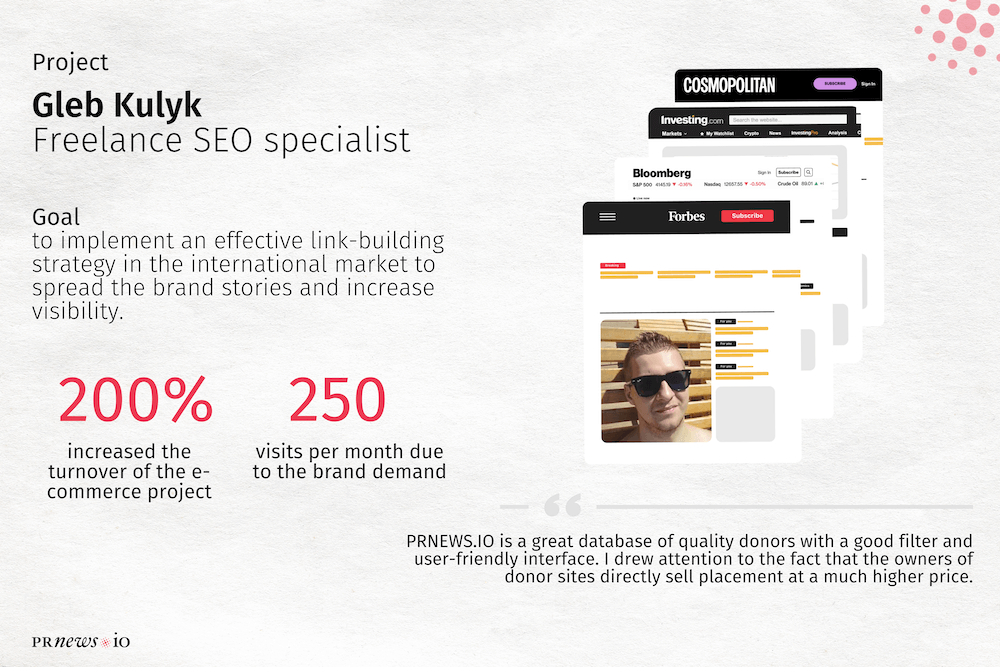
A Freelancer Doubled the Turnover of an Ecommerce Project by 200% With the Help of PRNEWS.IO
Gleb Kulyk, a freelance SEO specialist, understood that Link Building is one of the essential factors when it comes to ranking websites in Google.
Especially for eCommerce websites – external, high-quality links increase the topical authority in the eyes of search engines, and therefore, you get higher rankings on your desired keywords.
This represents a massive challenge because it’s not easy to get links on websites that are relevant to your field and have a high domain authority. Having to do it on an international market just adds to the challenge.
However, using PRNEWS.IO, Gleb managed to easily distribute his content in international markets and get placements in authoritative publications, which, as a result, gave his client’s eCommerce website a 200% turnover growth in the first year and 40% every six months.
Visit this link to see the full story of how he managed to get this astonishing result.
Retail PR Trends for 2026
The following shifts are not emerging — they are already here, actively reshaping what effective retail PR looks like and what it is measured against.
Hyper-Personalization at Scale
AI-powered CRM systems now allow retail brands to tailor not just email marketing but PR activations, influencer pairings, and event invitations based on highly granular customer behavior data. Mass personalization — once a contradiction in terms — is achievable. Brands that treat every customer interaction as an opportunity to extend their PR narrative will build stronger advocates than those maintaining one-size-fits-all messaging.
Authentic Storytelling Over Polished Perfection
The era of overly produced, aspirationally perfect brand content is over. Consumers — particularly Gen Z and younger Millennials — have a finely tuned “inauthenticity detector” that is triggered by content that feels corporate, sanitized, or performative. The retail PR campaigns gaining the most traction are those that embrace real employees, real customers, real messiness, and real emotion. Rough edges are now features, not bugs.
ESG Communication as Core Retail PR Function
Environmental, Social, and Governance reporting has transitioned from investor relations territory into mainstream consumer-facing PR. Brands are expected to communicate real environmental impact — waste reduction metrics, supply chain transparency, carbon footprint data — rather than aspirational commitments. “Greenwashing” is not just ethically problematic; in 2025, it is a litigation and regulatory risk in multiple jurisdictions.
Inclusive Design as Brand Value Signal
Retail activations in 2025 and beyond are expected to feature smart wayfinding for accessibility needs, multi-height interaction points, live captioning for events, sensory-friendly spaces, and creative that genuinely represents the full spectrum of consumers. Brands that treat inclusivity as a checklist item rather than a value signal will face both PR and commercial consequences.
Community Micro-Experiences Replacing Mega-Activations
The most forward-thinking retail PR teams are abandoning massive, impersonal brand activations in favor of high-quality, intimate community experiences that generate deeper loyalty per attendee. Neighborhood pop-ups, co-creation workshops, and locally anchored events deliver richer earned media and stronger word-of-mouth than stadium-scale events — at a fraction of the cost.
Your Retail PR Campaign Starts Here
Join thousands of retail brands — from independent boutiques to global chains — that trust PRnews.io to distribute their most important news to the media outlets that matter.
How PRnews.io Powers Retail PR: Platform Capabilities
Executing the strategies outlined in this guide requires the right distribution infrastructure. PRnews.io is the press release distribution and editorial placement platform built specifically for the demands of modern retail PR — combining scale, targeting precision, and transparent analytics in a single, accessible platform.
What Retail Brands Use PRnews.io For
- New store and franchise openings: Reach local, national, and trade media simultaneously with tailored geographic targeting
- Product launches: Distribute launch press releases to relevant lifestyle, consumer, and trade publications in your category
- Corporate milestones: Funding rounds, leadership appointments, partnership announcements, and sustainability commitments
- Crisis and recall communications: Rapid, wide-reaching distribution to ensure accurate information reaches all relevant audiences simultaneously
- ESG reporting: Position sustainability initiatives with publications that cover corporate responsibility and impact
- International expansion: Multilingual press release distribution to 50+ country-specific media markets
Why Retail PR Teams Choose PRnews.io
Unlike traditional PR agencies operating on retainer models that lock you into monthly minimums regardless of activity, PRnews.io offers a transparent, pay-per-placement model that aligns costs with actual campaign needs. Whether you are a single-store independent retailer announcing a major renovation or a multinational chain launching in new markets, the platform scales to your requirements without imposing agency overhead.
Critically for GEO strategy, PRnews.io’s distribution network prioritizes publications that are indexed by Google News and cited by AI search engines — ensuring that your press releases contribute to your brand’s cumulative authority footprint in AI-generated search results.