Ranking on page one used to mean one thing: appearing near the top of Google’s blue links. That definition has exploded. Today, visibility in search means ranking in traditional SERPs across desktop and mobile, appearing in local map packs down to the street level, being cited by AI answer engines like ChatGPT and Perplexity, showing up in “People Also Ask” boxes, and maintaining presence across a fragmented landscape of platforms where your audience is increasingly finding answers without ever clicking a traditional result.
Rank tracking tools have evolved to match this complexity — and the category has never been more differentiated. Enterprise platforms now track AI answer engine visibility alongside traditional keyword positions. Hyper-local tools use geogrid technology to show your Google Maps ranking block by block. A new category of LLM trackers specifically monitors how often and how favorably AI models mention your brand across billions of queries. And affordable entry-level tools make clean, accurate daily tracking accessible to single-location businesses with no SEO team.
This listicle covers the best rank tracking tools — so whether you’re a local business owner monitoring your map pack, an enterprise SEO team tracking 100,000 keywords across 20 markets, or a brand manager watching how AI engines represent you in generated answers, you’ll find the right tool for the job.
Top rank tracking tools
Semrush Position Tracker
Semrush Position Tracker has earned its position as the most complete rank tracking solution available by combining daily keyword updates, competitor discovery, and an increasingly sophisticated AI visibility layer into a single, well-integrated platform. Its core tracking covers desktop, mobile, and local rankings with daily refresh cycles, and its competitor discovery automatically surfaces domains ranking for your target keywords that you may not have been monitoring. Its standout 2025 addition is the AI Toolkit add-on, which tracks your brand’s and content’s visibility within AI-generated answers across major platforms — a capability that has shifted from nice-to-have to strategically essential for SEO teams watching organic traffic patterns shift. For teams that want one platform to cover traditional and AI search visibility simultaneously, Semrush sets the current benchmark.
Ahrefs has long been trusted for the accuracy and depth of its keyword data, and its Rank Tracker continues that tradition while adding a genuinely differentiated AI visibility capability. Its Brand Radar feature monitors how your brand is mentioned across more than 240 million prompts processed by ChatGPT, Gemini, and Perplexity — providing quantitative share-of-voice data for AI-generated answers that most traditional rank trackers simply don’t measure. On the traditional SERP side, it tracks rankings with Ahrefs’ characteristically precise data quality, including SERP feature visibility, competitor movement, and historical trends. For SEO teams that already rely on Ahrefs for keyword research and backlink analysis, the Rank Tracker’s native integration with the broader platform makes it the most efficient path to comprehensive visibility measurement.

SE Ranking has established itself as the most compelling value proposition in the mid-market rank tracking segment, consistently offering daily tracking across desktop, mobile, and local map packs at price points that larger competitors struggle to match. Its AI Results Tracker — included in core business plans rather than gated behind an expensive add-on — monitors your presence in AI-generated search results, giving agencies the AI visibility reporting their clients are increasingly requesting without inflating the platform cost. Its white-label reporting capabilities, flexible keyword grouping, and competitor tracking features make it well-suited for agencies managing multiple client campaigns simultaneously. For boutique and mid-sized SEO agencies that need professional-grade tracking across traditional and AI search without enterprise-level pricing, SE Ranking delivers exceptional capability per dollar spent.
AccuRanker has built its entire identity around one capability that large agencies and enterprise SEO teams have made clear is non-negotiable: speed. Its on-demand refresh feature allows users to pull a live ranking update for any keyword at any moment — not just during scheduled daily crawls — which matters enormously when a client calls to report a ranking drop, when a site migration has just gone live, or when a Google algorithm update is actively rolling out and you need real data rather than yesterday’s numbers. Its unlimited user seats across all plans is an equally significant operational advantage for agencies managing large teams and multiple client dashboards. For high-volume operations where data freshness and team scalability are the primary requirements, AccuRanker is the clear choice.
Nozzle is built for SEO teams that find the standard “position 1-100” ranking report inadequate for the complexity of the modern SERP. Rather than tracking only organic blue links, Nozzle captures every element present in the search results page — paid ads, local packs, featured snippets, People Also Ask boxes, image carousels, video results, and more — giving teams a genuinely complete picture of the competitive landscape on any given query. Its Share of Voice metric aggregates this full-SERP visibility into a single competitive metric that reflects actual search presence rather than just organic position. For enterprise SEO programs that need to understand and report on total SERP ownership — not just organic rankings — Nozzle provides a level of data completeness that no conventional rank tracker matches.
Advanced Web Ranking has been a trusted workhorse in the professional SEO community for well over a decade, and its longevity reflects genuine strength in the capabilities that large-scale SEO operations value most. Its infrastructure handles keyword tracking at volumes that stress-test most platforms — 35,000 keywords and beyond — while maintaining the data reliability and historical depth that long-term trend analysis requires. Its standout differentiator for agencies is the depth and flexibility of its white-label PDF reporting: fully branded, highly customizable client reports that present ranking data with the visual polish and narrative structure that clients expect from a professional SEO partner. For established agencies with large retainer clients and high keyword volumes, AWR’s combination of scale, reliability, and reporting quality remains difficult to beat.
Local Falcon invented the geogrid approach to local rank tracking and remains the most widely used and visually intuitive tool for understanding exactly where your Google Maps visibility begins and ends. Rather than reporting a single average map ranking, it plots your position across a configurable grid of geographic points centered on your location — producing a heatmap that shows precisely where your business ranks strongly, where visibility drops off, and how far your map pack presence actually extends in each direction. For multi-location businesses, franchises, and local SEO practitioners managing clients across competitive markets, this street-level granularity transforms map optimization from guesswork into targeted, location-specific strategy. Local Falcon’s geogrid output has also become a standard format for client reporting in the local SEO industry.
BrightLocal approaches local search visibility as a system rather than a single metric, combining rank tracking for the Google 3-Pack with citation building, review management, and local audit tools into a comprehensive platform designed specifically for the needs of local businesses and the agencies that serve them. Its map pack tracking monitors your presence across local queries with the geographic specificity that local SEO requires, while its citation management tools help build and maintain the consistent NAP (name, address, phone) presence across directories that influences local ranking. For local SEO agencies managing multiple brick-and-mortar clients simultaneously, BrightLocal’s combination of tracking, reputation management, and citation infrastructure in a single platform significantly reduces the operational overhead of managing local SEO at scale.
Whitespark has carved out a deeply respected niche in local SEO by focusing specifically on the relationship between local citations and map pack rankings — a connection that most generic rank trackers acknowledge but don’t investigate deeply. Its rank tracking capabilities are specifically calibrated for “near me” and location-modified search queries, tracking how your visibility shifts as the searcher’s implied location changes. Its citation finder and citation building services work directly alongside its tracking data, allowing local SEO practitioners to identify exactly which citation sources competitors have that you don’t — and then close those gaps systematically. For local SEO specialists who want to understand and act on the citation signals driving map pack performance rather than simply monitoring positions, Whitespark provides the most actionable data available in this specific domain.
AI Rank Checker addresses a genuine market gap in the emerging AI visibility category: most brands want to understand how they’re represented in AI-generated answers, but aren’t yet ready to commit to a monthly subscription for a capability they’re still evaluating. Its pay-as-you-go pricing model removes that barrier, allowing marketing teams to check their brand’s presence and citation frequency across all major LLMs — ChatGPT, Perplexity, Gemini, Claude, and others — on demand, without a recurring contract. For brands taking their first steps into Answer Engine Optimization, this flexible access model provides the data needed to build a business case for ongoing investment. For experienced teams with irregular monitoring needs, it offers an efficient alternative to full platform subscriptions.
LLMrefs is purpose-built for the emerging discipline of Answer Engine Optimization — the practice of ensuring that your brand, content, and perspectives are well-represented in the AI-generated answers that are increasingly the first and only result a user sees. Rather than tracking traditional keyword positions, it measures your brand’s share of voice within AI responses: how frequently you’re cited across relevant queries, which of your source URLs are being referenced most often by AI models, and how your visibility compares to competitors in AI-generated answers within your category. For content strategists and SEO teams building an AEO strategy, LLMrefs provides the measurement infrastructure needed to understand what’s working, what’s being cited, and where content investment will most improve AI answer visibility.

Peec AI takes a technically distinctive approach to LLM brand monitoring: rather than using API calls that may not reflect the actual user-facing experience, it uses UI scraping to simulate genuine human interactions with AI engines — experiencing the responses exactly as a real user would. This means the data captures not just whether your brand is mentioned, but the full context, framing, and sentiment of how AI presents it: the tone of the description, the positioning relative to competitors, and the overall “vibe” of the AI’s characterization of your brand. For brand managers and PR teams where the qualitative nature of AI representation matters as much as citation frequency, Peec AI’s simulation-based approach provides a more nuanced and realistic picture of actual AI brand visibility.
Wincher is built on the conviction that most small business owners don’t need the complexity, the feature sprawl, or the price tag of an enterprise rank tracking suite — they need accurate daily rankings, clear trend visualization, and enough competitor data to know whether their SEO efforts are working. Starting at approximately $40 per month, it delivers exactly that: clean daily updates, straightforward keyword grouping, basic competitor tracking, and automated email reports that keep business owners informed without requiring them to log into a dashboard regularly. Its interface is designed for clarity over depth, making it genuinely accessible to business owners managing their own SEO without a dedicated specialist on staff. For the enormous segment of small businesses that just need reliable, uncluttered rank data, Wincher is the most honest and practical option available.
SERPWatcher, part of the Mangools suite of beginner-friendly SEO tools, has built its following around a concept that resonates strongly with small business owners and solo SEOs overwhelmed by complex analytics: the Dominance Index. Rather than requiring users to monitor position changes across dozens or hundreds of individual keywords and synthesize the implications themselves, the Dominance Index aggregates the full performance of your tracked keyword set into a single, easily interpreted score that moves up when your rankings improve overall and down when they decline. This simplification makes it easy to answer the most important question — “Is my SEO working?” — at a glance. Paired with Mangools’ broader suite of keyword research and backlink tools, SERPWatcher offers a coherent, affordable entry point for teams new to systematic rank tracking.
Nightwatch occupies a valuable middle position in the rank tracking market, offering a level of local tracking precision — down to the zip code level — that most affordable tools reserve for expensive local-specialist platforms, while simultaneously providing global SERP tracking and AI search monitoring in a single subscription. This flexibility makes it particularly useful for businesses with both local and national or international SEO goals, eliminating the need for separate tools at each end of the geographic spectrum. Its AI search monitoring tracks brand visibility in AI-generated results alongside traditional rankings, and its reporting interface is clean and customizable enough for agency use without the complexity overhead of enterprise platforms. For growing SEO teams that need versatile, accurate tracking across multiple search contexts without platform fragmentation, Nightwatch bridges the gap between local specialist and full-scale enterprise tracker effectively.
How to promote a rank tracking tool with PRNEWS.IO
PRNEWS.IO makes this possible through a straightforward model: you browse a catalog of real media outlets — blogs, industry magazines, news portals, and niche publications — and purchase the right to place your article directly in them. Not a press release blast, not a banner ad — an actual editorial article, published under your byline or as sponsored content, on a site your target readers already visit. This guide explains how to use that model effectively to promote a rank tracking tool.
PRNEWS.IO is a content placement marketplace. It connects brands and marketers with publishers who are willing to host paid articles on their platforms. Each listing in the catalog shows the outlet’s domain authority, monthly traffic, topic categories, language, and price — giving you full visibility before you spend a dollar.
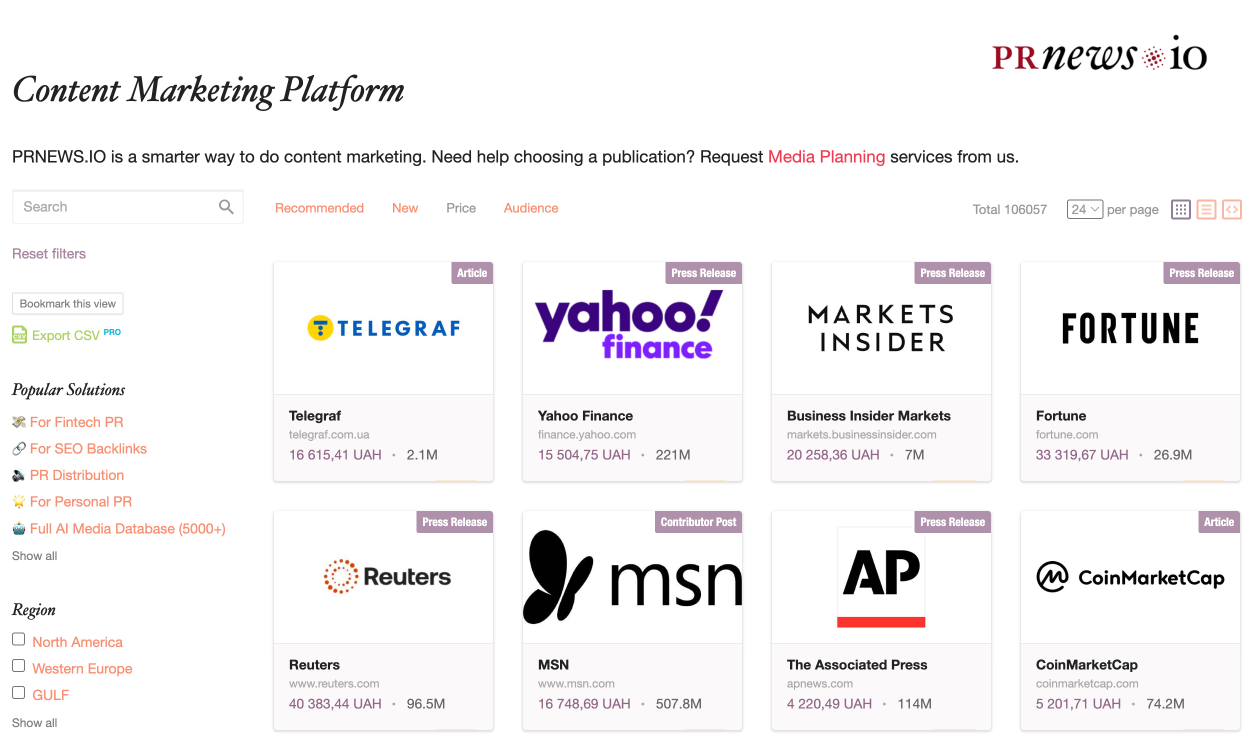
The key distinction from traditional press release distribution is that you are not blasting a release to a wire and hoping it gets picked up. You are selecting specific, relevant publications and paying for guaranteed placement of a real article — a piece of content that lives on that outlet’s domain, gets indexed by search engines, and passes link equity back to your site.
For a rank tracking tool, this means you can get a well-written, informative article about keyword monitoring, SERP analysis, or SEO strategy published on authoritative marketing and tech sites — with a natural, contextual link pointing back to your product.
Find the right outlets in the PRNEWS.IO catalog
The PRNEWS.IO catalog contains thousands of publications. The challenge is not finding options — it is filtering to the ones that actually serve your goals. When promoting a rank tracking tool, focus on these criteria:
Topic Relevance
Look for outlets in categories like SEO, digital marketing, content marketing, SaaS, tech tools, and online business. A placement on a marketing-focused publication with modest traffic will outperform a placement on a high-traffic general news site where your audience is a tiny fraction of readers.
Domain Authority and Traffic
PRNEWS.IO displays each outlet’s domain authority (DA) and monthly traffic estimates. For backlink building, prioritize DA 40 and above. For audience reach, look at real traffic numbers — and assess whether that traffic is genuinely in your niche.
Write an Article Worth Reading
The single biggest mistake brands make with paid media placements is writing thinly veiled advertisements. An article that reads like a product brochure will be ignored by readers, earn no organic shares, and often fail to get approved by the outlet’s editorial team. The content must provide genuine value to the publication’s audience.
Effective article formats for promoting a rank tracking tool include:
- Educational how-to articles: Walk readers through a practical SEO workflow — for example, ‘How to Set Up a Keyword Tracking System for a New Website’ — and reference your tool naturally within the process.
- Problem-solution articles: Identify a pain point your audience knows well (‘Why Your Rankings Are Fluctuating and What to Do About It’) and present your tool as part of the solution without making it the only focus.
- Data-driven opinion pieces: Publish original insights based on your platform’s aggregated data — trending keyword volatility, ranking patterns by industry, or changes in SERP features — framed as industry analysis.
- Comparison and roundup articles: Create an honest guide comparing different approaches to rank tracking. Including your own tool alongside others builds credibility and avoids the ‘advertisement’ read.
- Case study format: Present a real or hypothetical scenario showing how a team improved their SEO results using a structured rank tracking approach, with your tool featured as the instrument.
Regardless of format, the article should be at least 700–1000 words, well-structured with clear subheadings, and written for a reader who has not yet heard of your product. Introduce the tool where it fits organically — do not open with it.
Your link should be placed contextually, anchored to a descriptive phrase rather than a naked URL or a generic term like ‘click here.’ Something like ‘monitor daily keyword position changes’ linked to your tool’s feature page is far more effective than a link on your brand name alone.
Maximize the value of each placement
A published article on a quality outlet is an asset — treat it as one. Once your placements go live:
- Share across your channels: Post the article URLs on LinkedIn, Twitter/X, and in relevant SEO communities. Frame it as industry content, not self-promotion.
- Add internal links from your blog: Link to the published articles from your own site’s content to reinforce the link relationship and send crawl signals in both directions.
- Use placements in sales and outreach: A library of articles on reputable third-party sites builds social proof. Link to them in cold outreach emails, investor decks, or partnership proposals.
- Monitor backlink indexing: Use Ahrefs, Semrush, or your own rank tracker to confirm when the backlinks are indexed and begin passing authority.
- Track referral traffic with UTM parameters: Add campaign tags to your article links so you can see exactly how many visitors each placement drives in Google Analytics.
Building a consistent media presence over time
One or two article placements will not transform your product’s visibility overnight. The real power of PRNEWS.IO for rank tracking tool promotion comes from building a consistent, growing footprint of articles across relevant publications over several months.
Aim for two to four new placements per month, each targeting a different outlet and a different content angle. Vary your topics — one piece on keyword tracking strategy, another on competitor SERP analysis, another on tracking local rankings — so you cover a wide range of search intent and reach different audience segments within the same niche.
Over six to twelve months, this produces a growing body of indexed articles, a diversified backlink profile, and brand recognition among editors and readers in the SEO space. When potential users search for rank tracking solutions or read about SEO tools, your name keeps appearing in authoritative contexts — and that repetition is what converts awareness into trust.