TL;DR — QUICK PICKS BY USE CASE
Thought leadership has stopped being a nice-to-have adjacent to marketing — the data behind it is now hard to ignore. Companies with strong authority content report 2.4x higher odds of commanding premium pricing and 3.8x higher odds of winning competitive deals, 55% of decision-makers say they use thought leadership specifically to vet vendors before a sales conversation ever happens, and 65% of executives spend an hour or more a week consuming it. The harder question was never whether to do it — it’s where, since the honest answer is that no single platform covers prestige, reach, ownership, and AI-citation potential at once.
Full context before the list: PRNEWS.IO and Medialister are listed first because distribution is the actual bottleneck for most experts — a brilliant piece of thinking published only on a personal blog reaches almost nobody. Everything else on this list is a destination you have to earn your way into (an editorial board, a subscriber base, a community’s trust) or build slowly over months. PRNEWS.IO and Medialister are the fastest, most direct way to get that same piece of thinking syndicated across real, indexed outlets on a schedule you control.
Best platforms where experts should publish thought leadership
1. PRNEWS.IO
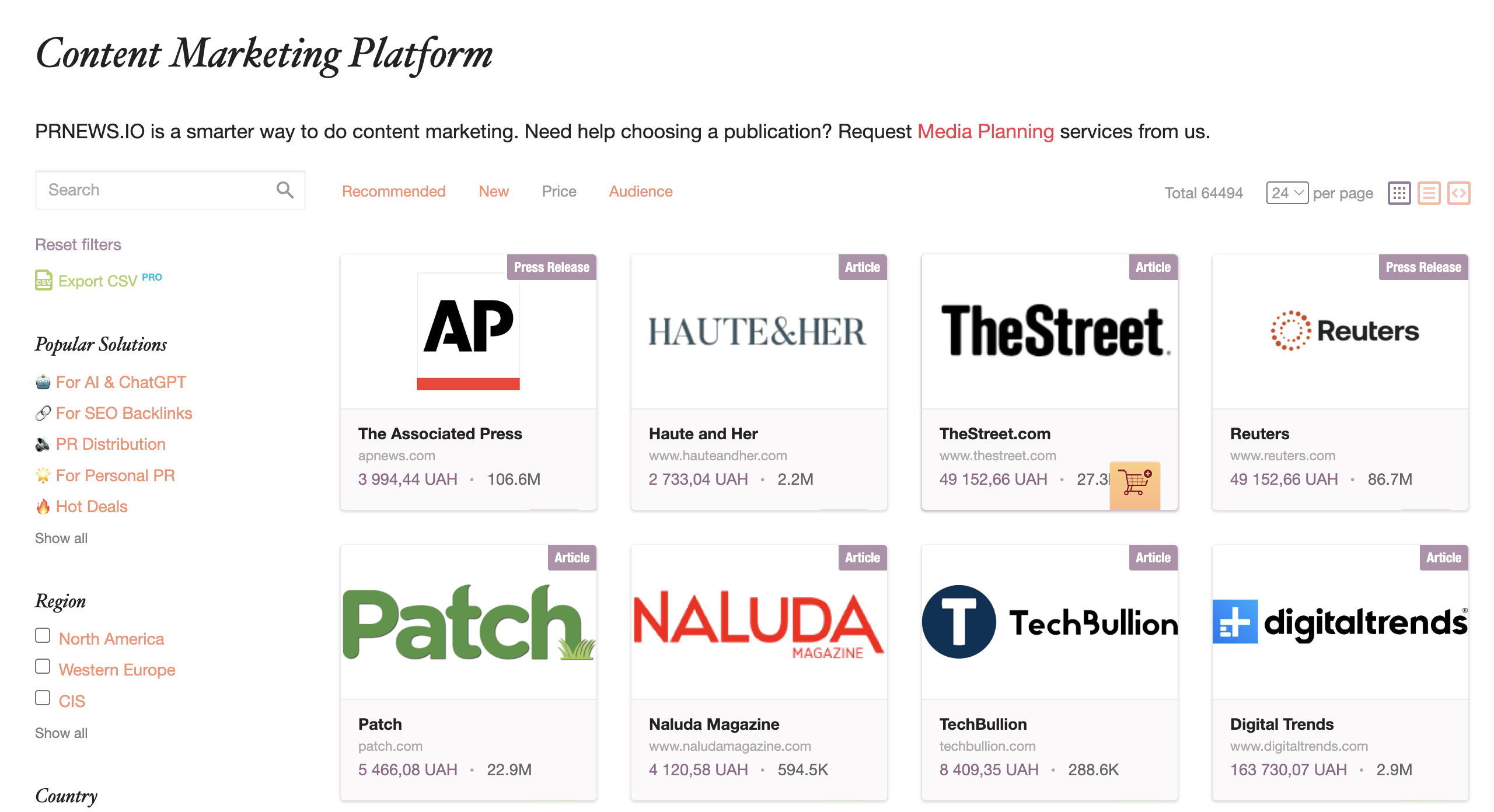
PRNEWS.IO is a marketplace: choose a specific outlet from a catalog of 105,000+ media sites across 175 countries and 77 languages, pay the listed price, and get a guaranteed placement — refunded if declined. For thought leadership specifically, that means an expert’s article, byline, or insight piece can be syndicated to real, indexed outlets without waiting on an editorial board’s acceptance timeline, with multi-channel distribution across news and industry sites, SEO-friendly publishing that uses canonical links to protect search credit, targeting toward specific decision-maker audiences, and performance analytics tracking views, engagement, and inbound inquiries.
Best for: experts and brands that need thought leadership distributed now, on a chosen set of outlets, rather than waiting on an editorial acceptance process that may take months or never happen.
What it doesn’t do: it doesn’t carry the specific institutional prestige of a Harvard Business Review byline or the peer-reviewed rigor of NEJM — pair it with a prestige-tier outlet when that specific credibility matters more than speed and reach.
2. Medialister
Medialister runs on the same publisher network as PRNEWS.IO, with a shared campaign board and outlets filterable by real Similarweb, Ahrefs, and Semrush metrics — useful for a communications team running a coordinated thought-leadership syndication campaign across multiple markets or languages for the same executive or expert.
Best for: agencies or in-house teams managing an executive’s thought leadership distribution across several markets at once.
What it doesn’t do: same caveat as PRNEWS.IO — a distribution tool, not a substitute for prestige-tier editorial acceptance.
3. LinkedIn Newsletters
LinkedIn Newsletters trigger a triple notification system — email, push, and in-app — that bypasses the platform’s usual algorithmic feed limits, making them the more reliable engagement channel of LinkedIn’s two publishing formats. The recommended cadence is weekly, Tuesday through Thursday mornings, with value-driven content free of corporate jargon.
Best for: business development and habitual engagement with an existing follower base.
What it doesn’t do: the audience and distribution are entirely LinkedIn’s — an algorithm shift can affect reach overnight, and there’s no data ownership to fall back on.
4. LinkedIn Articles
LinkedIn Articles are indexed by both Google and LinkedIn’s internal search, making them a long-term SEO and authority play rather than an engagement one — best suited to monthly or quarterly deep dives rich in data and instructional value rather than frequent short updates.

Best for: long-term search-discoverable authority content that keeps working well after publication.
What it doesn’t do: standard feed distribution only, without the newsletter’s notification advantage — reach depends more heavily on the algorithm and existing network.
5. Harvard Business Review
HBR remains the highest-prestige destination for senior leaders and scholars, offering rigorous editorial vetting across its print magazine (still the highest-prestige format), HBR.org, and HBR Ascend for earlier-career professionals. Acceptance requires deep expertise and genuinely counter-narrative ideas, not a restated industry consensus.

Best for: senior leaders with a genuinely original argument who want institutional endorsement that reach alone can’t replicate.
What it doesn’t do: the editorial bar is high and the process is slow — not a channel for time-sensitive announcements or frequent publishing.
6. Forbes Business Council
Forbes Business Council is a fee-based model requiring roughly $500k+ in revenue or funding and senior executive status, in exchange for bylined articles, expert panel inclusion, an executive profile, and predictable publication visibility that doesn’t depend on pitching an editor each time.
Best for: qualifying executives who want reliable, recurring visibility without repeatedly earning acceptance for each individual piece.
What it doesn’t do: the fee-based, curated model carries less pure editorial prestige than earning a placement through HBR’s competitive vetting.

7. Fast Company Executive Board
Fast Company’s Executive Board sets a higher bar than Forbes’ council — $1M–$3M+ in revenue alongside 25+ speaking engagements or a published-author track record — offering articles, vetted professional connections, and branding support in return.
Best for: more established executives who’ve already cleared Forbes Business Council’s bar and want the next tier of curated visibility.
What it doesn’t do: the higher revenue and track-record requirements put it out of reach for earlier-stage founders or executives.
8. Entrepreneur Network
Entrepreneur Network requires a proven entrepreneurial track record in exchange for high-traffic digital exposure, positioned as a founder-specific alternative to the broader executive councils.
Best for: founders specifically, as opposed to the more general senior-executive focus of Forbes or Fast Company’s councils.
What it doesn’t do: narrower focus than the broader councils — a poor fit for a non-founder executive or subject-matter expert.
9. Substack
Substack is the clearest “own the building” option: full ownership of the content and, crucially, the subscriber email list, with genuine network effects through cross-promotion between newsletters that helps with audience discovery from a zero baseline. It takes a 10% fee on paid subscriptions.
Best for: experts starting from no existing audience who want to build a loyal, ownable following and potentially monetize it directly.
What it doesn’t do: discovery is slower than a platform with built-in traffic like Medium — Substack rewards patience and consistency more than immediate reach.
10. Beehiiv
Beehiiv positions itself as the platform for scaling a newsletter into an actual media business — advanced monetization through an ad network, SEO tooling, and cohort/A/B-testing analytics, with a flat monthly fee and zero revenue share rather than Substack’s percentage cut.
Best for: newsletter operators planning to scale into ad-supported revenue rather than relying primarily on reader subscriptions.
What it doesn’t do: the flat fee model means paying upfront regardless of subscriber count, a real consideration for a newsletter that hasn’t yet found traction.
11. Medium
Medium functions as the “prestigious restaurant” of independent publishing — a built-in audience and strong existing SEO mean a piece can be discovered by strangers through Google or Medium’s own algorithm without the author needing to have built a following first, unlike Substack’s more ownership-first, slower-discovery model.
Best for: experts who want the chance of organic discovery without spending months building a subscriber base first.
What it doesn’t do: no data or audience ownership the way Substack provides — the tradeoff for built-in discovery is dependence on Medium’s own platform and algorithm.
12. SSRN
SSRN provides open-access distribution for academic and pre-print research with citation tracking, making it the standard venue for establishing a first-to-market claim on an idea in economics, law, finance, and related fields before formal journal publication.
Best for: researchers and academically-minded experts who need a citable, timestamped claim on an original idea.
What it doesn’t do: it’s a research repository, not a general-audience publishing platform — the audience is academic and professional, not broad business readership.
13. ResearchGate
ResearchGate serves a similar open-access research function to SSRN with a stronger emphasis on peer networking and visibility among other researchers and academics in a given field.
Best for: building visibility and citation credibility specifically within an academic or scientific peer network.
What it doesn’t do: same limitation as SSRN — not a channel for reaching a general business or executive audience.
14. HackerNoon
HackerNoon combines a technical community with real editorial vetting, a trending algorithm, and genuine potential for high engagement — a step above open, unedited developer platforms in perceived credibility.
Best for: technical experts who want editorial vetting and algorithmic discovery rather than a purely open publishing model.
What it doesn’t do: editorial acceptance adds friction compared to a fully open platform like Dev.to.
15. Dev.to
Dev.to runs on a high-volume, fully open, inclusive community model — no editorial gate, strong for tutorials and practical problem-solving content, with engagement driven by genuine usefulness to other developers rather than curation.
Best for: frequent, practical technical content aimed at solving real problems for a developer audience.
What it doesn’t do: the open model means less inherent prestige signal than an edited platform like HackerNoon.
16. Hashnode
Hashnode supports custom domains while still benefiting from community-level distribution, making it a strong choice for developers who want personal brand ownership similar in spirit to Substack, but built specifically for a technical audience.
Best for: developers building a personal brand who want a custom domain without sacrificing community discovery.
What it doesn’t do: narrower audience than Dev.to’s broader open community — a better fit for personal branding than maximum reach.
17. CFO.com & American Banker
CFO.com and American Banker anchor vertical authority in finance — CFO.com around AI in enterprise finance and cross-functional leadership, American Banker around geoeconomic fragmentation and regulatory trends — reaching an audience that a general business publication simply doesn’t concentrate as effectively.
Best for: finance executives and experts whose thought leadership is specifically relevant to CFOs, treasurers, and banking leadership.
What it doesn’t do: the specificity that makes them valuable also limits reach outside finance — not a channel for a general business audience.
18. NEJM & Health Affairs
The New England Journal of Medicine and Health Affairs (alongside The Lancet and Modern Healthcare) anchor vertical authority in healthcare, combining clinical rigor and policy impact (NEJM, The Lancet) with operational insight into AI in healthcare IT and value-based care strategy (Modern Healthcare, Health Affairs).
Best for: healthcare executives and clinicians whose work has genuine clinical or health-policy relevance.
What it doesn’t do: the peer-review bar at NEJM and The Lancet specifically is extremely high — not a realistic channel for a general healthcare-adjacent business perspective piece.
19. RevGenius & Mind the Product
RevGenius (revenue growth, B2B marketing, sales enablement) and Mind the Product (product design, UX strategy) operate as permissioned, reputation-based communities on Slack and Discord rather than broadcast platforms — high trust, high signal-to-noise, where consistent, non-promotional contribution earns organic credibility with peers, hiring managers, and investors watching the community.
Best for: experts who want genuine peer influence and qualitative market insight rather than broadcast reach or a follower count.
What it doesn’t do: influence here doesn’t translate into public, citable content the way a published article does — it’s relationship and reputation capital, not a portfolio piece.
20. AirOps
AirOps addresses the measurement gap the rest of this list creates: as AI engines increasingly become the discovery layer for thought leadership, AirOps tracks citation rate, mention rate, and sentiment across AI platforms, identifying which specific URLs — including third-party placements like a Forbes Council article or an HBR piece — are actually being pulled into AI-generated answers. Its Quill agent then runs playbooks for content refresh and gap-closure against those same visibility metrics, turning “did this work” into an ongoing, actionable loop rather than a one-time guess.
Best for: teams treating thought leadership as a measurable system rather than a one-off publishing effort, especially once AI-citation potential is a stated goal alongside traditional reach.
What it doesn’t do: it measures and helps improve what’s already published — it isn’t a publishing destination itself, and provides no value without an existing body of thought leadership content to track.
| Platform | Category | Access Model | Best For |
|---|---|---|---|
| PRNEWS.IO | Guaranteed syndication | From $5.69–$6.20/placement | Getting expert content published and syndicated across chosen outlets fast |
| Medialister | Guaranteed syndication | Placement price + 10% commission | Coordinating multi-outlet thought leadership campaigns across markets |
| LinkedIn Newsletters | Social authority | Free | Habitual engagement via a triple-notification system that bypasses feed limits |
| LinkedIn Articles | Social authority | Free | Long-term SEO visibility, indexed by Google and LinkedIn search |
| Harvard Business Review | Prestige / institutional | Editorial acceptance | Global, institution-backed credibility for senior leaders |
| Forbes Business Council | Prestige / fee-based | ~$500k+ revenue; membership fee | Predictable bylined visibility for qualifying executives |
| Fast Company Executive Board | Prestige / fee-based | $1M–$3M+ revenue; membership fee | Vetted professional branding alongside published articles |
| Entrepreneur Network | Prestige / fee-based | Proven entrepreneurial track record | High-traffic digital exposure for founders |
| Substack | Independent ownership | Free to publish; 10% fee on paid subs | Audience discovery from zero, with real network effects |
| Beehiiv | Independent ownership | Flat monthly fee, no revenue share | Scaling a newsletter into an ad-supported media business |
| Medium | Discovery / SEO | Free; Partner Program payouts | Built-in audience discovery without building one from scratch |
| SSRN | Academic repository | Free | First-to-market academic idea establishment with citation tracking |
| ResearchGate | Academic repository | Free | Open-access research visibility among peers |
| HackerNoon | Technical community | Editorial acceptance | Vetted technical credibility with a built-in trending algorithm |
| Dev.to | Technical community | Free, open | High-volume tutorials and problem-solving content |
| Hashnode | Technical community | Free, custom domains | Personal developer branding with community distribution |
| CFO.com / American Banker | Vertical (finance) | Editorial acceptance | Credibility with a finance-specific decision-maker audience |
| NEJM / Health Affairs | Vertical (healthcare) | Rigorous editorial/peer review | Clinical and health-policy authority |
| RevGenius / Mind the Product | Professional community | Membership/reputation-based | High-trust, peer-to-peer influence over broadcast reach |
| AirOps | AI-citation measurement | Paid platform | Tracking which of the above actually gets cited by AI engines |
The economic and strategic case for authority
Building authority is not just about reputation—it directly impacts business metrics:
| Metric | Impact | Strategic Implications |
|---|---|---|
| Pricing Power | 2.4x higher probability of commanding premium rates | Strong authority allows firms to justify higher pricing. |
| Sales Conversion | 3.8x higher likelihood of winning deals | Authority accelerates decision-making in complex B2B cycles. |
| Decision Impact | 55% of decision-makers rely on thought leadership to vet vendors | Authority content becomes a key factor in procurement. |
| Market Velocity | Shortened sales cycles via podcasts & deep-form content | Strategic insights influence faster transactions. |
| Content Resonance | 65% of executives consume 1+ hour/week | Regular exposure reinforces trust and recognition. |
A note on expert networks
Worth a mention alongside the twenty platforms above: expert networks like GLG, AlphaSense, and Guidepoint function as a different kind of thought leadership channel entirely — providing micro-consulting or contributing to proprietary research reports puts an expert directly in front of analysts and investors actively searching for specialized knowledge, rather than publishing for a general audience. It’s a narrower, more transactional form of visibility than anything else on this list, but a genuine one for experts whose actual audience is the investment and analyst community specifically.

FAQ
Should I choose Substack or Medium for long-form essays?
It depends on whether the priority is discovery or ownership. Medium offers a built-in audience and strong SEO, so strangers can find a piece through Google or Medium’s own algorithm without an existing following. Substack means owning the email list outright and being able to move it anywhere, which suits experts who want to build a loyal, monetizable community over time rather than optimizing for immediate reach.
How has AI search changed where thought leadership should be published?
Meaningfully — roughly 32% of professionals now discover thought leadership through generative AI tools rather than traditional social feeds. Being cited as a source in an AI answer favors publishing on genuinely high-authority sites (Forbes Councils, HBR, industry-specific journals) with fact-based, research-backed, data-rich content, since AI models consistently prioritize that kind of structured, “liquid” content over purely anecdotal commentary.
Is a personal blog still worth maintaining?
Yes, but functioning as a “warehouse” rather than a “storefront” — a personal site is the right place to host definitive guides and a portfolio for long-term SEO value, while platforms like LinkedIn, Substack, or a guaranteed placement through PRNEWS.IO serve as the storefronts that actually drive traffic back to it.
What’s the fastest way to get thought leadership actually distributed, versus waiting on editorial acceptance?
A guaranteed placement marketplace like PRNEWS.IO or Medialister — choosing a specific outlet and paying for guaranteed publication removes the acceptance-timeline uncertainty that comes with pitching HBR, a Forbes Council, or any editorially-gated outlet, though it doesn’t carry the same institutional prestige those acceptances confer.