If you’ve been asking yourself why your competitors keep showing up when someone asks ChatGPT or Perplexity to recommend the best tools in your niche — this article is your answer.
The short version: they’re being featured in listicles. And AI models love listicles.
Let’s break down exactly how to find the right sites, evaluate them, and turn them into real placements — step by step.
Why listicles are the #1 format for AI visibility
Before getting into the tactics, it’s worth understanding why listicles matter so much in the age of AI search.
When a user asks an AI assistant — ChatGPT, Claude, Gemini, Perplexity — “What are the best project management tools for small teams?”, the model doesn’t browse the web in real time and rank pages. It retrieves structured, pre-processed information from authoritative sources it has indexed or been trained on.
Listicles — articles like “10 Best CRM Platforms,” “Top Tools for Remote Teams,” or “Best Alternatives to Notion” — are structurally ideal for this retrieval process. Their clear headers, numbered items, and comparison tables give AI models pre-chunked, easy-to-extract information. The result: listicles account for a disproportionately high share of citations in AI-generated answers.
For brands, the implication is direct. If you’re not on those lists, you don’t exist in the AI’s recommendation cycle. If a competitor is on them and you’re not, they get the recommendation — every time.
That’s the problem this guide solves.
Step 1: find where competitors are already mentioned
The most efficient starting point isn’t guessing — it’s borrowing intelligence from your competitors’ backlink profiles.
Open Ahrefs and run the following workflow:
- Go to Competitive Analysis and add three to five of your direct competitors.
- Navigate to the Referring Pages report.
- Filter for URLs containing keywords like best, top, tools, alternatives, or vs — these signal listicle-style content.
- Look specifically for pages that link to your competitors but not to you.
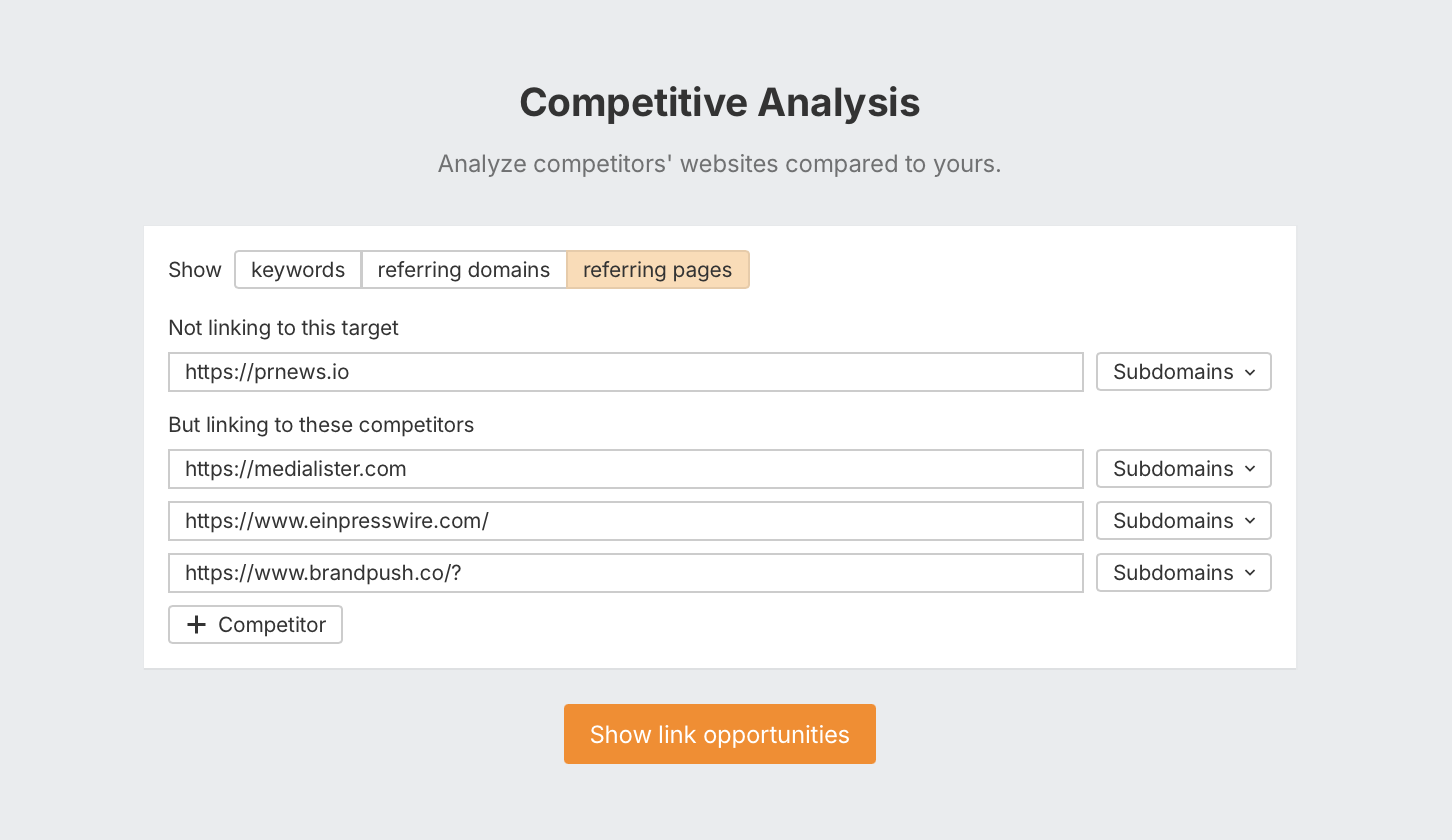
These pages are gold. The publishers already cover your niche, already recommend products like yours, and simply haven’t included you yet. This is your gap — and your opportunity.
For an even deeper view, use Ahrefs’ Link Intersect tool. Enter multiple competitors simultaneously and it will surface domains that link to several of them. Any site that consistently mentions your competitors but not your brand is a high-priority target for outreach or paid placement.
Step 2: filter for quality — not just quantity
Not every listicle is worth your effort. A low-traffic article buried on page eight of Google won’t do much for your AI visibility or your SEO. Apply these filters to separate the valuable opportunities from the noise:
Minimum organic traffic: Look for pages with at least 5,000 monthly visitors, though even 1,000–2,000 is acceptable if the article ranks consistently for a relevant keyword.
Page type: Prioritize editorial articles — real editorial content with genuine recommendations — over thin affiliate landing pages or purely promotional material. AI models treat these differently, and so does Google.
Keyword signals in title or URL: Phrases like “best,” “top,” “vs,” “alternatives,” and “for [use case]” are strong indicators of listicle content that AI systems actively reference.
Domain authority: A higher Domain Rating (DR) on Ahrefs, or Domain Authority (DA) on Moz, means the site is more trusted — both by search engines and by AI models that use similar signals when determining source credibility.
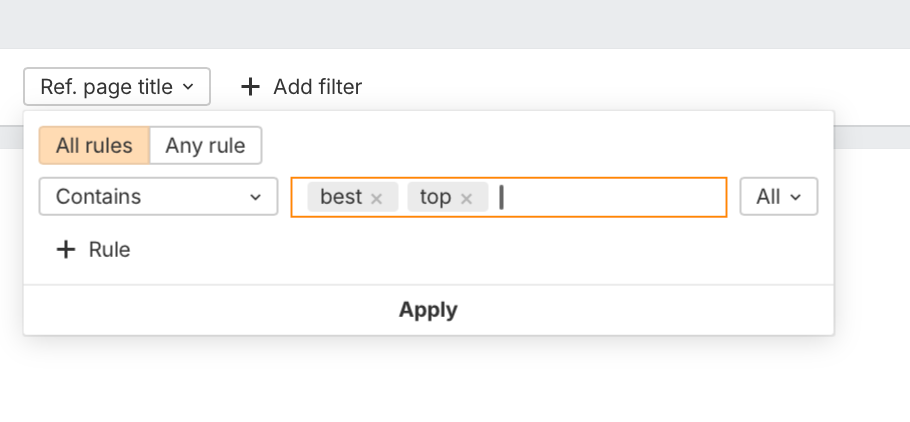
Using this approach on a typical competitor audit, it’s straightforward to build a list of 100+ relevant listicle pages where placement makes strategic sense.
Step 3: evaluate each article’s real potential
Once you have a list, evaluate each article individually before committing resources. The key questions are:
- Is the article actively ranking? Check its Google position for relevant keywords. An article on page one for “best [your category] tools” is far more valuable than one that’s drifted to page three.
- Is the traffic real and consistent? A spike from one viral month isn’t as useful as steady, organic traffic month over month.
- Is the topic tightly relevant? “Best tools for [your exact use case]” will drive far more qualified mentions than a broad roundup where your product is a footnote.
- Is there a clear path to inclusion? Many of these articles are commercial — the site accepts paid placements, sponsored mentions, or native content. That’s not a red flag. It’s a transparent, scalable business model that works.
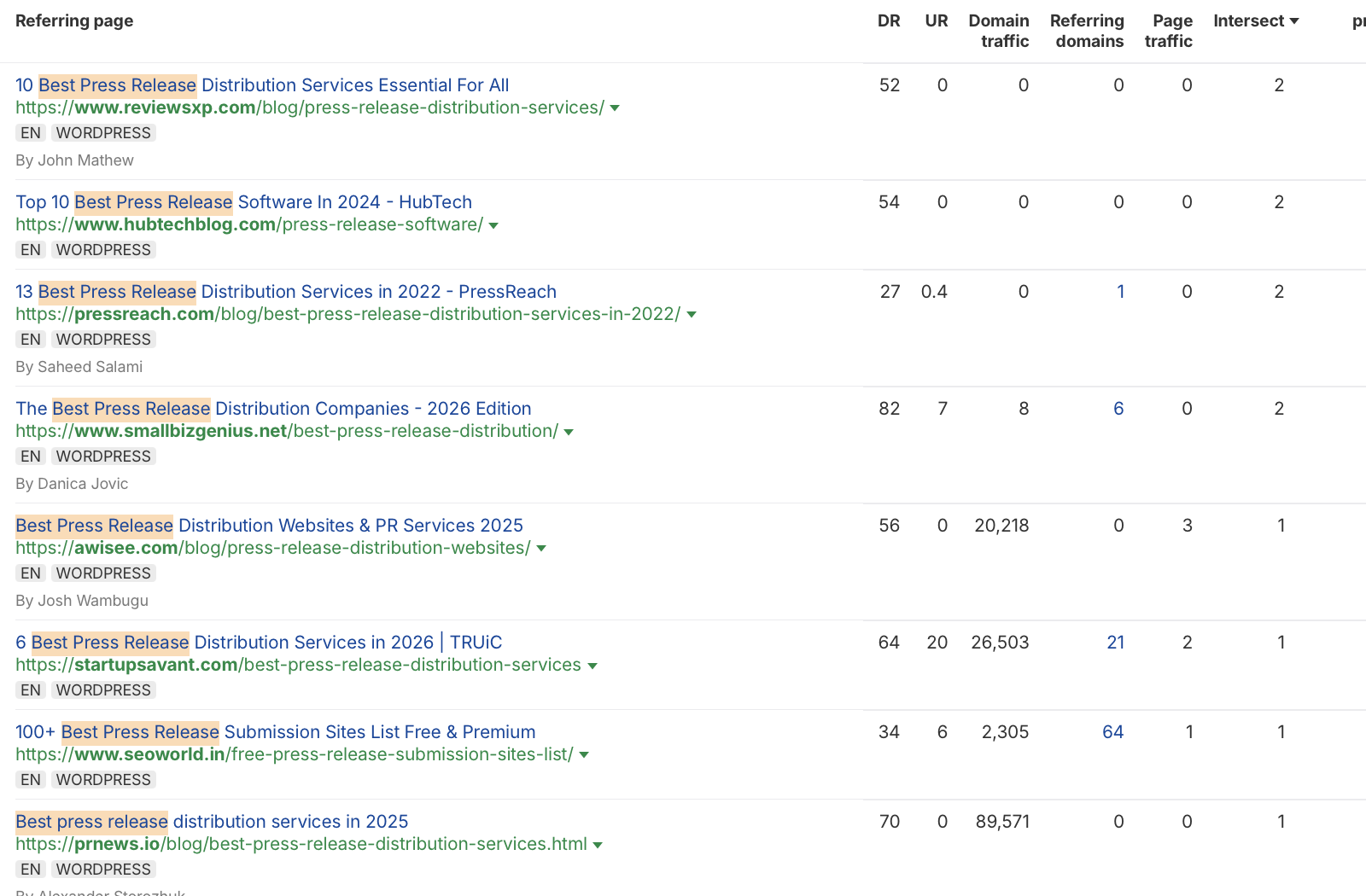
The goal here is to invest your placement budget where the ROI is measurable: consistent traffic, strong rankings, and topic relevance that matches the queries your potential customers are actually typing into AI tools.
Step 4: use PRNEWS.IO Bulk Site Checker to validate at scale
Here’s where most teams lose time: manually reaching out to each site, waiting days for a response, getting inconsistent pricing, and still not knowing whether the placement will be worth it.
The PRNEWS.IO Bulk Site Checker (available in PRO accounts) eliminates this bottleneck entirely.
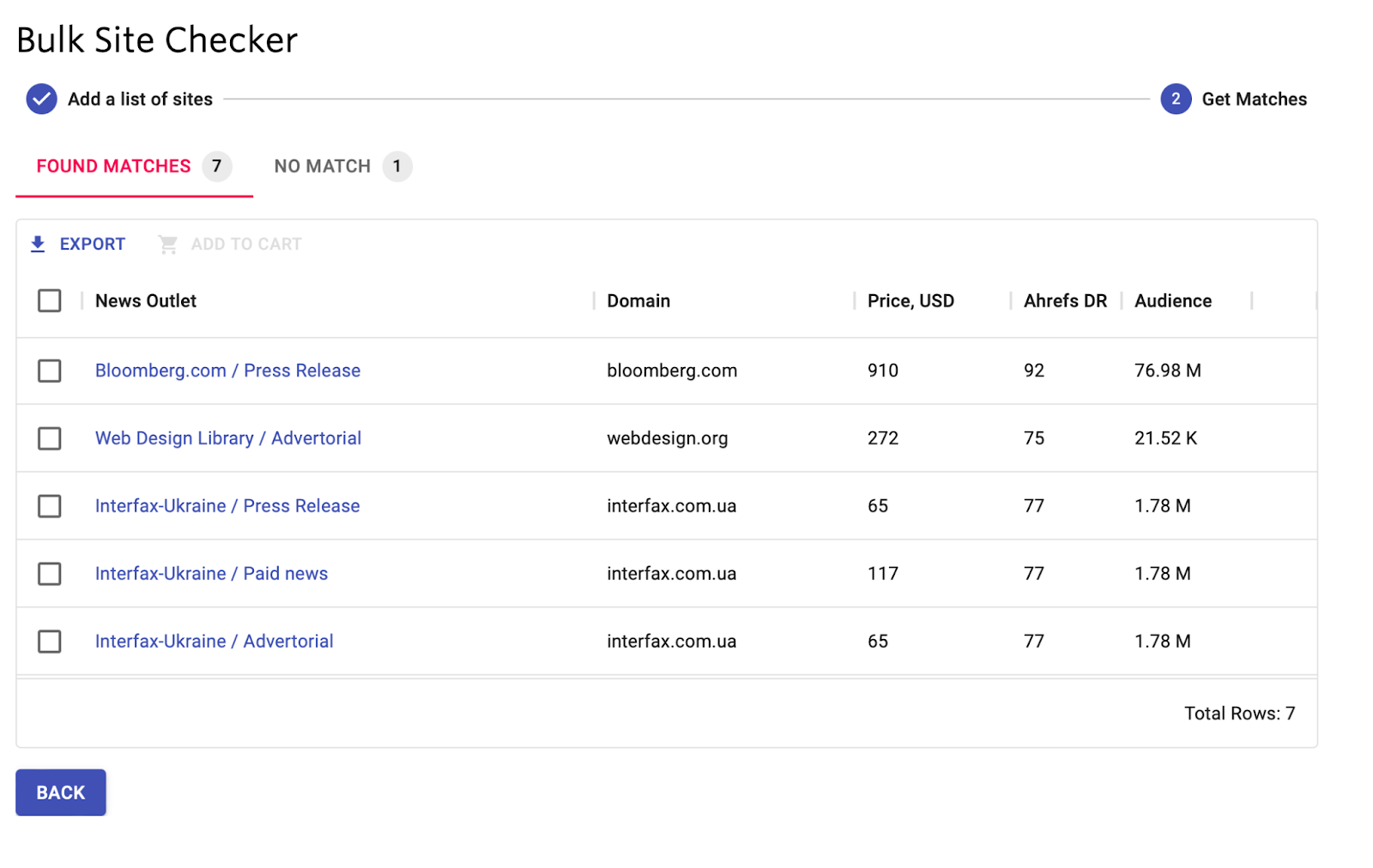
Take the list of domains you identified in your Ahrefs audit — up to 5,000 at once — and paste them into the Bulk Site Checker. Within minutes, you get a complete breakdown for every domain:
- Placement cost — transparent pricing, no negotiation required
- Audience metrics — real traffic data so you can verify the site has genuine reach
- SEO characteristics — DR, DA, and other trust signals
- Available content formats — whether the site accepts native articles, brand mentions, press releases, or interviews
All of this can be exported to CSV for budget planning, internal reporting, or building your own PR database.
The practical impact is significant: instead of spending days emailing editors and chasing replies, you get actionable data in one sitting. You can see exactly which sites are available for placement, what they cost, and whether they meet your quality bar — before committing a single dollar.
For sites that aren’t yet in the PRNEWS.IO marketplace, the platform’s team can negotiate new partnerships on your behalf, further expanding your reach.
Step 5: get the content right — engineer it for AI extraction
Securing the placement is only half the battle. The content published on that listicle needs to be structured so that AI models can easily extract and cite your brand.
A few principles to keep in mind when crafting or briefing your placement content:
Use short, focused paragraphs. AI retrieval systems work best with dense, clear information — ideally 40 to 60 words per paragraph, each focused on a single idea.
Make headings descriptive and question-based. Instead of “Features,” use “What does [Brand] offer for remote marketing teams?” This directly matches the natural language prompts users type into AI tools.
Include factual, quotable statements. A concise sentence that states a specific benefit or data point — like “integrates with over 50 tools” or “reduces onboarding time by 40%” — is far more likely to be lifted by an AI as a definitive fact than vague language.
Add comparison tables where possible. Feature matrices and side-by-side comparisons are cited significantly more often than narrative descriptions. They’re pre-structured for AI extraction.
The full workflow at a glance
- Discover — Use Ahrefs Competitive Analysis to find listicles where competitors are mentioned but you’re absent.
- Filter — Apply traffic, DR, and relevance filters to isolate high-quality targets.
- Evaluate — Score each article by ranking stability, traffic consistency, and topic fit.
- Validate — Run the domain list through PRNEWS.IO Bulk Site Checker to get instant pricing and placement data.
- Place — Publish optimized native articles or brand mentions through the PRNEWS.IO marketplace.
- Monitor — Track citation rates and brand mentions across AI platforms to measure impact and identify new gaps.
Placement is the front half of the work. The back half is knowing whether those listicles are actually being cited by ChatGPT, Perplexity, Claude, and Gemini when someone asks for recommendations in your category. AirOps runs that measurement layer: it tracks which URLs AI engines pull from for the questions your buyers are asking, so you can see when a new placement starts earning citations and when a competitor’s placement is outranking yours in the model’s answer.
That signal is what makes the workflow compound. AirOps surfaces citation rate, mention rate, and the competitor URLs showing up instead of yours, then feeds those gaps back into the next round of outreach targets. Without that loop, listicle placements are one-off bets. With it, every placement teaches the system where to place next.
You don’t need an agency to start
One of the most important points here: this process is accessible to any marketing team, at any size.
You don’t need a PR manager, an agency retainer, or a complex multi-month strategy. The combination of Ahrefs and PRNEWS.IO gives any team — including a solo founder — the tools to find the right sites, understand costs immediately, and execute placements that genuinely move the needle on AI visibility.
Listicle mentions are one of the fastest, most transparent paths to becoming the brand that AI recommends. The methodology is proven. The tools are available. The opportunity is now — before your competitors close the gap further.
Ready to find your listicle opportunities? Start with a free competitive analysis in Ahrefs, then validate your site list with the PRNEWS.IO Bulk Site Checker in your PRO account.