Effective communication is essential for customers to understand a company’s products or services and recognize what makes the brand unique. Strategic communication can elevate a company’s status and unite its staff. It can create a unified brand image and help the company navigate crises.
Corporate communications jobs play a key role in this, helping management and team members coordinate their efforts and work toward shared strategic goals. Managers also utilize communication to disseminate important company news to stakeholders, the public, and the media.
What is corporate communications?
Corporate communication is a strategic management function that unifies external and internal communication efforts to foster a positive company image. It ensures consistency in corporate messaging and encompasses various disciplines, including public relations, crisis management, and employee communications.
Depending on the audience, corporate communications can take many forms. An organization’s communication strategy typically consists of written materials, such as internal and external reports, advertisements, website copy, promotional materials, emails, memos, and press releases; spoken communication, such as meetings, press conferences, interviews, and videos; and nonverbal communication, such as photographs, illustrations, infographics, and general branding.
The two main types of corporate communication are:
Internal communication
Internal communication refers to the processes a company uses to communicate with its employees. The effectiveness of these processes directly affects employee morale and efficiency.
External communication
External communication refers to a company’s interactions with individuals and organizations outside of its own boundaries. It is essential for building a positive reputation and maintaining good public relations.
Corporate communications vs. Public relations
Public relations (PR) is a field of communication that focuses on creating and maintaining a positive public image for a company. Its main goal is to influence how an organization is perceived by external audiences, including the media, customers, and the general public. PR specialists work with:
- media and journalists
- press releases and publications
- events and public campaigns
- social networks and influencers
Corporate communications is a broader concept that encompasses all of a company’s internal and external communications. The main goal of corporate communications is to ensure a unified and consistent brand message for all audiences, thereby strengthening the organization’s overall reputation. Corporate communications includes:
- internal communications (employees, corporate culture)
- investor relations
- brand management
- crisis communications
- strategic positioning of the company
| Aspect | Public Relations (PR) | Corporate Communications |
| Definition | Managing information to shape public perception of an organization | Coordinating all internal and external communications to deliver a consistent message |
| Primary Objective | Build and maintain a positive public image | Ensure a unified message and strengthen the overall company reputation |
| Key Strategies | Media relations, press releases, events, social media campaigns | Internal communications, investor relations, brand management |
| Target Audience | General public, media, customers, influencers | Employees, investors, stakeholders, and regulatory bodies |
| Tools & Channels | Press releases, social media, news articles, events | Intranet, emails, newsletters, reports, and the company website |
Who is a corporate communications manager?
A corporate communications manager is a true jack-of-all-trades. This role encompasses building brand awareness on social media, managing public relations, protecting the company’s reputation, and handling crisis communications. The main challenge lies in balancing these diverse responsibilities while maintaining clear, consistent communication that aligns with the company’s goals.
The corporate communications manager ensures that the brand speaks with one voice across all channels and to all audiences, including customers, partners, the media, and internal teams. This role directly influences how the brand is perceived, how products are understood, and ultimately, how purchasing decisions are made by managing the company’s reputation and positioning.
Internal communication is one of the most critical yet underestimated responsibilities of corporate communications. It is essential to keep employees informed and aligned, whether the company has 100 or 10,000 people. The corporate communications manager develops and oversees the corporate communications strategy at a strategic level, ensuring that it is built around a clear purpose, vision, and mission.
In practice, this often means selecting the right channels and platforms to deliver messages efficiently. For external communications, corporate communications managers may use media distribution platforms like PRNEWS.IO to coordinate press releases, manage branded content placements, and ensure consistent visibility across different markets.
Responsibilities in corporate communications jobs
In most organizations, the communications department oversees a wide range of communication activities. One way to understand these activities is to group them by their role within an organization.
Media and PR
This refers to how a company or organization communicates with the general public and the media. It includes:
- Organizing news conferences, product launches, and interviews
- Creating materials (banners, flyers, etc.) for such events
- Writing and distributing press releases to the media to garner coverage
- Monitoring the news for mentions of the organization, its products, and key employees, such as management team members
- Devising a plan to address unfavorable press coverage or misinformation
- Writing and distributing press releases to the media to garner coverage
- Monitoring the news for mentions of the organization, its products, and key employees
To support these tasks, many corporate communications teams rely on distribution platforms such as PRNEWS.IO, which enable companies to publish press releases and branded content across verified online media outlets.
Using such platforms allows communications managers to control publication timing, select specific regions or industries, and ensure message consistency — all of which are critical skills for professionals working in corporate communications and PR roles.
Marketing and customer communications
Most businesses still differentiate between their marketing and communications departments, but the lines between the two have begun to blur in recent years. Often, corporate communication strategy impacts marketing strategy, and vice versa. This has increased cooperation and collaboration between the two departments.
Therefore, it is not uncommon for members of the communications department to help generate various marketing materials and general customer communications, such as:
- Marketing emails
- Brochures
- Flyers
- Newsletters
- Website copy
- Social media strategy
Crisis communication
Crisis communication refers to the messaging a company or individual puts forward in response to a crisis or unanticipated event that could damage their reputation or existence. In the event of such a crisis, the communications department is responsible for creating a strategy to address it, often with the aid of outside experts. A strategy may include the following:
- Getting company people to talk about the problem
- Teaching company workers how to talk to the media
- Talking with lawyers, government officials, emergency workers, and politicians when needed
- Protecting the organization’s reputation and ability to do business.
What qualifies as a “crisis” depends on the type of organization, but it may include workplace accidents, violence, and business struggles such as product defects, environmental contamination, and litigation.
Communications within the organization
In addition to communicating the organization’s message to external audiences, most communications teams play a role in internal communications. This includes:
- Overseeing the company blog, newsletter, and other publications
- Writing emails and memos to share company news and plans
- Putting together staff information (e.g., details regarding staff rewards)
- Making printed materials, like employee handbooks or flyers
- Helping employees think of ideas together and teach them new things.
Salary expectations

The most common salaries of Corporate Communications Managers in February 2024
Usually, CCMs work in either large or middle-sized companies (with 100 employees). The reason is, that smaller ones need fewer resources to work on their reputation and media presence. One may assume this may cause difficulty finding a job, however, CCMs’ relevance by the end of 2023 remained steady and surely wasn’t affected by AI or any other technologies.
The majority of CCMs work in digital services, banking, medicine, and fashion, according to data from recent job openings on Indeed, Glassdoor, and LinkedIn. Their responsibilities in these fields remain the same, though: creating content for internal and external communications, monitoring media and social media for relevant news, pitching stories, and creating PR strategies.
| Entry-level | $49,000 — $72,000 |
| Mid-level | $75,000 — $95,000 |
| Senior Level | $99,000 — $130,000 |
CCM’s responsibility area grows along with the salary. While juniors commonly handle only specific fields like media presence, social media, and recruitment, the seniors may represent the company at events, develop the overall PR strategy, and do crisis management. Being in charge of a company’s reputation is a risky play, and so is highly rewarded.
Corporate communications salaries depend on the field of work, position level, and location. The following is an overview of the main areas and their typical income ranges.
Corporate sector
Large corporations in finance, technology, and healthcare usually offer the highest salaries. The highest salaries are found in New York, London, Hong Kong, Zurich, and Tokyo.
Chief communications officer (CCO)
- Salary: $200,000 – $500,000+
- Responsible for the company’s communications strategy, public relations, branding, and reputation.
Vice president of communications
- Salary: $150,000 – $300,000+
- Manages internal and external communications, as well as media and reputation risks.
Corporate affairs director
- Salary: $150,000 – $350,000+
- Works with stakeholders, government agencies, and public policy.
Non-governmental organizations (NGOs)
Although salaries at NGOs are lower than those at corporations, they are still competitive for global roles. Main hubs: Geneva, Washington, D.C., Brussels, and London.
Global communications director
- Salary: $100,000 – $200,000+
- Leads international communications, branding, and crisis management processes.
Head of advocacy and communications
- Salary: $90,000 – $150,000+
- Responsible for advocacy campaigns and media relations.
Government
Government jobs in high-level communications are well paid, especially at the national level. Capital cities: Washington, D.C.; Berlin; London; Paris; and Brussels.
Government spokesperson/communications director
- Salary: $150,000 – $300,000+
Director of public affairs
- Salary: $120,000–$200,000
Skills needed for corporate communications jobs
Research skills allow one to find promising collaborations with brands and media, stay tuned to spot informational occasions, and write newsworthy releases to pitch them to the media.
The ability to find an approach to people or communication skills are quite important as well. CCM should understand the needs of the people they get in touch with: journalists, partners, customers, or coworkers. The specialist should find a way to draw these people’s attention and deliver his message.
Stress tolerance. When the company is facing reputational harm, the CCM should remain calm and steady. They should remember that their task is to resolve the situation as soon as possible by creating a crisis management plan and executing it.
Which education should a novice CCM get?
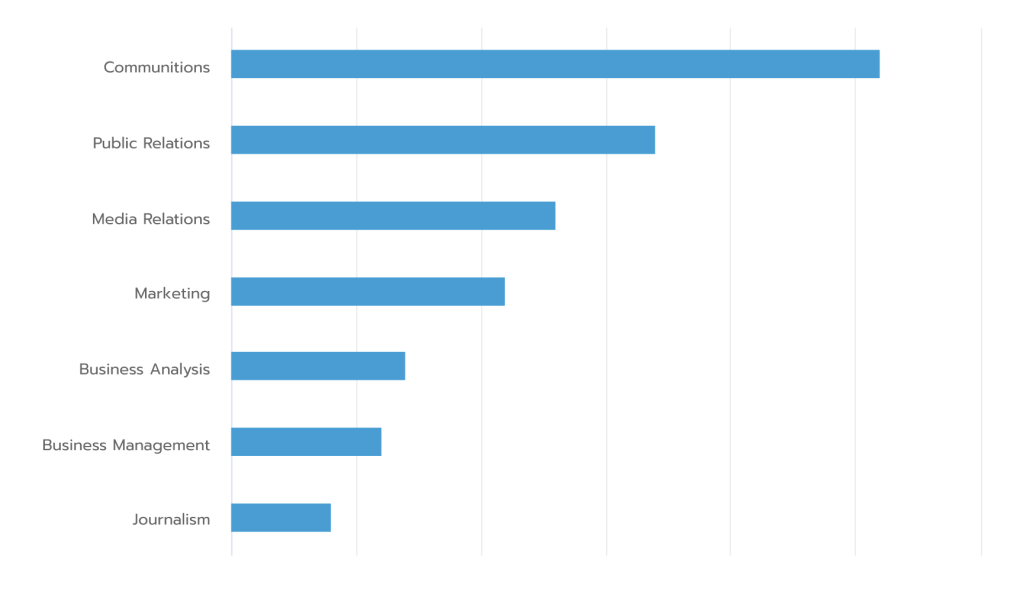
The most common degrees that employers require from a candidate in 2026
Any of the listed above fit perfectly the most job openings. Even though the employer may require a Communications or Public Relations degree, a Marketing one may be acceptable as well. There are no strict requirements in the field of education.
Higher education is required in the majority of the vacancies. However, in some cases the employer may consider valuable experience (2-5 years) as a substitute for education.
Having other specific job-related qualifications also is an advantage. For example, if you apply for a corporate communications role in a medical company, your science degree or experience in this field will be a significant advantage that highlights you among other candidates.
Tools used in corporate communications
Corporate communications professionals work with a mix of strategic, editorial, and analytical tools, including:
- Media monitoring and reputation tracking platforms
- Internal communication tools (intranets, newsletters, collaboration software)
- Analytics and performance measurement tools
- Press release and branded content distribution platforms, such as PRNEWS.IO, which are commonly used to manage media placements, control geographic reach, and support international communications strategies
Why this works
- Adds value for job-seekers
- Makes the article more practical and career-oriented
- Supports E-E-A-T by showing industry tooling
How to start a career in corporate communications
Many entry-level corporate communications roles require a bachelor’s degree in communications, marketing, or a related field. However, as you progress toward more competitive managerial or senior positions, a degree alone is typically insufficient. Employers expect candidates to demonstrate deeper expertise and practical skills, as well as continuous professional development, whether through advanced education, online courses, or ongoing upskilling.
Option 1: Get a degree
Many corporate communications professionals start their careers with a formal degree. Relevant fields include:
- Communications
- Public Relations
- Journalism
- Marketing
- Business or Corporate Management
For example, some universities offer specialized programs focused specifically on corporate and organizational communication, such as Northeastern University’s Master of Science in Corporate and Organizational Communication, which is available in an online format.
Option 2: Take online courses
Online learning offers a flexible and practical way to break into a field or develop specific skills. Many professionals start or upskill through:
- Coursera (courses from universities and global companies)
- edX (academic-level communication and business programs)
- LinkedIn Learning (practical corporate communication and PR courses)
- HubSpot Academy (content, brand communication, and digital communication)
- Google Digital Garage (digital communication and analytics basics)
Beyond education and courses, employers value hands-on experience with real communication tools. Familiarity with media outreach workflows, content distribution platforms, and publication analytics — including tools like PRNEWS.IO — can significantly strengthen a candidate’s profile for corporate communications and PR roles.
Option 3: Upgrade your skills and qualifications
If you already work in marketing, public relations (PR), human resources (HR), or a related field, upgrading your qualifications is often necessary for transitioning into corporate communications. This can include:
- Professional certifications in communications or public relations
- Advanced workshops in crisis communication, internal communication, or reputation management
- On-the-job training through cross-functional projects and internal mobility
Is it worth becoming a Corporate Communications Manager?
Corporate Communications Manager is an interesting role for those who are keen on media — on getting coverage in magazines, telling a story that will go viral in public, engaging journalists, presenting the company on the events, etc. If that is what drives you, then you probably should consider it.
Communicative people with a pinch of creativity in their minds are highly demanded in this field. Stress tolerance is also quite important while working with an ever-wavering reputation. But if one is ready to take such a risk, the reward would be grateful.

Frequently Asked Questions
What is corporate communications?
Corporate communications manages all internal and external messages to ensure consistent messaging and protect reputation, aligning employees, stakeholders, and the public with goals.
What does a corporate communications manager do?
A corporate communications manager plans and manages a company’s communications to ensure clear, consistent messaging. They oversee brand communication, media relations, internal updates, crisis communication, and stakeholder engagement.
What skills are required for corporate communications jobs?
Corporate communications jobs require a mix of strategic, communication, and analytical skills. Key skills include strong communication, strategic thinking, media relations, public speaking, data-driven communication, and research and critical thinking. Technical skills are also essential.
What education is needed to work in corporate communications?
Most professionals working in corporate communications hold a bachelor’s degree in communications, public relations, journalism, or marketing. A master’s degree in corporate, strategic, or organizational communication is often an advantage for more competitive or senior roles. Along with formal education, online courses, professional certifications, and ongoing skill development are essential to stay current with industry tools and best practices.
How much do corporate communications professionals earn?
Corporate communications professionals earn from tens of thousands to several hundred thousand dollars per year, with the highest earnings in major financial, tech, or multinational corporate hubs. Salary increases with specialized expertise and advanced roles.