Consumers don’t just buy products — they audit companies. Brands that survive this scrutiny will do so not through clever messaging, but through radical, verifiable honesty. Here’s what transparency demands, what it delivers, and how platforms like PRNEWS.IO make it operational.
From corporate spin to crystal-clear operations
The global marketplace of 2026 is defined by a fundamental and irreversible shift in how consumers assign value to brands. Transparency is no longer a crisis-response checkbox or a marketing buzzword — it has become the central pillar of brand integrity and the primary differentiator in an increasingly commoditized world. Driven by a consumer base with unprecedented access to information, every element of a business — from supply chain ethics to labor practices to ingredient sourcing — is now subject to granular public scrutiny.
The implications are profound. Transparency, as understood today, means complete openness about values, operations, and product information — not just the flattering parts, but a vulnerability-first approach where mistakes are acknowledged and corrective actions are communicated proactively. Brands that attempt to hide uncomfortable truths are not just taking an ethical risk; they are taking a commercial one.
The 2026 Edelman Trust Barometer tells a striking story: institutional failures over the past quarter-century have created a pervasive “grievance mindset,” with 61% of the global population believing that government and business systems serve narrow interests rather than the common good. Into this trust void, brands have stepped — often outperforming governments, media, and NGOs in public confidence. That is a remarkable opportunity, but it comes with equally remarkable responsibility.
Trust is not a static asset that can be bought. It is a relational exchange that must be earned through consistent, honest action — day after day, campaign after campaign.
The shift is also demographic and psychological. We have moved from a “we-centric” era — where brands were expected to champion broad societal causes — to a “me-centric” era in which consumers seek safety, personal stability, and honesty that directly affects their lives. This isn’t a retreat from values; it’s a demand that those values be real.
The generational and psychological drivers
The loudest voice in the transparency revolution belongs to Generation Z — a demographic influencing approximately $600 billion in global spending and, by 2026, ranging in age from 13 to 30. For Gen Z, authenticity is non-negotiable. They are expert detectors of “performative activism,” and they do not forgive it. Brands that change their logo for Pride Month but fail to demonstrate year-round commitment to diversity, equity, and inclusion are not just ignored — they are actively called out and abandoned.
The attitude of Millennials and GenZ to brands is different from that of previous generations, claims Norty Cohen, Moosylvania Agency founder:
“Millennials are not consumers and especially not targets in a military-style marketing blitz – they’re friends. We trust friends who listen to us, are open and honest, remember our name, are consistent, and stay true to themselves.”
Research by JWT Intelligence found that 73% of Gen Z consumers pay close attention to brand identity, and 94% expect companies to take a clear stand on important social issues, including climate justice and mental health. Hypocrisy — a brand preaching empowerment while exploiting workers in its supply chain — results in immediate desertion. Vague sustainability claims are rejected in favor of verified impact reports and traceable sourcing. Statistics show that 86% of mothers from 18 to 34 are ready to pay more for products of more open brands.
| Consumer Segment | Key Trust Signal | Behavioral Response |
|---|---|---|
| Generation Z | Authentic social & environmental commitment | 25% have ended brand relationships over unsustainable practices |
| Millennials | Reputation and ethical sourcing | 75% willing to pay more for brand reputation |
| Mothers (18–34) | Quality and safety openness | 86% willing to pay premium for transparent brands |
| General Population | Clear pricing and cancellation policies | 84% will switch brands on values misalignment |
Geography adds another dimension. The Edelman data shows that trust in domestically headquartered brands outpaces trust in foreign counterparts by an average of 15 points globally — and up to 30 points in markets like Germany and Canada. In an era of geopolitical tension and global institutional skepticism, local relevance and community investment are powerful transparency signals.
The study of the behavior of Yahoo, DigitasLBi, Razorfish, and Tumblr users contains the following recommendations:
- Set the mood. Create emotions and share impressions.
- Help your audience to escape humdrum by inspiring them to live life to the fullest.
- Be creative: use absurd collages, bright installations; make use of memes and modern concepts.
- Don’t discard pop-culture: make references to celebrities and arouse notes of nostalgia.
- Be useful: create “how-to” posts, lifehacks and other educating info.
- Re-discover old topics and help your audience to look at them from a different perspective.
The Zero-Cost Mindset
A critical behavioral shift reshaping all of this is what analysts call the “zero-cost mindset.” The friction required for a customer to switch brands has essentially disappeared. Historically, complexity and inertia were retention strategies. Today, any consumer encountering an unclear cancellation policy, a confusing pricing structure, or a feeling of being “trapped” will leave instantly — and likely say so publicly.
This environment demands what strategists are calling “upstream” transparency: creating an experience so trustworthy and so genuinely valuable that customers never want to leave. The goal is not to make exit hard; it is to make the relationship so good that exit is unthinkable. Customer experience leaders must move beyond surface-level metrics like Net Promoter Score and invest in deeper data insights that proactively anticipate customer needs — building emotional connections where consumers feel genuinely “known, heard, and valued.”
What transparency actually moves the needle on
Academic and market research is increasingly precise about the mechanics of how transparency translates into commercial outcomes. Studies identify four categories of information transparency — product, price, inventory, and process — which together explain approximately 65.8% of the variance in consumer buying intention.
| Transparency Element | Correlation with Trust | Impact on Purchase Intent |
|---|---|---|
| Product Information | High — verified sourcing, lifecycle, quality | Strongest predictor of purchase intent |
| Price Information | Strongest predictor of trust (57.9% variance) | High — perceived fairness reduces risk |
| Inventory Information | Moderate — signals reliability | Moderate — convenience and availability |
| Process Information | Significant — operational ethics | Lower direct impact, but high brand equity value |
Price transparency emerges as the single strongest predictor of consumer trust. When a brand is upfront about its pricing structure — the factors behind it, the fees involved, the reasoning — perceived risk drops and purchasing confidence rises. Notably, transparency itself does not directly cause a purchase; rather, it creates the trust that mediates and ultimately drives the intent to buy.
For digital brands, which lack the tactile, in-person trust-building opportunities of physical retail, these findings are especially critical. Credibility must be built through transparent and ethical communications that systematically counteract the skepticism generated by data breaches and deceptive advertising. The reward for getting this right is compelling: digital trust leads not only to repeat purchases but to positive word-of-mouth recommendations — which are 11 times more effective than traditional advertising in certain sectors.
How PRNEWS.IO democratizes media transparency
For decades, public relations operated as a black box. Brands paid high agency retainers for unpredictable results, opaque editorial processes, and access to a journalist network that typically favored only the largest and most resource-rich organizations. Success in PR was less about the quality of a story than about who your agency knew. This gatekeeping model is fundamentally at odds with what the 2026 marketplace demands.
PRNEWS.IO disrupted this hierarchy by building the world’s first and largest sponsored content marketplace — a platform that has evolved from its origins as a blogging service (B2Blogger) into a global network covering over 100,000 media outlets across 175 countries.
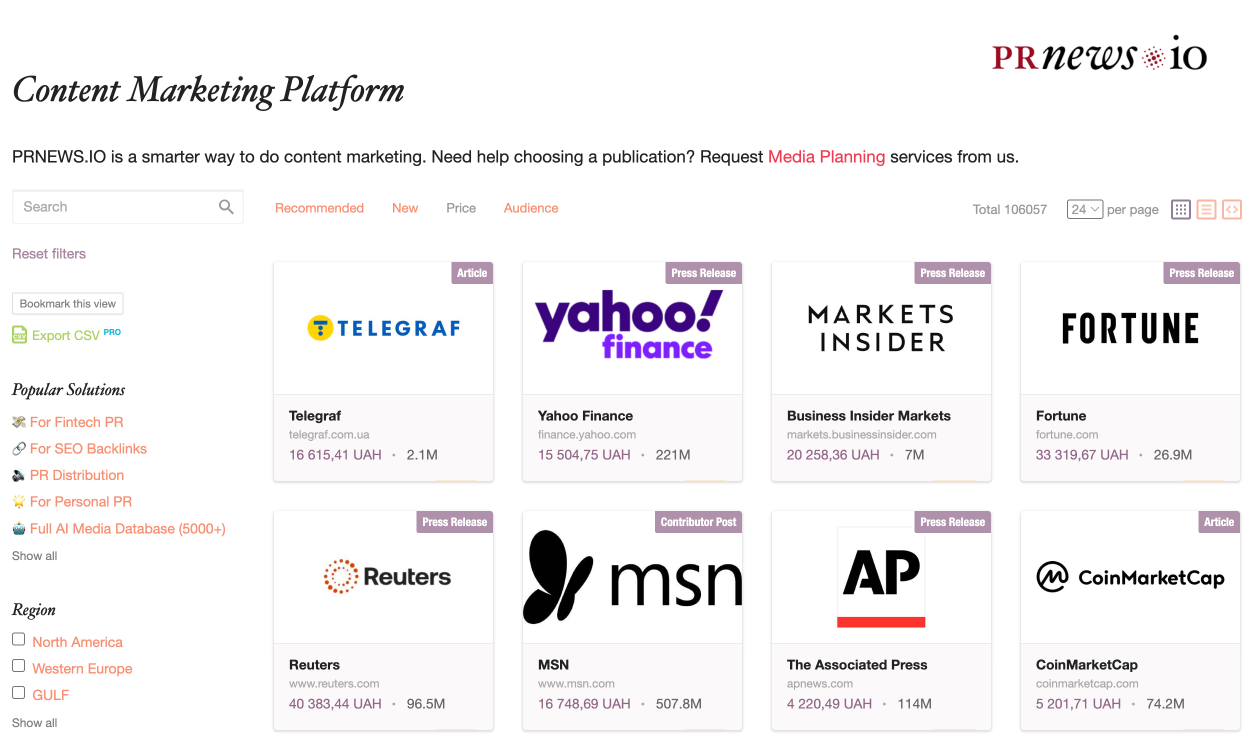
By transitioning PR into a service-as-a-product model, it has democratized access to global media: startups, mid-market companies, and Fortune 500 enterprises alike can now publish their stories with guaranteed placements and full pricing transparency.
- Manual pitching with no publication guarantee
- Opaque retainers and unpredictable billing
- Weeks or months to see results
- Limited to the agency’s personal journalist network
- Self-reported performance data — hard to verify
- Access restricted by budget and relationships
- Guaranteed placements in 48–72 hours
- Fixed, upfront pricing per outlet — no surprises
- Results visible from day one
- 100,000+ outlets in 175 countries
- Third-party verified SEO and traffic metrics
- Available to any brand, any size, any budget
Platform features that enable real transparency
The platform’s most powerful feature is not scale — it is the data it puts in the hands of the buyer before they spend a single dollar. Every listing in the PRNEWS.IO catalog displays detailed, independently verified performance metrics: SimilarWeb traffic statistics (monthly visits, bounce rate, time on site), domain authority scores from Ahrefs, Moz, and SEMrush, geographic audience breakdowns, and technical SEO details including do-follow versus no-follow link ratios.
This transforms PR from intuition-based to evidence-based. Instead of trusting an agency’s assurance that a placement is “high-value,” brands can evaluate outlet performance with the rigor of any other business investment. The fixed-price model — with per-placement costs ranging from $4.94 for niche blogs to several thousand dollars for global premium news sites — eliminates scope creep and allows precise budget planning. A transparent 15–18% service fee covers platform operations with no hidden costs.
Advanced Filters
Niche targeting by industry, geography, language, and audience type ensures cultural fit and maximizes relevance.
Real-Time Analytics Dashboard
All orders tracked in one place, providing measurable ROI from placement to live publication.
Money-Back Guarantee
100% refund on unfulfilled orders, eliminating commercial risk in new markets.
77-Language Distribution
Localized, culturally appropriate content deployment across global markets.
PRO Bulk Site Checker
Rapid competitive analysis and niche-specific media catalog access for high-volume PR operations.
Why media presence now feeds the machines
Perhaps the most consequential shift in how PRNEWS.IO delivers value in 2026 has nothing to do with traditional SEO. The rise of Generative AI platforms — ChatGPT, Claude, Gemini, Perplexity — has fundamentally altered how consumers discover and evaluate brands. When a user asks an AI assistant for “the best payment software” or “top-rated security tools,” the AI’s response is not generated from thin air. It is synthesized from authoritative news sources indexed across the internet.
This means brand presence in high-authority media is no longer just about human readers — it is about becoming part of the source material that AI systems cite as truth. PRNEWS.IO directly addresses this shift by connecting brands with the very outlets that LLMs prioritize. Organizations that secure a broad footprint across 100,000 trusted publications ensure that when the AI world talks about their category, their brand is part of the conversation.
| Discovery Platform | Primary Trust Signal | PRNEWS.IO’s Role |
|---|---|---|
| Google / Bing (SEO) | Keywords and backlink authority | High-quality do-follow links from DR 40+ sites |
| AI Assistants (GEO) | Authoritative news citations | Inclusion in training data and citation pools of major LLMs |
| Social Discovery | Creator endorsements and trending news | Publication on sites indexed and shared by social platforms |
| Knowledge Graphs | Entity mentions and factual data | Positive, accurate mentions that shape Google’s entity understanding |
Marketing Link, a digital agency that adopted PRNEWS.IO in 2018, offers compelling evidence of this dual-channel value. A targeted publishing campaign through the platform produced a 25% increase in Google search impressions and — strikingly — a 254% boost in traffic originating from AI-native tools like ChatGPT and Perplexity. The agency also reported a link attrition rate below 2% across more than 500 placements, compounding value over time in a way that traditional PR simply cannot match.
In the AI era, being cited by an authoritative news outlet is the ultimate form of brand transparency. It is third-party verification at algorithmic scale.
Case studies: what happens when it works
The strategic logic of transparency becomes most tangible in real-world deployments. The following cases from the PRNEWS.IO ecosystem illustrate how genuine openness, combined with the right distribution infrastructure, produces measurable business results.
AdBlock360 — Reclaiming Trust From Malicious Clones
AdBlock360’s organic growth had outpaced its official media presence, leaving a dangerous vacuum. Malicious actors released malware-laden clones of the product, and users searching for the software were frequently downloading harmful impostors. The brand’s credibility — and user security — was at risk.
Using PRNEWS.IO, AdBlock360 bypassed the slow manual outreach process and launched an immediate campaign across high-authority websites, educating users on clone risks and establishing a verified, authoritative media presence.
Bojoko — Building Authority in a Scrutinized Sector
Operating in iGaming — one of the most regulated sectors on the internet — Bojoko’s core mission was explicit: “Empowering Choices, Building Trust.” Their transparent, educational press releases were being ignored by traditional media that simply didn’t pick up manual pitches from comparison portal brands.
Through PRNEWS.IO, Bojoko connected with prominent publications that immediately published their regulatory analysis and responsible gaming messaging, expanding their profile significantly and breaking into new markets including Canada.
Spikeslot — Localization as Global Authenticity
Spikeslot, a global gaming brand, discovered that translation is not the same as localization. Simply converting Italian content into other languages produced content that felt foreign and disconnected to international audiences — the opposite of transparent and authentic.
Partnering with PRNEWS.IO, Spikeslot adapted not just language but tone, cultural references, and framing for audiences across Latin America, Europe, and beyond — all while maintaining a consistent core message around responsible gaming.
What unites these cases is not just the mechanics of media distribution but the underlying commitment to honest communication. In each scenario, the brand had a genuine story to tell and needed infrastructure capable of telling it with the speed, scale, and credibility that the market required.
Transparency under pressure
The value of transparency compounds most dramatically during a crisis. In 2026, 65% of organizations activated their crisis communication plans at least once — a figure that underscores how frequently the “make or break” moment arrives. The near-universal lesson from these events is the same: acknowledge honestly and act swiftly. Attempting to spin or suppress the facts is not just ethically wrong; in a social media-driven world, it is strategically futile. Brand awareness also helps to cope with these issues. Recent cases with Samsung’s exploding Galaxy Note 7S showed that no matter how hard the issue is, people still trust Samsung and buy their smartphones.
PRNEWS.IO plays a specific and valuable role in crisis narrative management. A brand that has consistently published transparent, educational content across trusted publications over time builds what crisis communicators call “reputational armor.” When negative coverage emerges, search engines and AI systems present a balanced view — citing the long-term track record of openness alongside the immediate incident. Equally important, the platform enables rapid distribution of factual updates during a crisis, filling the information vacuum before rumors take hold.
The regulatory stakes
Transparency in 2026 is not only a competitive imperative — it is increasingly a legal one. The FTC and equivalent regulatory bodies globally have intensified scrutiny of sponsored content and native advertising. Updated guidelines are clear: disclosures must be “clear, conspicuous, and unavoidable” within content itself. Vague terms like “collab” or “ambassador” are no longer acceptable; direct language like “sponsored” or “advertisement” is required. Every format — video, audio, written post — demands consistent disclosure.
PRNEWS.IO’s editorial guidelines are specifically designed to keep brands compliant: the platform refuses to distribute misleading content, spam-like advertising, or unsubstantiated medical claims. This isn’t just ethics — it’s protection. Brands that partner with influencers and media outlets through a platform with rigorous standards dramatically reduce their exposure to enforcement actions and the reputational damage that follows regulatory scrutiny.
Transparency is not a tactic. It is the strategy.
The evidence is comprehensive and converging: brand transparency is the most potent competitive advantage available in the 2026 economy. The era of “selling” — of polished narratives and carefully managed impressions — is being replaced by an era of “telling.” Telling the honest story of where products come from, how they are made, what they cost and why, and what the company genuinely stands for.
This is not sentimental. It is structural. As consumers gain more tools to investigate and verify, and as AI systems increasingly synthesize brand reputation from third-party authoritative sources, the gap between what a company claims and what it actually does will become impossible to maintain. Brands that close that gap voluntarily — and communicate it effectively — win. Brands that don’t will be exposed.
PRNEWS.IO sits at the intersection of this strategic imperative and operational reality. By transforming PR from a slow, opaque, relationship-dependent art form into a transparent, data-driven, predictable marketplace, it gives brands of any size the infrastructure to turn their commitment to transparency into a visible, verifiable, and globally distributed fact.
Organizations that view transparency as a core strategic discipline — not just a PR tactic — will be the ones to flourish in a landscape where the consumer is looking for stability and authenticity above all else.
The path forward is clear: be open, be consistent, and use the tools of the digital age to make your brand’s integrity visible to the world. In the generative era, that visibility isn’t just good ethics — it is the foundation of every future sale.
Industry experts about brand transparency
Lydia Boychuk, VP of Marketing at More Labs

One of the best definitions of brand transparency that’s crucial to remember is that it’s simply about building trust between you and your consumers. In today’s world, many are reluctant to take things at face value. This is where you come in, by changing this dynamic.
Don’t shy away from the fact that your brand isn’t perfect but communicate its vulnerabilities to your audience. They will be drawn to your connecting honesty and your brand. Maintain this level of openness with your customers, and your loyalty base will grow exponentially.
Deepanshu Bedi, Marketing Director at Holistapet

Brand transparency is a process of sharing with the public what the company is doing, how it’s doing it, and why it’s doing it. It differs from behind-the-scenes transparency in that it’s not about sharing the process of how the company operates but rather how it works. It’s about transparency and honesty about what is happening to the public.
Brand transparency is the idea that the true essence of a product or service is available to the customer without the need for advertising or marketing. It is accessible to the public through open language and clear, uncluttered visuals. In this way, what is not seen is as important as what is seen. Brand transparency is the idea that any brand’s authenticity should be easily visible to customers and not be hidden or obscured by marketing.
Vaibhav Kakkar, CEO and Founder of DigitalWebSolutions

In today’s hyper-connected world, brands need to be transparent with the public about what they are doing and why. Consumers have more power than ever before and can easily speak up and demand that brands answer their questions. A recent study found that 84 percent of consumers would switch brands or stop shopping with a brand if they felt their values didn’t line up.
There are a few reasons why brand transparency is so important in today’s business landscape:
1. Customers want it: In a world where customers have easy access to information, they expect companies to be transparent about their products and practices.
2. It builds trust: When customers feel they can trust you as a company, they’re more likely to do business with you and recommend you to others.
3. It sets you apart from the competition: customers are more likely to remember and choose companies that are open and honest about their products and practices over those that aren’t.
4. It can help you avoid problems: If there’s a problem with one of your products, being upfront about it can help you resolve the issue quickly and prevent it from damaging your reputation.
Mocca Bajao, Digital PR Specialist at Thrive Digital Marketing Agency

Brand transparency is how a brand shows its authentic self, especially during public interactions. It is an effective way to gain customers’ trust and loyalty. The concept of brand transparency mainly refers to a brand’s proactive efforts, to be honest.
Brand transparency involves communicating with customers and being open to mistakes. Brand transparency improves customer retention, strengthens the organization’s advocacy, and increases sales
Mika Tomada, a PR specialist from Pearl Lemon Group
Brand Transparency in its most basic form is having 100% clear glass on everything about your business in general. This would include your products, retails, principles, or services overall.
Being as transparent as possible ultimately promotes trust. Between different relationships either, staff to staff or staff to clients. It boosts morale and solidifies a dignity that would be seen by your customer base.
Being seen will also open you to every opinion in the market. And you can use this as an opportunity to improve. Take the ones that are reasonable and constructive, and improve around them.
Stephanie Venn-Watson, DVM, MPH

Building a transparent brand means being completely open and honest about all areas of your business. Beyond that, it’s important for companies to be candid about their mission and values by sharing the details on their websites. Not only does this build trust with onlookers, but it also promotes accountability for businesses to stay true to their standards and principles.
My company, for example, has made a commitment to sustainability, and we’re very transparent about that. We opt for reusable packaging and less frequent shipments, and we expect our customers to hold us to that standard.
Another good example of brand transparency can be found with one of my favorite companies — Mrs. Meyers Clean Day. They’ve made a commitment to quality, and their website contains an ingredients glossary that details all of the components in their household cleaning products.
Sophia Jones, Investment Analyst at PiggyBank

I think it’s easy to get caught up in the day-to-day grind of business and forget that people are watching and waiting for you to tell them what you stand for. You might think that no one cares what your company’s mission is, but they do—and it’s important that they know where you’re going and why so they can decide whether or not they want to follow along.
Brand transparency is all about building trust with your customers by being upfront about who you are as a company and what you stand for. Customers want to feel like they know where their money is going when they buy from you; if they don’t feel like it’s going somewhere good, then they won’t buy from you again.
There are many ways companies can build brand transparency into their marketing strategies:
- Publishing an annual report on social media or through email.
- Adding information about the company’s values on product packaging (e.g., “This product was produced using recycled materials”).
- Encouraging employees to share stories about working at your company.
Adam Crookes, Lead Generation Specialist at Unstuck Agency
For me, brand transparency is about building a relationship of trust with customers by sharing all the information they need to make an informed purchase decision. This includes everything from the company’s history and manufacturing process to the ingredients in its products and the way those products are sourced. Customers today are more interested than ever in knowing where their products come from and how they are made. They want to be sure that the brands they buy from are ethical and responsible and they are willing to pay more for products from companies that are transparent about their business practices.
Aima Irfan, Editor in Chief and Marketing Manager, InsideTechWorld

Brand transparency is the perception of consumers regarding a brand’s strategic efforts to make information available – be it positive or negative. The purpose is solely to improve their understanding and hold the brand accountable for its marketing efforts.
The reputation of being honest and open yields substantial benefits for advertisers. Therefore, the idea of brand transparency has received growing attention over the years.
Brand Copywriter and Strategist Chloe Barnes of The Write Chloe

Brand transparency is about building trust with internal and external stakeholders by being open and honest about the way you conduct business.
True transparency is more than a policy or a value—it’s entrenched in company culture. In practice, this can look like anything from disclaimers on enhanced (“Photoshopped”) photos, to publishing a press release about an error (like a data leak) before it appears in the news, to publishing the salary budget in a job ad.
Jon Paul, tutor at Lsattutor.NYC
Brand transparency is a way new theme or definition that came into existence in recent years. The term refers to the complete transparency that a customer has in a brand, where it means the trust of customers who believe in and purchase their goods and services. It’s more like giving respect and taking respect and this will help in giving them a better understanding of such factors as the growth of the company and customer reach in order to provide a well-satisfying service and goods that meet their expectation and needs.
Thomas Newman, Founder and CEO VIVA Financial Tuition

Brand transparency is the idea that consumers can see what goes on behind the scenes of a company or product. They want to know where your products are made, how they’re made, and what ethical decisions were made about those processes. It’s not just about the quality of the product—it’s about how it was made and why it was made that way.
The reason I think this is so important is that consumers want to know that they can trust a brand. When you look at a brand like Panera Bread, you can see exactly where every single piece of its product came from and how it was manufactured. That kind of transparency helps build brand loyalty because the customer knows exactly what they are getting from the company.
Daniel Foley, Founder of Daniel Foley SEO Consultancy

1. Brand Transparency:
These days, “brand transparency” is more than just a phrase; brands really do need to be completely open and honest with their customers about everything they do. In larger organizations with more employees, layers, and complexities, sustaining transparency isn’t always easy despite the seeming simplicity of the concept.
Providing a thorough price sheet upfront and not requiring clients to schedule an appointment with a sales agent to acquire a quote are both examples of how straightforward it can be for a business to be transparent with its customers. Transparency may also be more involved and difficult to implement without the aid of cutting-edge technology.
2. Employee engagement:
By providing open and honest performance evaluation systems that actually support individual and team growth, as well as including employees in decision-making processes, a brand may increase employee engagement. To achieve this goal, it is important to facilitate in-person interactions, as this is the medium through which non-verbal communication can have the greatest influence and through which human ties can be formed with the greatest ease. Employees can gain insight into how other parts of the business function through cross-departmental mentoring.
Adam Wood, Co-Founder of RevenueGeeks

In my opinion, the concept of brand transparency is more than just a marketing cliché; in today’s world, brands are expected to be transparent in all aspects of their operations.
Keeping one’s operations open and honest may appear to be a straightforward concept; nevertheless, this is not always the case, particularly in larger corporations that have a greater number of employees, levels of management, and intricacies involved in their organization.
Cody Candee, Founder and CEO of Bounce

Though there are many definitions of brand transparency in essence it is a business’s effort to put on display its authenticity. With the onslaught of digital advertising and social media, consumers have become weary of slick presentations that present a false narrative, with over 85% stating that transparency in a business is more important to them than it was previously.
By presenting the true stories of its founders, sharing both their successes and missteps, and presenting the real profiles of its team members, a business can showcase its authentic self. In the end, brand transparency is about choosing truth over the image, and building customer trust through an honest reflection of the business.
Geoff Cudd and I’m the Founder of Don’t Do It Yourself

Incorporating transparency into a brand’s strategy can be a powerful differentiator and driving force for business success. Brand transparency encompasses a company’s willingness and ability to openly communicate its values, ethics, business practices, and decision-making processes to both customers and stakeholders. This type of transparency builds trust with consumers and allows them to make informed purchasing decisions aligned with their personal values. Along with increasing consumer trust and loyalty, brand transparency can also improve a company’s reputation, attract top talent, and enhance partnerships with other organizations, primarily because it demonstrates a commitment to integrity and responsibility.
In today’s market, consumers seek brands that align with their values and prioritize ethical practices. The environment-conscious will most likely boycott companies without transparency surrounding their environmental impact. At the same time, those who prioritize diversity and inclusion may opt for brands that are open about their diversity initiatives.
Implementing brand transparency can also lead to improved company performance and decision-making. By openly communicating with stakeholders, a company can tap into valuable feedback and insights to drive innovation and improve overall operations from supply chain management to product development.
Helga Dosa, Head of Marketing for Brand Rated

Brand transparency is the practice of making a company’s brand identity, values, and purpose clear to consumers. This can be done through marketing campaigns, social media interactions, and other customer-facing activities. Brand transparency allows customers to understand what a company stands for and what it is trying to achieve. It also builds trust between a company and its customers, as customers feel they are being given honest information about the products or services they are interested in. Finally, brand transparency can help a company differentiate itself from its competitors, as customers are more likely to choose a company that is open and transparent about its operations.
What are the benefits of brand transparency?
- It builds trust: When customers feel like they understand what a company is trying to achieve and why, they are more likely to trust that company.
- It can help differentiate a company from its competitors: In a world where companies are increasingly selling similar products and services, brand transparency can be a key differentiator.
- It allows customers to make informed decisions: If customers know what a company stands for, they can make better-informed decisions about whether or not to do business with that company.
- It holds the company accountable: If a company is being transparent about its operations, it is held accountable to meeting the standards it has set for itself.
Meyr Aviv, Founder & CEO of iMoving

The term “brand transparency” is used to describe the practice of being open and honest about the sources of your product or service, the work that goes into making it, who makes it, as well as any environmental or social impact associated with it. This type of transparency can help to build trust with consumers, as they are able to see exactly where your products come from and how they are made. It also assures them that you are operating ethically and responsibly.
There are many benefits to being transparent as a brand.
In addition to building trust with consumers, it can also help to differentiate you from your competitors. If consumers know that they can trust you to be open and honest about your products and manufacturing process, they are more likely to choose your brand over one that is less forthcoming. Additionally, being transparent can help to build loyalty among your customer base, as they appreciate knowing that you are a responsible and trustworthy company. They would also be more likely to recommend your brand to others, which can bring in new customers and help to grow your business.
Brand transparency is not always easy, and it can be a challenge to strike the right balance between providing too much information and not enough. Just make sure that you are clear and concise in your communication, and be sure to provide consumers with the information they need to make an informed decision about your product or service. When done correctly, brand transparency can be a powerful tool for building trust, loyalty, and business growth.

Brand Transparency FAQ
What is brand transparency?
Brand transparency is the extent to which a brand is open and honest about its operations, policies, and practices. This includes being transparent about its products and services, as well as its business practices and ethics.
Why is brand transparency important?
Brand transparency is important for several reasons. First, it builds trust with customers. Customers are more likely to do business with a brand they trust, and transparency helps build that trust. Second, transparency can help protect brands from public relations crises. If a brand is open and honest about its operations, it can quickly address any issues that arise and prevent them from becoming major scandals. Third, transparency is important for compliance reasons. Many countries and states have laws requiring businesses to be transparent about their operations, and brands that are not transparent may face penalties.
What are the benefits of brand transparency?
The benefits of brand transparency are many. Transparency can help build trust, protect brands from crises, and comply with legal requirements. In addition, transparency can help brands better understand their customers. By being open and honest about their operations, brands can gain a better understanding of what customers value and what they are looking for in a brand. This can help brands make better decisions about their products and services and improve their marketing strategies.
How can brands be more transparent?
There are several ways brands can be more transparent. One is by being more open and honest about their operations, policies, and practices. This includes being transparent about their products and services, as well as their business practices and ethics. Brands can also be more transparent with their customers. This can include providing more information about their products and services, as well as their operations and policies. Brands can also create transparency reports, which are documents that detail the company’s transparency policies and practices.
FAQ provided by Yusaf Khan, Head of Business Development over at StartupsAnonymous