Advertising has become so ingrained in our lives that many people can easily identify whether a post or video is promotional. We have developed what could be called an “advertisement sense,” allowing us to overlook unwanted ads. However, it’s important to note that advertising is evolving, especially in response to the online landscape. Today, ads are often rich with content, storytelling, and social themes. You might find yourself watching an advertorial with genuine fascination, often without realizing it’s an advertisement. This shift is largely due to advancements in marketing and the effective use of tools designed to capture consumer attention. This article will explore creating engaging advertorials by applying the best practices in this field.
Advertorial definition
An advertorial is a form of advertising that blends editorial content, product promotion, and a broader effort to capture customer attention. According to advertising regulations, advertorials must include a clear indication that they are paid or sponsored content and provide a reference to the advertiser to avoid misleading consumers. Typically, the channel for an advertisement is selected based on its target audience, and there is a wide range of channels to choose from. Thus, you can view and use advertorials in channels such as newspapers, magazines, popular websites, or video advertising on YouTube.

Not everyone manages to follow these rules and not every advertiser can create a high-quality advertorial.
A high-quality advertorial sits on two chairs simultaneously – it does not directly indicate that it is an advertisement, but it does not hide it either. You must pay attention to the quality of the content – an advertorial is the same as a blog post or video, so the presence of your main product is also necessary here.
For example, the cosmetics brand Maybelline New York creates advertorials that showcase different makeup looks for various skin tones and facial features. One example is the Maybelline New York Instant Eraser Concealer TV spot, where stars like Naomi Campbell, Gigi Hadid, and RuPaul, each with different skin tones, try the concealer. This approach allows customers to see how the products look on diverse appearances, making them more likely to consider purchasing from the brand.
The primary surface-level goal of an advertorial is to capture the target audience’s attention and leave a lasting impression so that they recall your brand when making decisions. As in any other form of marketing, advertorials can have additional goals and functions that each brand will determine for itself. In the following paragraphs, we will dive deeper into this topic.

How to write an advertorial?
1. Create what you would like to see
When creating an advertorial, the goal shouldn’t simply be to advertise, but to produce high-quality content that even you would enjoy watching. This means showcasing your brand’s values – letting the customer see that you prioritize quality, build trust, and offer genuine value, not just superficial promises. There is no need to write a direct advertisement for your product or company – instead, the client should see it as a regular blog post with a highlight in the form of a hyperlink or a mention of you.
Blog posts create a friendly atmosphere and give the reader a useful curiosity that is not typical of a daily blog. Before creating an advertorial, your team should consider what information will be useful to the reader and what new things they can find in your advertorial.
Clearly define your goal for the ad. If the aim is to highlight a new product, consider comparing it to competitors, and showcasing its advantages. This way, potential buyers will gain a fuller understanding of your product and can use that information when making their purchase decision.
2. Correspondence between advertorial titles and their content
When creating an advertorial, it’s easy to stray from the core message and focus too much on promoting yourself. To avoid this, consistently refer to your headline and ensure your ad is built around it. Discrepancies between the content and the title can lead to potential buyer dissatisfaction, making it clear that the focus is more on self-promotion than on the value itself.
For instance, when discussing skin types, their properties, and characteristics, it’s easy to veer off track and begin overtly promoting your products or product line. Keep in mind that advertising should be relatively unobtrusive, allowing it to blend into the content rather than demand attention. This approach fosters customer loyalty and embodies the concept of “unobtrusive advertorial marketing.”
Therefore, matching the title to the advertorial content is vital, and it directly affects your reputation in the eyes of potential customers.

3. Focus on the clients
To effectively demonstrate your value and uniqueness to customers, utilizing targeted marketing strategies is essential. When creating an advertoriall, your focus should be entirely on the customer. Ultimately, your product should be seen as a solution to their problems. By solving your customer’s problem with your product, there is an intention to get even more customers shortly.
To solve the customer’s problem, you must know their needs best. Understanding the needs, desires, and clients’ intentions, you open a mysterious Pandora’s box for yourself, that can significantly increase your client base. It is also important to explain exactly how your product will solve their problems and what advantages you have over your competitors. Remember that your main goal is to help the client, not to promote yourself. Imagine that you recommend a product to a friend and use it as the basis for advertising.
4. Motivate to take action
Following the principle of the golden mean, your advertorial should strike a balance by subtly containing the essence of advertising while encouraging the buyer to take action. Creativity plays a key role here, as you need to find the most engaging way to prompt the customer to act. For example, many game ads feature a demo version that allows users to play before downloading the full app. While this type of advertising can be intrusive, it is often highly effective—people try the demo, enjoy the experience, and then download the app.
Interactive elements like tests or quizzes also help speed up the buyer’s decision-making process. For instance, the Ukrainian vitamin and supplement manufacturer Perla Helsa offers a free test for new customers, where they answer questions to discover which vitamins they need. They operate according to the principle of influence marketing, but it can also be attributed to advertorial marketing. Based on the results, the service selects the vitamins, and customers can order them directly.
5. Don’t be self-absorbed
Customers value sincerity and simplicity in their brand, not fluff and self-centeredness. Leave the self-promotion strategy for other marketing strategies, because this cannot be allowed when creating an advertorial. One would rather buy a product from someone who talks about it or offers to try it than from someone who only talks about themselves. This is part of building a strong connection with the customer, and it’s a crucial element that should never be overlooked.
For example, when writing instructions on a particular topic, it’s important to credit yourself as the primary source while also incorporating other research. Referencing influential and well-known brands in your article not only strengthens your credibility but also validates your insights in the customer’s eyes.
6. Deliver quality Content, not fluff
Brands often maintain a consistent tone of voice, which helps streamline their marketing strategies and overall operations. However, to attract new customers, something unexpected needs to happen – something that breaks the mold for the brand. For example, if you typically write articles, try releasing videos. If you usually promote with videos, craft an engaging story. Collaborations with well-known brands can also create buzz and capture public attention. The key is to think outside the box and deliver quality and uniqueness, rather than superficial content.
Best Practices: Advertorial Examples that Work
Having basic theoretical knowledge about advertorial, you can move on to practice and real examples of successful advertorial marketing. Responsiveness in various work examples is our mainstay today.
Example 1: Nike & Vogue – “Sustainable Sneakers for the Future”
Nike is known for its famous collaborations with various brands, influencers, and publishers. Nike makes extensive use of advertorials as part of its marketing strategy. In this advertorial in British Vogue, Nike promoted its line of eco-friendly shoes. They launched the Nike Forward line, which is revolutionary and shows a completely new approach to creating clothes, but does not contradict the brand’s high standards. Nike also does not ignore the needs of athletes and manufactures this line to the standards of Nike Therma-FIT ADV technology for warmth. The article tells the importance of sustainability and eco-innovation in the fashion industry, highlighting how Nike uses recycled materials to create shoes.
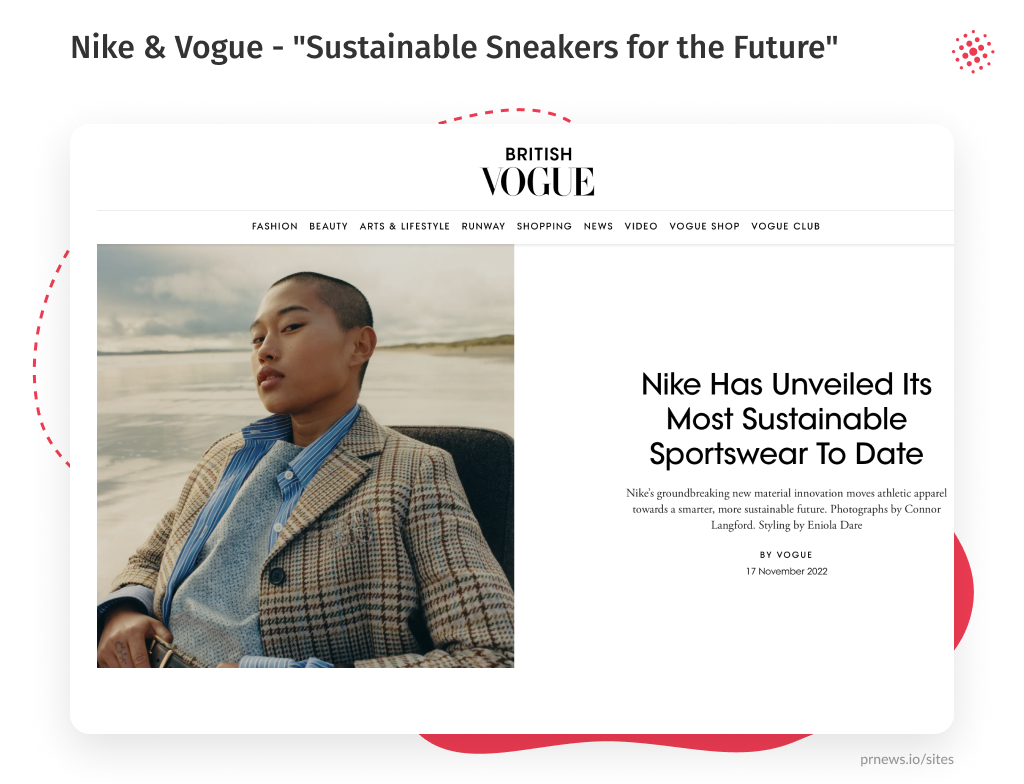
The choice of British Vogue is ideal and fitting for advertising a renowned clothing brand – after all, who better inform us about fashion trends than Vogue? The article strikes a balance, blending helpful advice with the brand’s values. It doesn’t come across as pretentious, but rather as visually appealing and engaging.
Example 2: The New York Times & Netflix – “Women Inmates: Why the Male Model Doesn’t Work”
We’re all familiar with The New York Times and Netflix, two giants in their respective industries. Now these business hubs have joined forces to deliver a new level of quality content. This advertorial is a win-win: Netflix created this ad to promote Orange Is the New Black. As of 2016, Orange Is the New Black was Netflix’s highest-grossing series and its longest-running original series. In turn, the article in The New York Times not only talked about the problems of women in the penitentiary system, but also unobtrusively reminded of the series theme, providing informative content that captivates the audience.
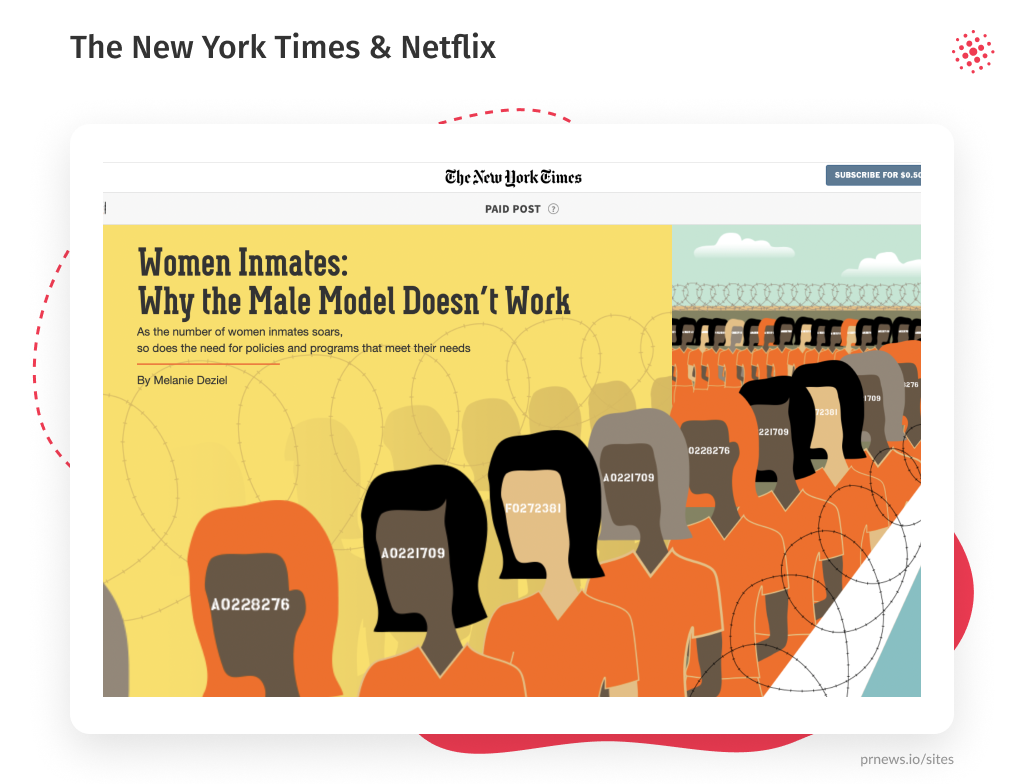
The article’s tone of voice is excellent, bringing the content to life. It allows us to dive deeper into the issue, revealing that 75% or more of female prisoners have experienced physical or sexual abuse in their lifetime. There is also the issue of inappropriate behavior by male prison staff, raising the need for women’s prisons to be staffed primarily, if not entirely, by women. These shocking and disturbing statistics not only draw attention to the series but also spark interest in the broader topic of women’s experiences in prison.
Example 3: Huffington Post & Sleep Number – “5 Yoga Poses To Do Tonight That Will Help You Ace Tomorrow”
The need for sleep is essential for the normal functioning of the human body. Living in a world where sleep has become a luxury rather than a necessity, it is crucial to talk about the importance of sleep. In this advertorial for Sleep Number, the Huffington Post created a story about the importance of good physical rest before falling asleep. Simultaneously declaring correct values, the article unobtrusively promoted beds with adjustable mattress stiffness. They’ve created a helpful promotional post to help people better prepare for sleep by relying on five relaxing yoga practices as part of their bedtime routine. Thus, they promote good habits and remind us about the importance of sleeping on quality mattresses from Sleep Number.
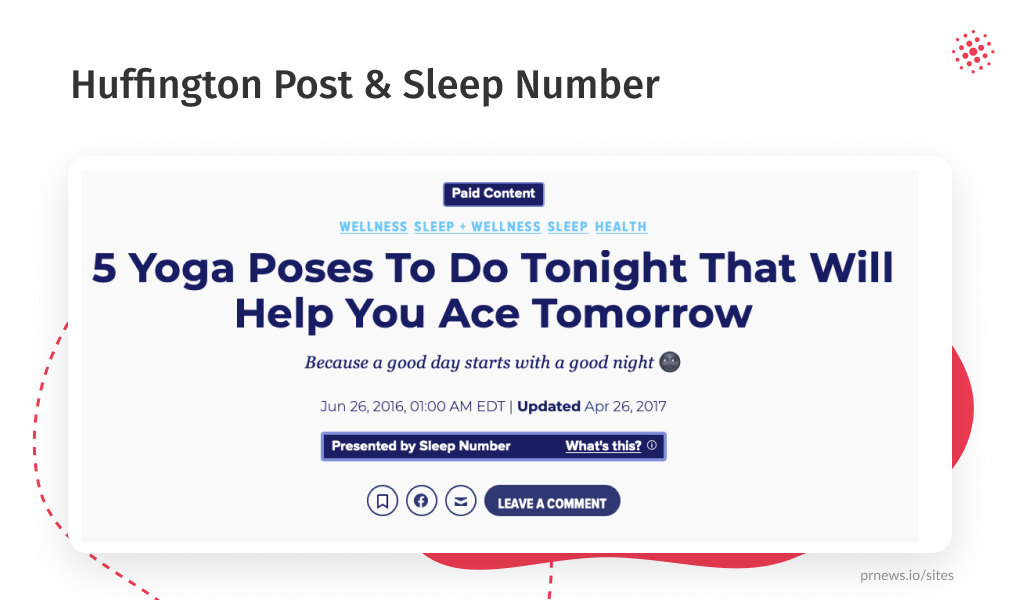
It’s worth noting that the use of animation, rather than traditional images, significantly improves the accuracy of the exercise demonstrations. Additionally, the mention of sponsored content is cleverly positioned at the end of the article, with only subtle indicators placed at the top. This strategy may be perceived positively by potential customers, suggesting a more genuine approach, which enhances the likelihood of the advertisement’s success.
Example 4: The Guardian & Worldwide Cancer Research – “Cancer is a modern disease”
The Guardian’s joint advertorial with Worldwide Cancer Research presents informative content about cancer misconceptions, subtly promoting a deeper understanding of the disease. The article focuses only on what is important – the development of people’s consciousness and a serious approach to cancer treatment. The article dispels all myths and gives factual information that helps readers better understand the disease.

This approach not only increases public engagement with the issue of cancer but also motivates individuals to undergo screenings and tests for cancerous tumors. Highlighting a significant global problem while acknowledging the article’s sponsor can positively influence reader perception, attracting a wider audience. This exemplifies how advertorials can elevate public consciousness and draw attention to critical health issues. Furthermore, the article calls on international organizations to take action, urging them not to wait until a substantial portion of the population succumbs to cancer, but rather to actively seek cures and solutions.
Example 5: The Atlantic & IBM – “How Open-Source AI Drives Responsible Innovation”
The Atlantic, sponsored by IMB, effectively combines informational content with promotional elements about IBM’s open-source AI initiatives. The article highlights the importance of open-source artificial intelligence in fostering innovation and ensuring the responsible use of technology. It provides insight into how open-source frameworks can improve collaboration and transparency in AI development, making it easier for many tech companies. This advertorial’s goal is to identify IBM as a leader in this field, demonstrating IBM’s commitment to responsible AI practices while aligning the brand with positive industry values. The article engages readers in a critical discussion about the role of technology in society and the importance of artificial intelligence in our present while positioning IBM as a leading company that actively contributes to the development of solutions.

It’s also worth noting that the article serves an educational role, introducing readers to the complexity of artificial intelligence and the benefits of open-source models, reinforcing the idea that responsible innovation is vital to the future of technology.
Advertorial vs. editorial vs. sponsored content
Deciding between editorial, advertorial, and sponsored content can feel tricky, especially if you’re new to PR and marketing. Each option can be a powerful tool for brands in the beauty, aesthetics, or wellness industries—if used the right way. As a business owner, it’s key to understand the differences so you know what you’re getting when you invest time and money into these marketing strategies.
| Aspect | Advertorial | Editorial | Sponsored Content |
|---|---|---|---|
| Purpose | Promotional disguised as editorial | Non-commercial; informative/opinionated | Brand awareness through subtle promotion |
| Creator | Brand or sponsored publication staff | Editorial staff | Brand or sponsored publication staff |
| Disclosure | Labeled but often subtly | No label needed | Clearly marked as “Sponsored” |
| Tone | Informative but promotional | Neutral, informative, opinionated | Educational or entertaining, soft-sell |
Editorial Definition
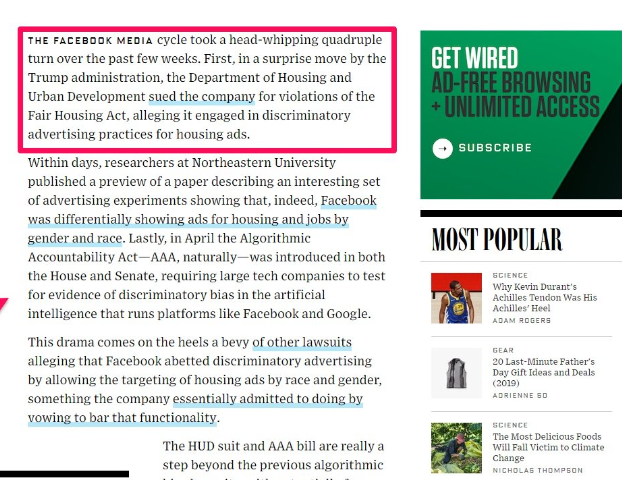
Editorial content is free and crafted purely to inform, educate, or entertain readers, adding real value without any financial backing or sales pitch. Think of it as content that covers topics or shares insights that are valuable to the reader, like a blog post, news article, or feature piece written directly by the publisher or author. For example, a newspaper article on a local event counts as editorial content because it’s produced independently, without outside sponsorship.
Editorials tend to carry more credibility and reliability since they go through the publication’s editorial process. The purpose is genuine reader engagement, not sales or conversions.
While editorial content can lead to sales indirectly, that’s not the primary goal. By providing helpful information, you earn readers’ trust, which over time is more valuable than direct selling.
Key Features of Editorial
- Funding: Editorials are free, with no payments made to the media outlet for publishing. For this reason, the content must truly offer value to be included.
- Visual Presentation: Editorial content blends in with the publication’s regular articles.
- Credibility: Created by the publication’s editorial team, often backed by research and fact-checking, which boosts trustworthiness.
- Author/Byline: The author might be a journalist, editor, or even the publication’s editorial team.
- Creative Control: The editorial team has full control over development and final approval.
- Imagery: Photos are chosen to match the topic and are unbranded, with lifestyle images being a great choice.
- Legal Disclaimers: Editorials stick to the publication’s format, with no need for footnotes, references, or copyright symbols.
Editorial Examples
Credits: carminemastropierro
Advertorials vs. Editorials
| Aspect | Advertorial | Editorial |
|---|---|---|
| Definition | Paid content styled like an article to promote a brand | Informative content by the publication’s staff, non-promotional |
| Purpose | To subtly market a product or service | To inform, analyze, or entertain without bias |
| Disclosure | Marked as “Advertorial” or “Sponsored” | No disclosure, as it’s independent content |
| Tone & Voice | Blends with editorial tone but has a promotional angle | Neutral or opinion-based, no hidden promotion |
| Brand Mentions | Directly mentions or links to the brand | Mentions brands only if relevant, without bias |
| Audience Perception | Recognized as an ad; may impact credibility | Trusted as unbiased content |
Sponsored Content Definition
“Promoted”, “Paid post”, “Presented by”, “Sponsored by”, “Partnered with”, “Affiliated with”…
Remember it? These phrases are indicators of sponsored content. It means that a company has spent some effort and budget to show you its content.
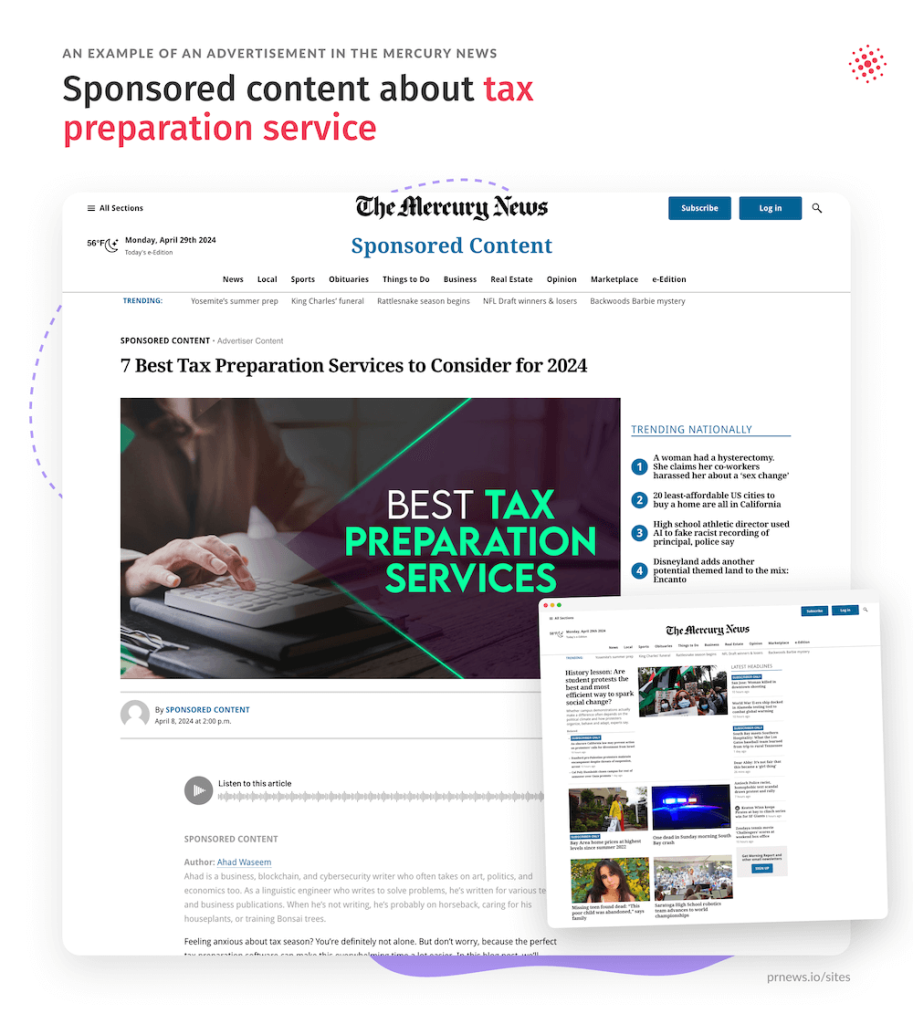
Sponsored content is a form of advertising issued by publishers or social media influencers in a format and quality they are known for whether they be articles, photos, videos, or other executions. Brands co-create this content to generate conversations around their product category or even their product.
That is to say, sponsored content is an ad that looks like it’s supposed to be there. It gives a feeling of natural content for a platform, instead of an intrusive advertisement.
Sponsored content is a simple yet effective way to send your promotional message to new audiences.
When content is sponsored, it must be clearly marked as such to avoid misleading users. Google’s guidelines have, since 2005, required that paid links should not affect PageRank, the algorithm that ranks pages in search results. The reason behind this is to maintain a level playing field, allowing organic and unpaid content to rise on its merit alone.
Google’s Approach to Non-compliance
In recent years, Google has penalized several websites, particularly in the United Kingdom, for failing to disclose paid links adequately. Such penalties include removing the site’s content from Google News or reducing its visibility on search results. Non-compliance with Google’s policies creates distrust among readers and can lead to further scrutiny and potential legal action.
Key Features of Sponsored
- Funding: Payment also is made directly to the media outlet or marketing agency for placement.
- Visual presentation: Doesn´t look like an advertisement; sponsored information is included in the posts and editorial content.
- Credibility: Can go through the journalistic vetting process that editorial content must follow.
- Author/byline: The author of the piece is not identified as the brand or its representative.
- Creative control: Development and final control over content is not retained by the media outlet.
- Imagery: This may include a promotional image, such as a branded photograph or product shot.
- Legal disclaimers: These may include footnotes, references, and legal disclaimers. Can also include copyright and trademark symbols.
Sponsored content can increase reach your audience in a non-intrusive manner. Because it takes after editorial content, people are more likely to engage with it.
This can help you to:
- Raise brand awareness
- Inform your audience
- Gain trust and credibility
- Set up thought leadership
If users get value from your content, they’ll likely continue engaging with your business in the future and may even become customers.
Sponsored Examples
In the sponsored articles usually, you will find names of brands, and addresses of the restaurants, shops, etc. The overall information may be useful and interesting, but definitely, brands, companies, and services will be included there.

Read more: What is Sponsored Content? Everything You Need To Know
Advertorials vs. Sponsored Content
| Aspect | Advertorial | Sponsored Content |
|---|---|---|
| Definition | Ad content made to look like an article | Brand-funded content, designed to engage or inform |
| Purpose | To directly promote a product or brand | To build brand awareness with subtle promotion |
| Disclosure | Labeled as “Advertorial” | Clearly marked as “Sponsored” |
| Tone & Voice | Mimics editorial tone but more direct in promotion | Informative or entertaining, aligns with brand values |
| Brand Mentions | Frequently mentions and links to brand | Minimizes direct mentions; focus is on engagement |
| Audience Perception | Seen as promotional, may affect trust | Viewed as more credible and engaging |
What Are Advertorials and Native Advertising?
Advertorials are paid pieces that resemble editorial content in style and format but are created with an underlying promotional intent. Native advertising follows a similar model but is generally less distinguishable from regular content, often placed within publications to blend in seamlessly with the platform’s tone and style. Both types of content can mislead readers if not clearly marked as advertisements, as they might appear to be impartial or independent.
Guidelines for Advertorials and Native Ads
To comply with search engine guidelines:
- Do Not Pass PageRank: Any paid link within advertorials or native ads should be marked so that it does not affect Google’s PageRank algorithm.
- Conspicuous Disclosure: Disclosure must be prominent and clear. Disclaimers should be easy to spot, avoiding small or hidden text that might obscure the fact that the content is paid.
- Be Transparent with Readers: Readers should always be aware if what they’re reading is a result of a sponsorship or financial incentive.
How Can You Leverage Editorial from Paid Advertising?
There are a few ways you can try to leverage editorial in the publication you have advertised in, aside from simply asking the question in the first instance.
1. Themed articles:
When you start the process of purchasing an advert, ask to see an editorial calendar and look out for themed publications. It may be a summer travel special, an autumn fashion issue, or a Christmas gift guide.
A good advertising sales team will inform clients of this when booking advertising to align advertising content with the editorial theme. For example, if you conduct a Christmas gift fair and want to advertise prior to the event, an issue focusing on Christmas gifts and what to buy would be perfect, provided the timings match up, of course. This will give you the perfect opportunity to show off your product or service at a time when editors may be looking for something just like it.
2. Advertorials:
This is also where advertorials can form an effective item of your marketing plan. As we’ve seen, advertorials can be very useful to inform readers about a product launch, but they can also be used to secure true editorial in the same or a linked publication. Ensure you ask about this and negotiate with the media sales representative when you book an advertorial, noting any deadlines.
3. Other channels:
There is so much overlapping between traditional print media and social media that we can’t talk about advertising and editorial without telling this. If you promote in a publication, ensure you ask them about the opportunity for linked posts to your content and retweets on their social media channels. This should help give you fantastic promotions and increase the number of followers on your own accounts.
Enhance Your Advertorials with PRNEWS.IO
In conclusion, you have successfully familiarized yourself with advertorial marketing and explored five vivid examples of success using this approach. But what if we told you that our company specializes in creating advertorials? By publishing content about your business in prestigious resources such as The New York Times, The Guardian, or even Vogue, you can enhance your visibility – regardless of whether your business is big or small. Don’t wait – leverage the advantages of advertorial marketing with PRNEWS.IO right now!

Advertorial vs. Editorial FAQ
What is an advertorial?
An advertorial is paid advertisement designed as a usual article, video, or webpage. An advertorial may contain useful information, but its final goal is to promote a product. Advertorials can generate effective reader engagement and can be more effective than classic ordinary ads.
How to write an editorial?
- Thoroughly research your topic. Before you start to write, ensure you have a thorough knowledge of your topic—particularly if it’s a complex issue.
- Pick a thesis statement. Your thesis statement will create the basis of your editorial. Take the time to craft a clear, concise statement that will lead to the rest of your editorial structure.
- Support your thesis with several main points. Depending on your prescribed article length, plan to pick two to four main points to back up your thesis statement. Expect to dedicate a paragraph or two to each of these points.
- Acknowledge counter-arguments. You can admit points to the side or spend a paragraph disproving counterarguments, but it’s important to address alternative points of view to buttress your own argument.
- Close it with a call to action or summary of your main point. At the end of an editorial focused on praise or disapproval, return to your thesis statement and connect any ideas that remain open-ended.
- Edit your article until you reach a final draft. Read over your draft and remove unnecessary words, stereotypes, or sentences that distract from the central idea. Then proofread your editorial for grammatical errors and typos.
What is an advertorial?
An advertorial is paid advertisement designed as a usual article, video, or webpage. An advertorial may contain useful information, but its final goal is to promote a product. Advertorials can generate effective reader engagement and can be more effective than classic ordinary ads.