Any image is subject to copyright, meaning you must get approval from its author or current owner to use it. With some exceptions for attributed editorial image use (content quotation), all visuals and multimedia files you may use in your campaign or corporate blogs should be licensed for this application.
The easiest yet most expensive way to get content for marketing campaigns and PR is to create it yourself or hire photographers, illustrators, designers, or videographers. However, this approach is also time-consuming and doesn’t guarantee that the content will fit your needs in the end—and to make changes, you’ll need to go back to earlier production stages and lose more time.
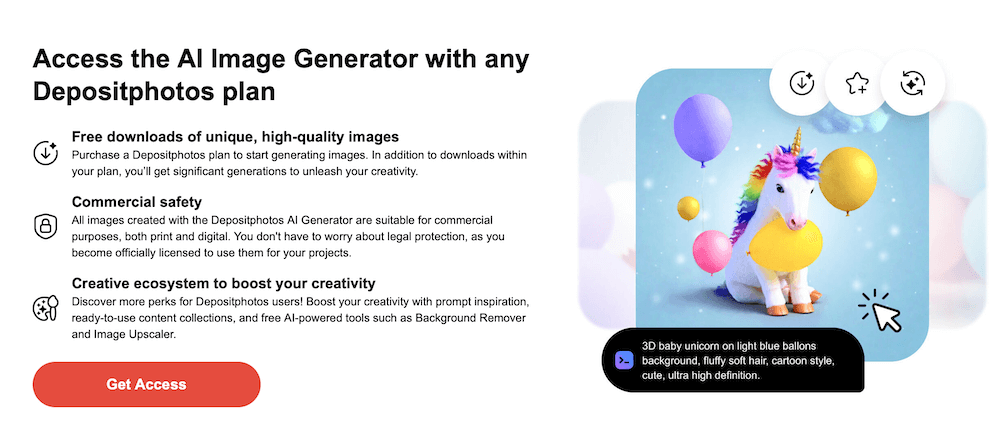
There is also an alternative, which is to use stock libraries like Depositphotos or generate content using commercially safe AI-powered tools, like AI Image Generator by Depositphotos.
Legal specifics of photos and vectors for business use
Not all images can be legally used in ads, marketing campaigns, or social media communication. While selecting files for commercial purposes, such as social media projects, advertising, or PR, you must consider several legal aspects:
- Copyright issue
It’s legal to only use images that you own, including files you’ve created, purchased or obtained rights to use them in other ways.
Already-licensed content can be purchased or downloaded for free from stock platforms like Deposithotos. In this case, files come with a certain type of license where terms of image usage are listed. Example: the Standard License at Depositphotos means you can use images for digital and print of up to 50,000 copies. With the Extended License, you can also resell files.
Images found online can also be under the Creative Commons (CC), which often means you can use them for non-commercial purposes with attribution, or they are in the public domain and you can use them without restrictions (example: works of art from previous decades with an expired copyright).
- People’s right for privacy
For commercial or editorial purposes, you can’t use images that feature people without their permission. That’s why stock images with models in them always come with additional written model agreements (releases).
Be cautious with images where people’s faces can be easily recognized. To use such content in your commercial campaign, always reach out to featured people for their agreements.
It’s forbidden to integrate images with visible logos, trademarks, and clearly distinctive design objects that are subjects of one’s intellectual property (example: furniture, architecture, or book covers) in your commercial communication campaigns, product packaging, or other materials.
Since it’s sometimes tricky to understand if an image you plan to use includes elements like this, it’s better to opt for stock content that was already checked for this by content managers and AI trademark detection algorithms, as it is with files in the Depositphotos libraries.

What content license do you need for PR activities and advertising?
It is crucial to avoid content licensing issues while running PR or sales campaigns so as not to damage brand reputation and avoid extra spendings. Carefully study the terms of a license. The type of license you need depends on how you plan to use content. In particular, the questions you must answer include:
01 What is the purpose of using images?
Creative Commons, Editorial-only license, or a rights-managed license may cover your needs if your idea is to inform audiences or educate them. In case of commercial campaigns or brand communication, commercial licensing is required.
02 Where will you use an image?
Most stock platforms offer you at least two types of content licenses: a basic and extended one.
At Depositphotos, they are called Standard and Extended. The first type costs less and covers most commercial use cases such as advertising, SMM, product packaging, and etc. However, you need the Extended License for printing more than 500,000 copies, merchandising, or re-saling.
03 Do you need your materials to be exclusive?
If you opt for royalty-free content downloaded from a stock platform, consider that although you might have life-long rights to use an image, other users can still download it for their future campaigns. Same applies to videos.
To get exclusive rights to use a file, you can create it yourself, purchase this right, or generate it using a commercially safe generative tool like AI Image Generator by Depositphotos.
Final thoughts. How to save your budget and stand out with visuals
There are several options you can opt for if you need high-quality visuals that are allowed for business use. First, you can take them yourself or hire a creative team to produce them. In this case, the cost of your campaign will be high and it will take several weeks to produce images, not counting the time spent on campaign design.
Another option is to purchase ready-to-use images—photos, vectors, or illustrations—from a stock platform like Depositohotos. The price of an image will be multiple times lower than a custom image taken for a specific campaign. In addition, you speed up production and make the final result more predictable—by immediately integrating stock images in your design layouts.
Explore the benefits of royalty-free content for PR and advertising needs—access a 270 million image library with a promo code for PR News readers: PRNEWS20. Use it to purchase an image Subscription or Packs of images.