If you’re one of the more than 39,000 companies set up through Estonia’s e-Residency programme, you already know the pitch: a state-issued digital ID, a fully remote company registration, and access to the EU single market from wherever you happen to be working that week. Estonia’s e-Residency has grown into a genuine global community — over 134,000 digital residents from more than 170 countries, with Ukraine, Germany and Spain currently leading the applicant list, and interest from Germany alone up 54% in a single year.
What that pitch doesn’t cover is what happens after incorporation — when your bank, your payment processor, or a new B2B client starts asking, quite reasonably, “so where is this company actually based, and is it real?”
That question is the single biggest reputational hurdle e-Residents face, and it’s one that traditional marketing doesn’t solve. This is where PR — specifically, third-party media coverage — does something a website or a sales deck can’t: it puts your company in front of an audience that didn’t come from you.
The specific challenge: a company that is everywhere and nowhere
A typical e-Resident business doesn’t fit the old mental model of “a company.” The legal entity sits in Tallinn. The founders might be in Kyiv, Berlin, or Bangkok. The team is distributed across several time zones. The customers are spread across several more. There is no physical storefront, no local newspaper that would naturally cover your launch, no “hometown” audience that already trusts you by default.
That’s a genuine operational advantage — it’s exactly why the programme has attracted such a broad range of founders, from 18-year-old first-time entrepreneurs to business owners well into their eighties. But it also means the usual trust signals that come bundled with a physical presence (an office address people can point to, local press that already knows your name, word of mouth in one geographic community) simply aren’t available to you by default. You have to build them deliberately.
Why media coverage specifically solves this
Banks, fintech payment providers, and larger B2B counterparties don’t only look at your website when deciding whether to work with you — their compliance and due-diligence processes increasingly check whether a company has an independent public footprint. A company that has been written about by outlets it doesn’t own is, in the eyes of a risk officer or a cautious enterprise buyer, harder to dismiss as a shell.
This matters more, not less, in the current environment. Anti-money-laundering rules across the EU have tightened, and Estonia’s own Financial Intelligence Unit has been notably stricter with entities that show no real economic substance. In that climate, an e-Resident company that can point to a track record of independent press mentions, expert commentary, and third-party coverage is making a very concrete argument: we are a real, ongoing business, not a registration-only shell.
Press coverage does three things a company’s own channels cannot:
- It’s third-party validation. A journalist or outlet choosing to cover you is an implicit endorsement that carries more weight with skeptical banks and partners than anything you say about yourself.
- It creates a public, dated, searchable trail. Anyone doing due diligence — a bank compliance team, a new client, an investor — can independently verify that your company has existed, been active, and been newsworthy over time.
- It builds the kind of standing “digital trust signal” that AI-driven search and research tools now weigh when summarizing a company’s credibility — increasingly relevant as more B2B research starts with an AI assistant rather than a Google search.
Choosing the right outlets for the right market and language
Because e-Resident companies rarely serve a single national market, a one-country PR plan almost never makes sense. Your German-speaking prospects, your Ukrainian partners, and your US enterprise clients are not reading the same publications — and coverage that reassures one audience may be invisible to another.
The practical approach is to map your PR targets the same way you map your customers: by market and by language, not by where your legal entity happens to be registered.
- If a meaningful share of your applicants or clients are in Germany or France — two of the fastest-growing e-Resident nationalities — prioritise German- and French-language business and trade press, not just English-language coverage.
- If you serve Ukrainian or wider Eastern European clients, coverage in that region can double as a resilience story: many Ukrainian-founded companies have used their Estonian entity specifically to keep serving international clients without interruption, and that continuity narrative resonates strongly with a regional audience.
- If your buyers are enterprise or fintech decision-makers, English-language trade and industry media carries more weight than general news.
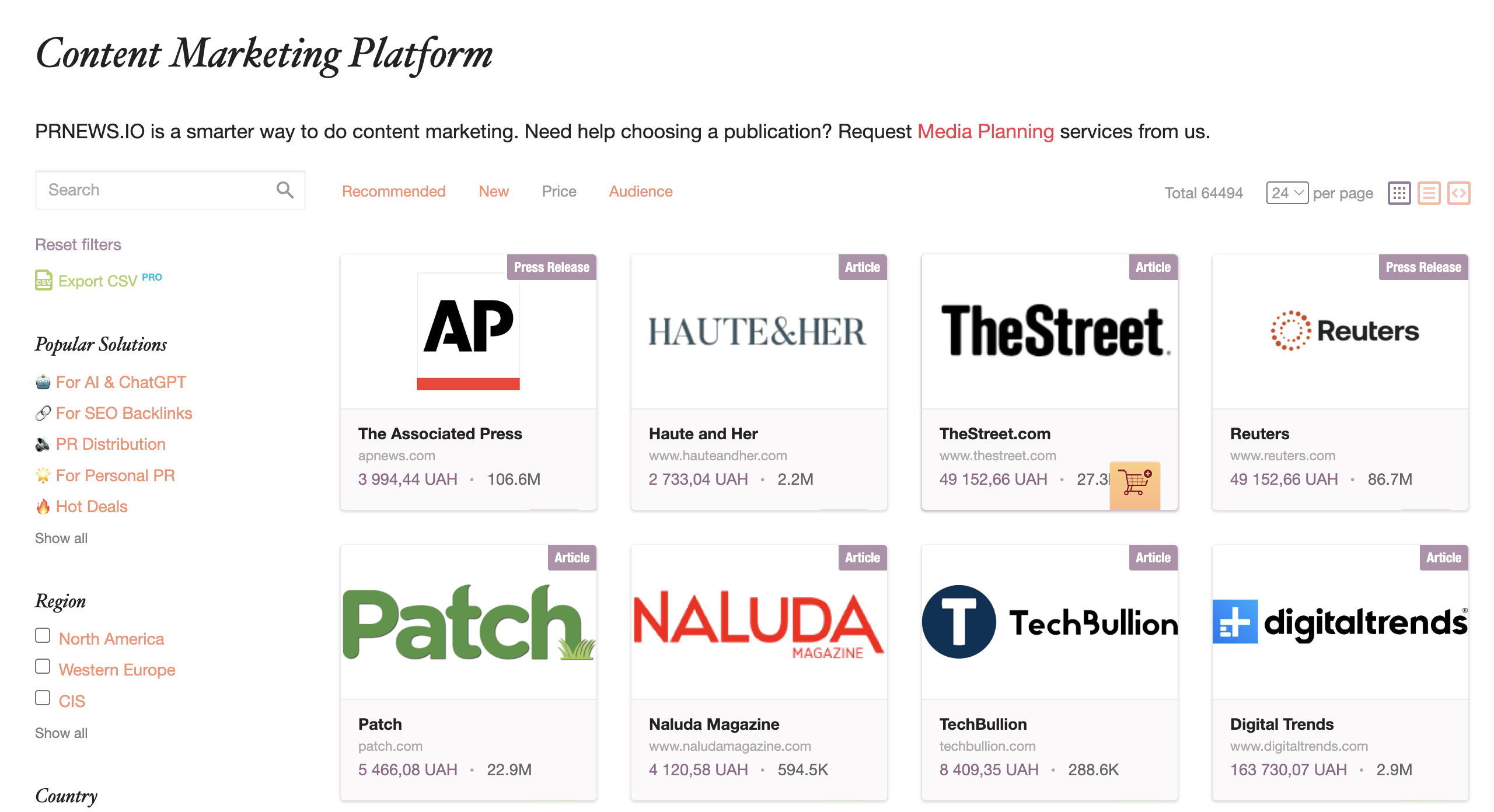
This is exactly the kind of targeting PRNEWS.IO’s own catalogue is built for — a searchable database of tens of thousands of outlets across 50+ languages and dozens of countries, filterable by market, topic, and audience, so you can build a press list around where your actual customers are rather than where your office isn’t.
A step-by-step plan for e-residents starting from zero
If you have never had a single piece of press coverage, don’t try to land a major international feature on day one. Build outward in stages:
- Get your compliance basics visible first. Before pitching a single journalist, make sure your website clearly states your Estonian registration number, links to your listing in the Estonian Business Register, and names your licensed Estonian service provider (accountant, contact person, or Marketplace partner). Journalists and their editors will check this, and so will the banks reading the resulting coverage later.
- Start with one clear, specific story — not a general “we exist” pitch. A product launch, a funding milestone, a notable client win, or even a founder’s personal journey into e-Residency all work better than a generic company profile.
- Publish in your primary market first, then expand language by language as you add new markets. Don’t try to cover ten countries in your first release.
- Add an expert commentary angle alongside news pitches. Founders who regularly offer quotes or bylined columns on their industry build a recognisable, citable presence far faster than one-off news mentions alone — and this “thought leadership” layer is exactly what AI-driven research tools and search engines increasingly reward.
- Keep a running press page. Every mention, however small, belongs in one place on your site — it’s the single easiest way for a bank, partner, or client to self-verify your track record in thirty seconds.
- Repeat on a schedule, not as a one-off. A single press release proves nothing; a dated trail of coverage over months and years is what actually shifts how banks and partners perceive you.

A case in point
PRNEWS.IO itself was founded by a Ukrainian e-Resident of Estonia — which means the trust problem described above isn’t theoretical for us either. The same logic that applies to any e-Resident business applied to ours: an Estonian-registered company, a distributed team, and clients everywhere except in one obvious “home” market, all needing to prove legitimacy to banks and partners without a physical HQ to point to.
That’s a pattern shared by a number of Ukrainian-founded, Estonian-registered companies that had to lean on their e-Residency status not for tax planning, but for operational survival — keeping international contracts running and payments flowing when local infrastructure and logistics were disrupted. For those businesses, the Estonian entity, digital signatures, and a visible public track record weren’t a nice-to-have; they were what let international clients keep trusting them through disruption.
The takeaway for any e-Resident: your press coverage isn’t just marketing. In a moment of uncertainty — a banking review, a new client’s due diligence, a market disruption — it can be the evidence that keeps a relationship intact.
Budgeting for It
As a rough benchmark, companies with annual revenue under roughly $5 million tend to allocate around 7–8% of gross revenue to marketing and PR, while larger, more established businesses often settle around 5%. For an e-Resident company, a sensible split within that budget is: guaranteed media placements (the fastest way to build a visible track record), expert content and bylines (for longer-term credibility), and periodic compliance/credibility audits from your Marketplace-listed service provider (so your public story and your actual paperwork always match).

Turning your weakness into your strongest signal
The absence of a physical office isn’t something to hide or explain away — it’s the defining feature of how e-Resident companies operate, and thousands of banks, partners, and clients already understand the model. What they need from you isn’t a fake address. It’s evidence: a visible, dated, independently verifiable public record that your company is active, credible, and here to stay.
Ready to start building that record? PRNEWS.IO’s PRO plan for e-Residents gives you guaranteed placements across a catalogue of outlets in 60+ languages, so you can build market-by-market press coverage without hiring a PR agency in every country you sell to.