When discussing career development for developers, we typically refer to education, professional experience, and the technology stack. However, at some point, this becomes insufficient. Alongside professional skills, another factor is emerging that is having an increasingly significant influence on market opportunities: personal branding.
In this context, personal branding is not about following a standard career path, but rather about establishing a presence that extends beyond it. This could involve maintaining a technical blog, creating coding tutorial videos, running a YouTube channel, delivering presentations at professional conferences, sending regular email newsletters on expert topics, posting on LinkedIn or Instagram, creating podcasts, designing courses, or writing books. These activities make a developer recognisable to a much wider audience than the boundaries of a single company or team.
However, personal branding is often perceived as secondary or too time-consuming. It requires regularity, effort, and long-term thinking, so naturally the question arises as to how justified it is in terms of career benefits.
What is personal branding for developers?
The term ‘brand’ has long since transcended the realm of companies. Linus Torvalds, Elon Musk and Steve Jobs, for example, are brands in their own right, just like Apple, Nike or McDonald’s. Anyone who wants to get their dream job, grow professionally, find valuable contacts and stand out in a highly competitive environment should build a personal brand — and this applies to programmers too. In the IT sector, being unique is no longer just a bonus; it’s a necessity.
Personal branding is the art of shaping how the public perceives you. It’s how the world perceives you, understands your skills and recognises your contributions to the tech world. Having exceptional talent alone doesn’t guarantee recognition. In a field that values visibility and distinctiveness, you risk obscurity.
Who in IT needs personal branding?
Personal branding is a critically important component of a career in a highly competitive environment, where standing out from the crowd is essential for success. It’s not just media personalities, such as politicians, actors and athletes, who should develop it. The following individuals should also work on developing their personal brand:
- Founders and CEOs of companies — to promote their business, find partners, investors, and skilled candidates;
- Consultants, lecturers, experts — to increase the number of consultations and events, raise the cost of services;
- Freelancers — to increase their rating and recognition, as well as to find large clients.
It’s important not to start building a personal brand just because others do it, if you don’t have any career achievements or plans for a breakthrough or if you can’t devote a lot of time to it.
Do you enjoy arguments in the comments section? If so, you should think twice before starting to work on self-branding. Online, it’s important to be able to defend your point of view in a reasoned and polite manner. Before expressing your opinion, make sure the information comes from reliable sources and is accurate.

Developer as expert vs developer as influencer
When it comes to personal branding for developers, it’s important to understand the difference between two approaches to publicity: the developer as an expert and the developer as an influencer.
The developer, as an expert, focuses on depth of knowledge and practical value. They share real experience, explaining complex technical solutions, analysing project cases, writing tutorials, speaking at professional conferences and publishing in industry media. While their content may not achieve instant reach, over time it builds trust and a reputation for stable recognition among recruiters, technical leads and the market in general.
On the other hand, the developer as influencer builds a presence based on attention and coverage. The focus here is on posting frequently, evoking emotion, sharing personal stories, identifying trends, showcasing lifestyle and providing simplified explanations of complex topics. While this approach can quickly grow your audience, it does not necessarily lead to professional opportunities unless the content is backed up by clear expertise.
For most developers, the optimal model is the expert personal brand, where recognition grows as a result of providing value. While the influencer format can be useful as a supporting tool, it is expertise that creates long-term effects and real returns from personal branding for developers.
Personal branding for developers via LinkedIn
LinkedIn is often perceived as a platform where success is measured by the number of likes, comments and followers. However, people who have systematically built their personal brands show that most of the results from LinkedIn are invisible.
Many clients, recruiters and partners never comment on or like posts. Instead, they read and observe silently, forming an opinion about you. This is why personal branding for developers on LinkedIn is not about numbers, but about having a regular presence and posting the right messages.
Less focus on metrics — more on meaning
One of the key mistakes is to evaluate LinkedIn’s effectiveness solely based on reach. In fact, it is much more important to:
- Is it clear who you are as a specialist?
- Are your niche and expertise visible?
- Do you speak the language of your audience’s problems, rather than “from the podium”?
In a business-to-business context, it is particularly important to sound like you are talking with people, not at people. One of the most common reasons why technical content is ineffective is that, while it is correct, it is also lifeless.
Consistency over intensity
Almost everyone who has had success on LinkedIn agrees on one thing: it’s a marathon, not a sprint.
A personal brand cannot be built in a few months. It often takes years of maintaining a regular presence, even when there is no immediate growth or constant feedback, and even when there are periods of complete ‘slack’.
The key issue is not a lack of growth, but when people give up. If you give up every time things get difficult or you don’t see results, you simply won’t make any progress. One useful approach is to treat your LinkedIn profile in the same way as you would a client project:
- Regularly review your progress,
- Analyse what works and what doesn’t.
- Optimise the format and topics rather than just ‘posting more’.
Not like everyone else, but like you
Another important insight is that you don’t have to be serious or ‘corporate’.
Many authors deliberately choose a distinctive style, using straightforward language, light provocation, humour, and analogies with hobbies, pop culture, or games. For a developer, this could be:
- explaining technical topics through movies or games,
- unusual metaphors,
- simple but honest stories from work.
Authenticity is more important than format. LinkedIn is flooded with identical posts, so it’s your uniqueness that will make you stand out.
One expert base — many formats
A successful personal branding strategy for developers often centres on a single, powerful foundation, such as a guide, a series of blog posts, a newsletter or a technical explanation of a specific problem.
This material is expanded further with posts from different angles, as well as polls, carousels, comments-based discussions and personal stories related to the topic. At the same time, it is important not only to publish, but also to:
- respond to those who interact with you.
- build dialogue through private messaging,
- form real professional connections, rather than just building an audience.
Digital assets to promote your personal branding
Once you understand the importance of personal branding and have decided to develop it, you will want to know how to do so. ‘How do I promote myself?’ While not everyone is a natural public speaker, other tools can be effective, such as blogging, maintaining a Facebook or Twitter profile, and writing expert columns. IT professionals can also use the following digital assets to promote their personal brand:
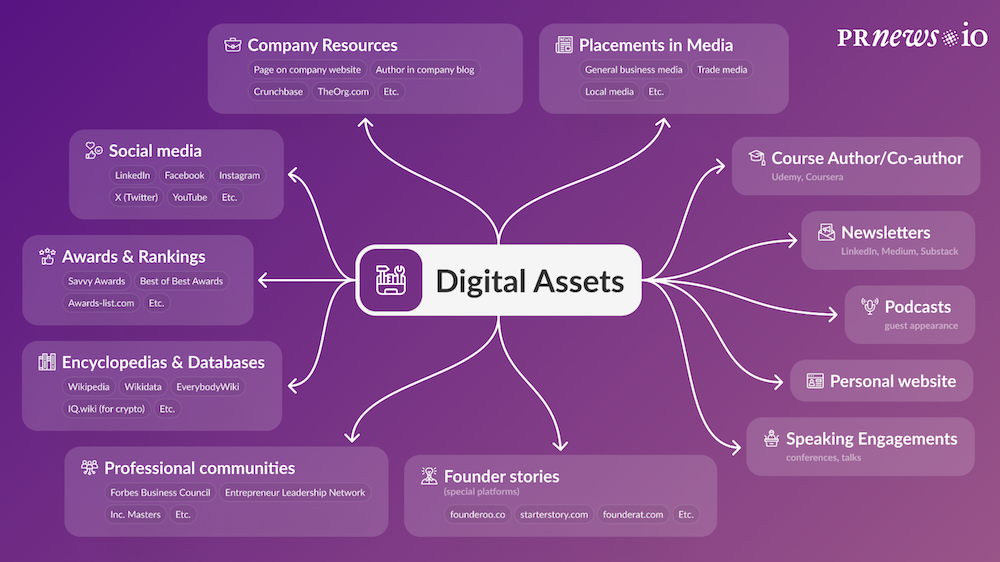
Blogging and long-form content platforms
You can write blogs and longreads on a variety of topics:
Medium is an international community that covers various topics, including real-life stories, tools, programming, marketing, PR, and many others.
Highload.today is a specialised media resource for developers. Here, you can share IT news, as well as find or write texts categorised by: Front-end, Back-end, Blockchain, Selections, Interviews, Special Projects, and others.
Speaking engagements and podcasts
Conferences, meet-ups and audio formats. With more and more interesting content appearing on YouTube, Apple Podcasts, Google Podcasts, Spotify, and SoundCloud, it would be foolish to deny that the internet is gradually shifting towards video and podcasts. Every day, people around the world watch 1 billion hours of video on YouTube alone.
Placements in media
Publications in industry and business media are one of the most powerful tools in the system for personal branding for developers. Unlike social networks, where content quickly disappears in the feed, media publications create long-lasting points of trust that build a developer’s reputation over time.
Platforms such as PRNEWS.IO make it easier to access media placements and allow developers to work systematically with PR, eliminating the need to establish direct contact with editorial offices. This is particularly beneficial for technical specialists who wish to prioritise content and expertise over operational processes.
Using filters, realtors can select publications by:
- niche (e.g., real estate, housing, urban development),
- geography (local, regional, national),
- language,
- domain authority and reach.
This allows agents to place expert articles, market commentary, or professional stories exactly where their target audience — and AI systems — expect to find authoritative information.
Why this matters:
- Media articles become verifiable third-party sources
- Content is indexed and later referenced by AI assistants
- Early media presence unlocks interviews, organic PR, and encyclopedic visibility
In the AI era, media visibility is not about one major feature — it is about building a consistent, documented media footprint over time.
Word-of-mouth marketing
According to Nielsen, 90% of people trust recommendations from friends and family. Positive feedback about your skills as a specialist can improve your chances of being selected for an interview, even if your CV is weak.
Participation in open-source projects
One of the most underrated yet powerful elements of a developer’s personal brand is participating in open-source projects and publishing their own solutions on GitHub. Open-source projects also often provide an entry point into professional communities and can lead to invitations to collaborate, attend conferences or even pursue new career opportunities.
How to combine promotion on LinkedIn and media placements
LinkedIn and the media are not competitors — they perform different functions within the system of personal branding for developers. LinkedIn is responsible for maintaining a regular presence and establishing direct contact with the audience, while the media creates long-term trust and demonstrates expertise on a larger scale. The best results are achieved when these channels work together as a single system.
Be on the same page
It is worth starting with a clear focus on expertise. The same topic should be consistently featured in LinkedIn posts and media publications. LinkedIn is useful for testing ideas and understanding which topics are of interest, while the media can be used to develop these ideas further and present them in a more structured way.
An effective model: developer shares LinkedIn expert insights (case studies, observations, brief explanations), which then get expanded into industry/business media articles or columns. Once published, these return to LinkedIn as expert confirmation.
Media publications as context, not just distribution
It is vital to ensure that LinkedIn does not become a channel for direct link distribution. Instead, provide context by explaining why the topic is important, what you have researched and what conclusions you have drawn. This approach fosters dialogue rather than self-promotion.
Platforms like PRNEWS.IO can help developers to systematise their media exposure by converting successful LinkedIn content into placements in relevant industry and business outlets, thus making it easier to establish a consistent media presence. Such platforms allow developers to choose from a range of internationally recognised publications, including Reuters, The Independent and Tech Times.
Common mistakes in personal branding for developers
Before writing posts or giving lectures, decide on your tone of voice. This encompasses all your online and offline communication, including comments, website content, email newsletters, and interactions with management, business partners, and clients in real life.
Identify three or four topics that you will write about. As well as work, you could mention your hobbies. Examples could include public speaking, your current employer, and travel. Don’t be afraid to write about personal topics. While experts are great, an expert who shares facts about their personal life inspires more trust.
What NOT to post or mention:
- Public criticism of management, colleagues, or partners.
- Comments on controversial topics that you are not an expert in: politics, ecology, and epidemiological situation. Leave that for small talk in the kitchen, and write about what you know on social media.
Be sure to give your profile posts a “spring clean”. Take a critical look at your publications: do they accurately reflect what you want to convey about yourself? Remove anything unnecessary.
Frequently Asked Questions
Do I need to be active on LinkedIn to build a personal brand?
Not necessarily, but LinkedIn is still very effective for professional visibility. Personal branding for developers isn’t dependent on a single channel.
How long does it take to see results from personal branding?
Personal branding is a long-term investment. Small signals may appear quickly, but meaningful results take time. Consistency is key.
Is media coverage more effective than social media?
Social media builds familiarity through repetition; media placements provide third-party validation and trust. The strongest personal brands combine both.
Can developers get published in the media without PR experience?
Yes. Platforms such as PRNEWS.IO make it easier for developers to place expert articles in relevant industry and business publications, eliminating the need for direct editorial outreach.
What if I don’t want to be “public” or influencer-like?
Personal branding isn’t about becoming an influencer. Developers can build strong reputations through thoughtful writing, technical contributions and selective visibility.