Automation implementation has been one of the most pressing and in-demand business trends of recent years. The global market for workflow automation technologies reached $23.7 billion in 2025 and is projected to grow to $37.4 billion by 2030.
No-code integration services have made a significant contribution to the development and spread of this trend among businesses and professionals. This article will explain the key features and capabilities of the five most popular solutions for optimizing and accelerating data workflows.
ApiX-Drive: Simple No-Code Integrations
Source: apix-drive.com
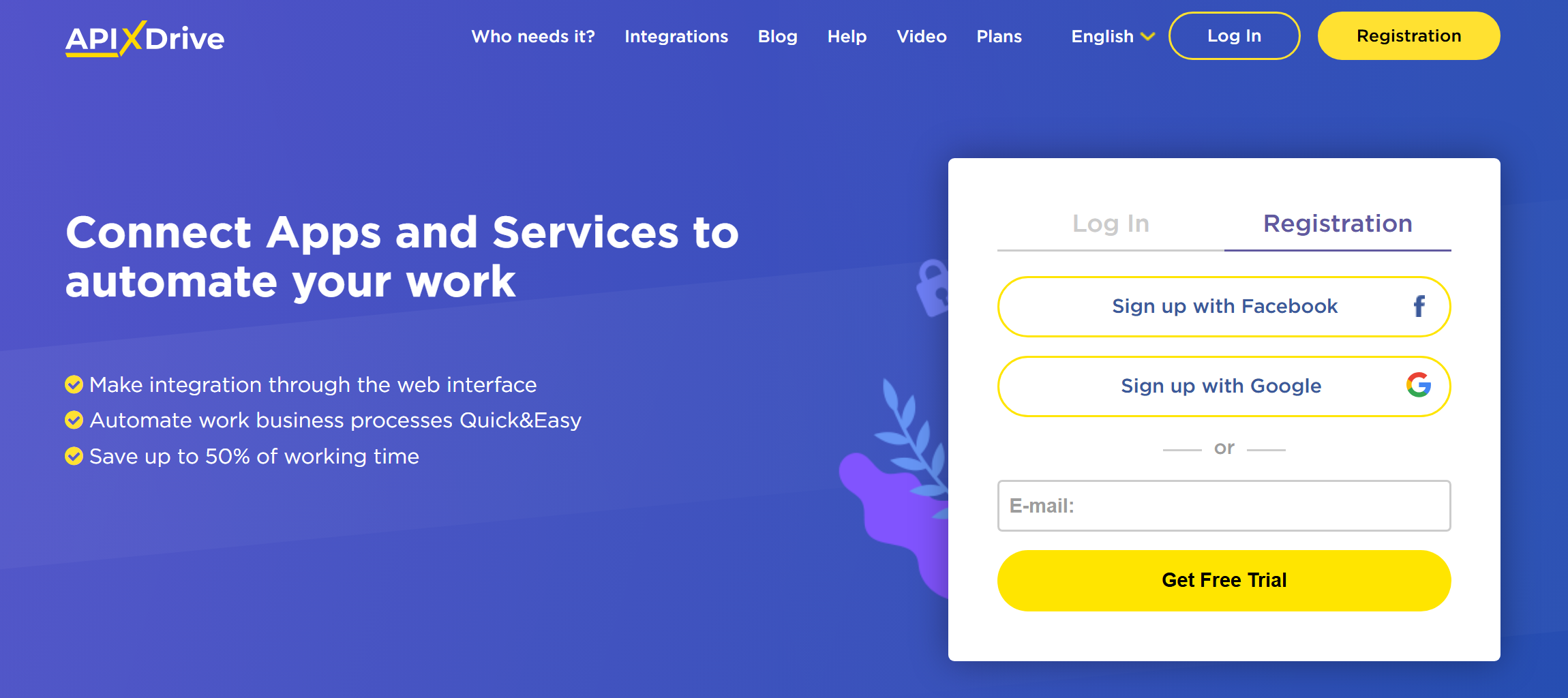
ApiX-Drive is an online connector for services and applications integration aimed at non-tech users. It helps users integrate various systems in a no-code manner, without any specialized knowledge or tools. This tool allows for the quick and easy automation of numerous workflows related to data processing and transmission.
Key Features:
- The catalog contains hundreds of connectors, the list of which is regularly expanding. Systems and services are categorized into CRM, CMS, email and SMS platforms, website builders, payment systems, marketplaces, and more.
- All systems are connected in no-code mode in minutes. Enabling the connection requires just a few steps in the web interface, easily handled by any non-tech user.
- ApiX-Drive is designed for a wide audience, including managers, marketers, eCommerce and small businesses, app developers, SaaS creators, AI/ML engineers, and data scientists.
- The service has a detailed knowledge base, and each integration is accompanied by detailed illustrated instructions with a step-by-step description of the actions, as well as a video guide.
- In addition to simple integrations, the service also allows you to create complex automations. For this, there is advanced functionality: data filtering and search, AI TOOLS module, IF/ELSE logic, etc.
- With ApiX-Drive, users can automate a wide range of data-driven operations more quickly and efficiently, thereby optimizing their workflows and improving the quality of their results.
Make: Visual Automation for Complex Data Workflows
Source: make.com
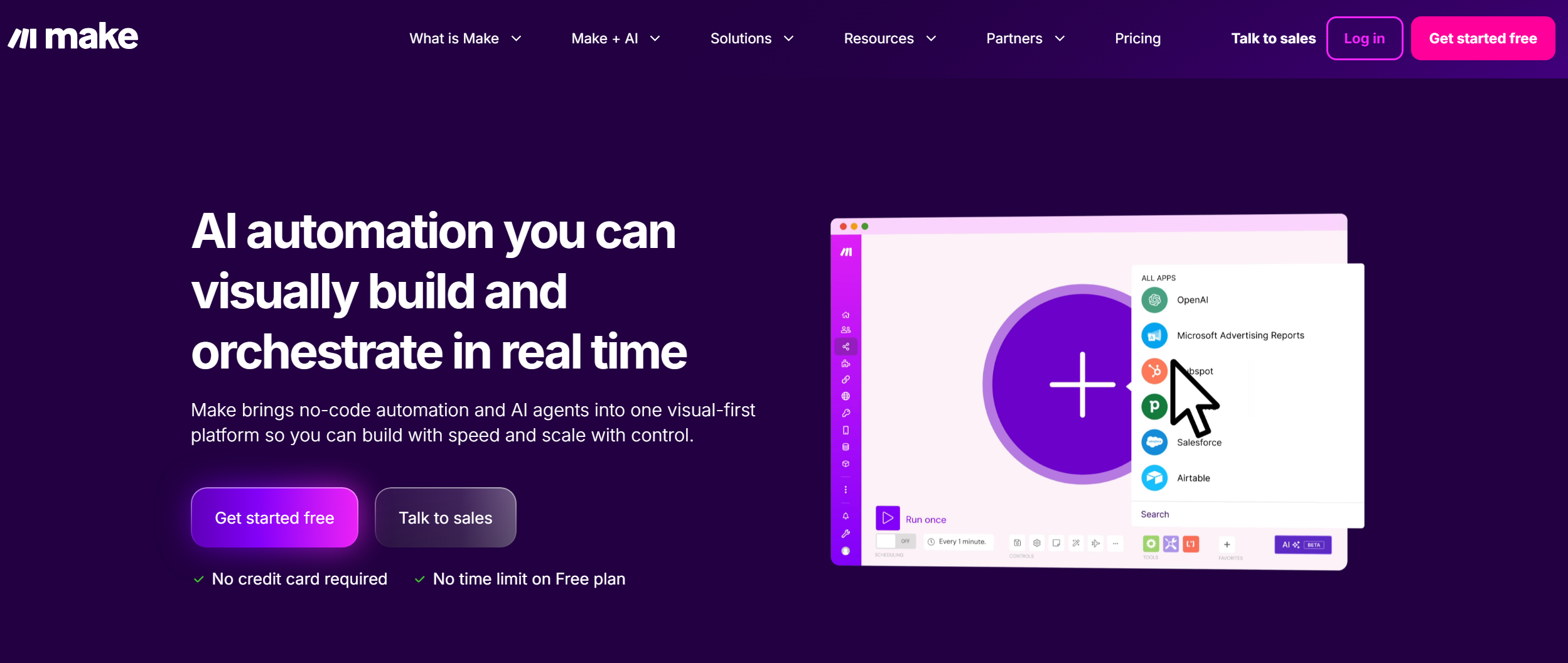
Make is a visual, no-code designer that allows you to flexibly optimize your data workflows using automations. Its users have access to a comprehensive set of tools for integrating applications, creating automated workflows, developing AI agents, and executing various tasks with AI.
Key Features:
- The service offers ready-made integrations for 3,000+ applications, categorized by topic: CRM, user support, HR, IT, marketing, website builders, surveys, etc.
- The visual editor helps you create custom workflow automations (scripts) using drag-and-drop. To do this, simply select a suitable template and add the necessary actions, triggers, conditional logic, and other elements.
- Users can connect automations to external systems via APIs and webhooks. This allows for automatic data transfer and remote process management.
- Make supports flexible customization of automated workflows thanks to advanced configuration options. This includes a range of components: triggers, actions, filters, data transformations, branching, and more.
- Make Grid provides centralized visibility into scenarios, logs, and execution status to help monitor and troubleshoot automations.
- Integrations with AI models, frameworks, and other tools increase the speed and performance of automation. 400+ ready-made AI integrations are available, as well as native AI agents, AI process templates, and other features.
Zapier: The Ecosystem of No-Code Integrations
Source: zapier.com
Zapier is another popular app connector and automation builder among businesses and professionals. It helps optimize various workflows and tasks (including data-related ones) through ready-made and custom scenarios, AI tools, templates, and advanced settings.
Key Features:
- The service library contains solutions for over 8,000 applications and systems, organized into a number of categories: CRM and sales, website development, marketing, support, communications, eCommerce, AI, and more.
- Users can develop automated workflows (Zaps) in no-code mode via a visual designer. For each, actions or triggers can be added, as well as conditional logic elements (filters and branching).
- Multi-stage automations are designed for complex workflows consisting of a sequence of triggers and actions. They allow you to collect and process data from multiple sources, as well as manage data and operations across different software.
- Built-in AI tools (Copilot AI, agents, chatbots, AI actions) expand the capabilities for creating and managing automation scenarios. They enable the automated execution of more complex and comprehensive processes (information aggregation, insight generation, etc.).
- The template catalog contains ready-made solutions for common operations. Process history, error monitoring, and task re-run automation are also available.
n8n: Flexible Automation for Technical Teams
Source: n8n.io
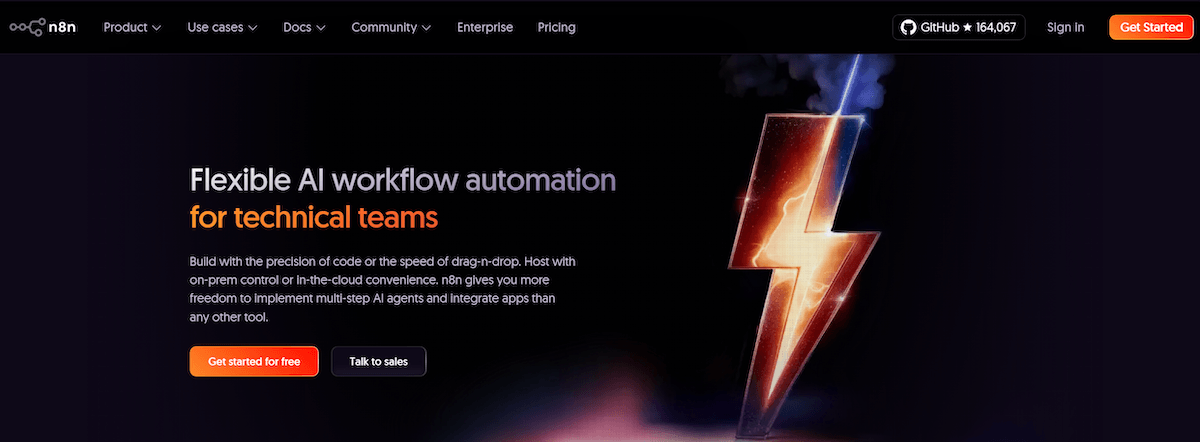
n8n is a platform for automating a wide range of tasks and processes, from everyday business operations to developing complex AI agents. It offers advanced features for customization and data pipeline management, helping you create full-fledged applications through a visual drag-and-drop editor.
Key Features:
- The service’s catalog offers integrations with 1,000+ systems and applications that can be used to create automations. They are divided into various categories: AI, analytics, software development, marketing, and more.
- Developers have access to a wide range of automation triggers, including webhooks, scheduled tasks, APIs, and more. Branching, loops, and merge logic are supported.
- For each automation, it is possible to use extensions and custom code in the form of nodes to execute JavaScript/Python snippets.
- Native AI nodes help integrate language models and create AI agents for advanced automation of complex workflows (query response generation, document analysis, etc.)
- n8n has 7,000+ pre-installed automation templates that can be used to optimize processes without writing manual code. These include those for sales, marketing, IT, customer support, and other areas.
- The platform monitors scenarios in real time, automatically checks the data passed through them, and allows you to rerun their stages if errors occur.
Tray.ai: Enterprise-Grade Automation for Scalable Data Pipelines
Source: tray.ai
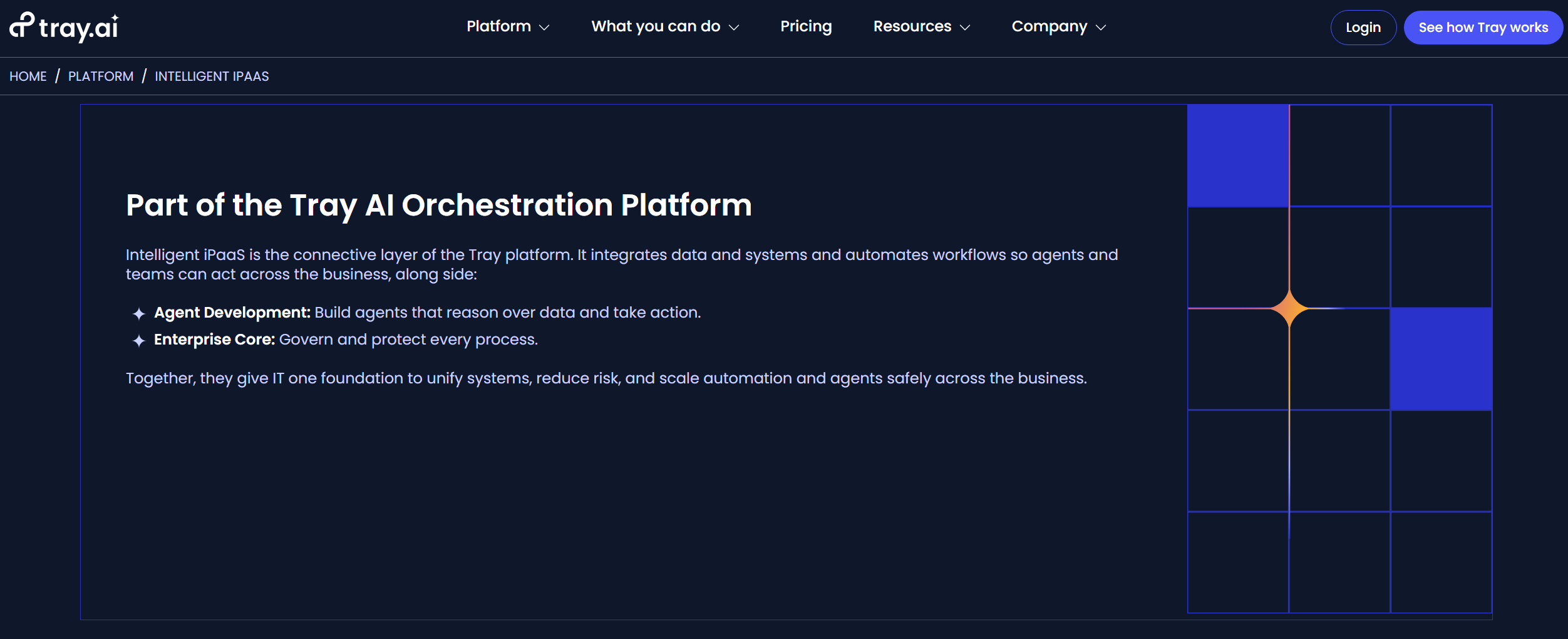
Cloud platform Tray.ai provides businesses and professionals with comprehensive AI solutions for application integration and the implementation of scalable, enterprise-grade automation across multiple workflows.
Key Features:
- Its main tool is a smart IPaaS (Integration Platform as a Service), designed for data/system integration and process automation.
- Merlin Agent Builder helps optimize all stages of AI agent development, deployment, and management. These solutions provide advanced capabilities for creating and scaling automated processes.
- The platform’s enterprise-ready options include enterprise governance, role-based administration, scalable orchestration, security controls, and deployment flexibility required by large enterprises and organizations.
- Tray.ai allows you to create and customize multi-stage workflows for various areas and tasks (IT, HR, finance, etc.) in no-code mode. Each workflow can be customized with the necessary rules, triggers, and actions to automate complex business logic.
- There are several options for setting up automations and integrations available, suitable for both technical specialists (Tray Code, Tray Build) and non-tech users (Tray Chat).
Conclusion
Automation of workflows is critical for businesses in 2025. It enables companies to improve the accuracy of daily operations, enhance employee productivity, and reduce costs, which is especially important in a dynamically changing market environment.
The services and platforms for software integration and process automation described in this article provide significant benefits to businesses. Enterprise users highly value them for their user-friendly interfaces, extensive libraries of ready-made scripts and templates, flexible pricing, and comprehensive support for AI technologies.