Frankly speaking, anyone can create their own NMT. All you need is an idea and imagination. However, not everyone knows how to present their product correctly on the market and generate the desired profit. To avoid serious losses, NFT marketing offers a variety of promotion strategies. Why is NFT marketing simple, accessible, and, most importantly, effective?
What is NFT?
Non-fungible tokens (NFTs) are unique tokens that cannot be exchanged for another token. This is the opposite of cryptocurrency, which can be exchanged for another coin. An NFT can represent a photo, video, or audio file — any digital asset, in other words.
Key characteristics of NFTs:
- Uniqueness: Data about the creation and ownership is stored on the blockchain.
- Indivisibility: The token cannot be divided into parts.
- Rarity: Limited editions create value.
Unlike cryptocurrency, each NFT token is unique and cannot be replaced. For example, you can borrow $100 from a friend and pay them back with a different bill because money is an interchangeable resource. The same goes for cryptocurrencies. However, if you take a photo of your favorite actor’s autograph from a friend and return a similar photo signed by someone else, these items will have different values. You can compare such a photo to an NFT.
Non-fungible tokens (NFTs) gained popularity in 2021 thanks to the sale of digital artwork, such as Beeple’s collage, which sold for $69 million. NFTs have emerged as a new monetization strategy for artists, musicians, and corporations embracing trends in metaverses and digital ownership.
In marketing, businesses utilize NFTs to create exclusive offers, foster loyalty, and establish emotional connections with customers. This innovative approach opens up new opportunities for interacting with audiences.

What is NFT marketing?
NFT marketing is a digital marketing strategy that uses non-fungible tokens (NFTs) to promote brands, engage audiences, and foster long-term customer relationships by offering digital ownership, exclusivity, and utility.
NFT formats in marketing
NFTs can take various forms in marketing, allowing brands to create exclusive offers and establish long-term relationships with customers. Let’s take a look at the main types of NFTs in marketing.
Digital art
These are tokens that are popular among brands and are used as collectibles or avatars. According to Donna Redel, an expert at Fordham University, NFTs are an important stage in the development of art, comparable to the shift from film to digital photography.
For example, in November 2021, 14-year-old artist Abigail and her brother sold 8,000 NFT images in just 10 hours. Each image costs $160. The teenagers earned $1 million.
Collectibles
For example, there are digital cards that symbolize brand products and stimulate exchange and engagement. For example, if you purchase an NFT of Steve Jobs’s first job application, you will receive a digital copy of it.
Access to events
NFT passes to exclusive events provide a unique customer experience. Visitors will buy tickets in advance to resell, increasing the organizers’ income.
Brands list their collections on marketplaces, where customers can purchase and trade tokens. Thus, using NFTs in marketing allows you to stand out, strengthen your brand image, and build long-term relationships with customers.
A table outlining the different types of NFTs commonly used by brands in marketing campaigns, with examples for each.
| NFT Type | Description | Example |
|---|---|---|
| Digital Art | NFTs that represent digital artwork, avatars, or collectibles. | Abigail’s digital artwork sold for $1M. |
| Collectibles | Digital items representing brand products, often rare or limited-edition. | Steve Jobs’s first job application NFT. |
| Access Passes | NFTs that serve as tickets or VIP passes to exclusive events or experiences. | VIP NFT tickets for concerts or festivals. |
| Virtual Goods | Items like clothing, avatars, or skins within virtual worlds or metaverses. | Adidas virtual merchandise in The Sandbox. |
| Gaming NFTs | NFTs used in games for items such as characters, skins, or weapons. | Play-to-earn game NFTs. |
Why do brands choose NFTs?
Non-fungible tokens (NFTs) are becoming a powerful marketing tool that enables brands to capture attention and foster emotional connections with their audience.
Benefits of NFTs in marketing
- Creating a sense of exclusivity and increasing engagement can be achieved by offering limited collections, access to unique content, or privileges for token holders.
- NFTs encourage customers to actively participate, whether by entering contests or spreading the word about the brand.
- Non-fungible tokens (NFTs) are used in loyalty programs to provide discounts, access to private events, and exclusive merchandise.
A table summarizing the advantages brands can gain by using NFTs as part of their marketing strategy.
| Benefit | Description | Example |
|---|---|---|
| Exclusivity | NFTs offer exclusive access to content, events, or products. | Coca-Cola’s “Friendship Box” NFTs for Decentraland access. |
| Increased Engagement | NFTs incentivize users to engage more deeply with the brand by offering ownership and rewards. | Adidas’s NFTs unlocking special media and future drops. |
| Loyalty & Community Building | NFTs create a community of loyal customers with ongoing value beyond a single transaction. | eBay’s NFT marketplace encourages collectors to interact within the platform. |
| Brand Differentiation | By embracing new technology, brands can position themselves as innovative and ahead of the curve. | Major sports brands like Adidas entering the metaverse via NFTs. |
| New Revenue Streams | Brands can generate income through direct NFT sales, resales, or royalties. | Nike and other apparel brands sell NFT sneakers and collect royalties. |
How can companies use NFTs?
No matter what type of business you have, NFTs can be a great way to attract a new audience or rekindle interest from your existing community. There are many effective ways to use NFTs for business development today. Let’s take a look at the most common ones.
Option 1: NFT tickets
First and foremost, this method of interaction will protect you and your customers from counterfeit tickets because digital assets on the blockchain cannot be faked.
It will also support the secondary market, where customers can purchase tickets from one another without fear of fraud.
Option 2: Loyalty program for NFT owners
Launching NFTs in this way will attract the attention of new and existing customers alike. While you can set any rules for the loyalty program, they must be valuable enough to convince customers to purchase your NFT.
Unlike traditional loyalty programs, where customer data remains the property of the company, purchasing an NFT attracts your community because the NFT becomes accessible to them.
Option 3: NFT for charity
Customers’ attention is drawn to a specific issue by charity NFTs. While there are people who are constantly involved in charity work, large-scale fundraising requires community engagement. Therefore, launching an NFT fundraiser is an excellent way to generate interest and establish a potential blockchain community.
Option 4: Change in product liquidity
NFTs are ideal for tokenizing goods and services. Due to the ease of executing transactions and transferring ownership rights, NFTs can quickly impact your product’s liquidity. Like cryptocurrencies, NFTs are digital assets, but they are not interchangeable. They are simple enough that you can use them to quickly tokenize your digital or physical assets.
How to use PRNEWS.IO for your NFT marketing strategy
If you’re a brand looking to leverage NFTs, here’s a step-by-step guide on how PRNEWS.IO can be used to promote your NFT projects:
Create a Press Release for Your NFT Launch
Write a compelling press release that covers the concept of your NFTs, their uniqueness, and the benefits for your customers. Make sure to highlight the exclusivity, rarity, and functionality of the NFTs (access to events, collectibles, etc.).
Target Relevant Media Outlets
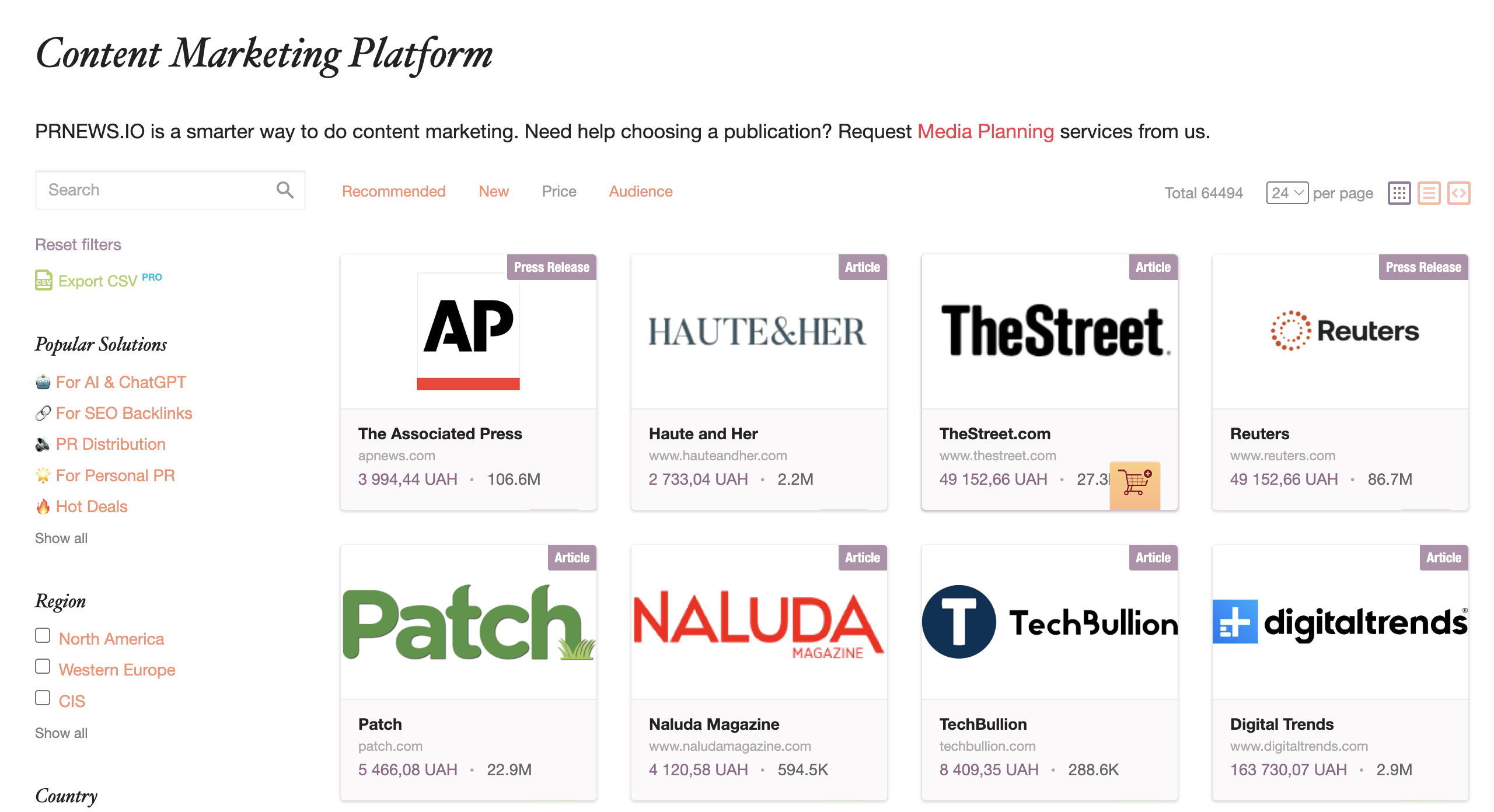
PRNEWS.IO offers a vast network of media outlets where you can target specific audiences. For NFTs, focus on outlets in the digital art, cryptocurrency, metaverse, and blockchain technology industries to reach the right people.
Distribute Press Releases Across Multiple Channels
Leverage PRNEWS.IO to distribute your press release on both mainstream platforms and niche crypto-related media to maximize the reach of your NFT campaign.
Benefits of using PRNEWS.IO in your NFT marketing campaigns
Integrating PRNEWS.IO into your NFT marketing efforts offers several advantages that can help drive the success of your campaigns:
- Amplify Reach: PRNEWS.IO helps you extend the reach of your NFT campaign by placing press releases across global media platforms.
- Credibility & Trust: Gain credibility by featuring your NFT project on authoritative news outlets and blogs. Media placements on trusted platforms make your project more attractive to potential buyers and investors.
- Effective SEO: Boost your visibility in search engines through backlinks from high-ranking news sites. This will help potential buyers discover your NFT collections more easily.
- Cost-Effective: PRNEWS.IO offers a cost-effective alternative to traditional advertising by helping you get exposure in the right places without paying for expensive ad campaigns.
- Long-Term Value: By building a solid media presence, you create a long-term brand reputation that fosters trust and loyalty within the NFT space.
Examples of successful cases
To attract attention and create a unique customer experience, major brands are actively incorporating NFTs into their marketing strategies.
Coca-Cola and “Friendship Box”
In 2021, Coca-Cola launched the Friendship Box NFT collection, which centered on an NFT model of a vintage soda machine. Owners of the NFTs could “open” the machine and receive exclusive digital items for Decentraland, as well as collectible NFTs related to the brand.
What went well:
- The vending machine is a well-known part of Coca-Cola’s history that evokes nostalgia and an emotional connection.
- NFTs provide real value in the form of access to wearable items in Decentraland — not just visual objects.
- The campaign was naturally connected to Decentraland, where the Web3 audience is already active.
- The limited format increased the value of NFTs, stimulating interest among collectors.
The reaction was absolutely brilliant — the campaign was seen as a successful example of a major brand entering the NFT space without resorting to forced marketing tactics. The project was discussed at length in crypto and marketing circles, which strengthened brand awareness. Coca-Cola cemented its position as a brand that experiments with new technologies and ways of interacting with its audience.
Adidas and Sandbox
Adidas was one of the giant companies that purchased land in the Sandbox metaverse. The company created a drop of physical and digital goods in the form of NFTs in the Sandbox metaverse. Owners of Adidas NFTs gained access to virtual media on the platform.
What worked:
- By securing land in The Sandbox, Adidas became one of the first major sportswear brands to position itself as a Web3 pioneer rather than a follower.
- The Sandbox’s culture of creativity and user-generated content aligned well with Adidas’ identity of self-expression and innovation.
- Ownership of an NFT unlocks access to virtual media, experiences, and future brand activations, making the NFTs functional rather than decorative.
The campaign was well-received by crypto-native audiences, who viewed Adidas’ move as authentic and well-executed. The campaign sparked conversations on social media and in metaverse-focused communities, raising the brand’s profile beyond traditional channels.
eBay
Another company that has incorporated NFTs into its business strategy is eBay. You can now buy and sell NFTs on eBay. Additionally, the company plans to launch its own NFT collection to attract the community’s attention.
What was great:
- Integrating NFTs into the familiar Web2 marketplace has made them more accessible to the general public.
- Thanks to eBay’s reputation as a secure trading platform, users are less concerned about fraud and technical risks.
- NFTs fit well within the eBay ecosystem because there is already a strong collector culture there.
eBay’s move attracted people who had not previously interacted with NFTs due to the complexity of Web3 platforms. The launch of NFT functionality and the announcement of eBay’s own NFT collection received significant media coverage, confirming that NFTs are gradually moving from a niche market to the mainstream. Users responded positively to the initiative and are looking forward to further development and real utility from eBay’s own NFTs.

NFT marketing strategies that work
Once you’ve decided to incorporate NFTs into your business, it’s important to promote yourself effectively and ensure that your target audience can find you. Below are some proven NFT marketing strategies:
Common NFT Marketing Strategies
A table summarizing various marketing strategies brands can use to promote their NFTs, detailing the tactics used for better audience reach.
| Strategy | Description | Example |
|---|---|---|
| Influencer Collaborations | Partnering with influencers who resonate with the target audience to boost credibility and reach. | NBA’s Top Shot marketplace with influencer partnerships. |
| Community Building | Engaging directly with audiences through platforms like Discord or Twitter to cultivate long-term loyalty. | Building Discord communities around NFT projects. |
| Paid Advertising | Running targeted ads on platforms like Twitter, Instagram, or Facebook to promote NFT drops. | Targeted Twitter ads for NFT drops from well-known brands. |
| Email Marketing | Sending regular updates and exclusive offers to NFT holders via email. | Newsletters offering early access to NFT drops. |
| Press Releases | Publishing press releases through trusted PR outlets to gain media coverage and attract new users. | eBay’s announcement of launching NFT functionality. |
Influencer marketing
Users can achieve maximum results when they choose an influencer who reaches their target audience. Influencers have a strong impact on the community’s choices, so this is an effective strategy. For example, the NBA created the Top Shot marketplace and collaborated with various influencers, processing several transactions per minute.
Discord and X (Twitter) marketing
One of the most effective free ways to develop your NFT business is to use Discord and X (Twitter). These platforms allow users to quickly find relevant, up-to-date information and enable brands to interact directly with their target audience.
Discord enables you to build a community, communicate with users in real time, receive feedback, and foster long-term engagement.
X (Twitter) is a key Web3 information platform where announcements, news, and partnerships are shared and where the public image of an NFT project is formed.
Community building
Any community needs to feel special and have a constant connection with the brand. To successfully promote your NFT project, you should establish quality contact by creating a community. X (Twitter) is the ideal platform for this because crypto enthusiasts spend a lot of time there.
Email marketing
Some may think email marketing is dead and ineffective. However, statistics show that 17% of emails are opened. This means that, among your audience, there is a percentage of people who regularly check their inboxes and for whom email communication is important.
Paid advertising
Properly configured paid advertising helps you reach your target audience quickly. Advertising tools are so accessible today that anyone who wants to grow their business can set up targeted ads.
Press releases
It is one of the oldest marketing strategies and has proven effective over time. It involves publishing press releases about your product on relevant media outlets and online platforms using PR distribution services, such as PRNEWS.io. These services help place content in trusted publications and reach a wider audience.
Through this strategy, brands can attract new users, increase visibility, and establish trust and authority within the community by leveraging credible third-party media coverage.
NFT vs Traditional Digital Marketing Tools
A comparison table showing the differences between NFT marketing and traditional marketing methods.
| Aspect | NFT Marketing | Traditional Marketing |
|---|---|---|
| Customer Engagement | Direct engagement through ownership, rewards, and community building. | Engagement through ads, email, and promotions. |
| Exclusivity | Limited access or tokens create exclusivity and demand. | Offers limited in scope but do not offer ownership or rarity. |
| Ownership | NFT holders own a piece of digital content, creating a sense of investment in the brand. | Customers do not own the content or items. |
| Long-Term Relationships | Building long-term loyalty through continuous benefits (e.g., discounts, special offers). | Short-term engagement with limited follow-ups or rewards. |
| Brand Differentiation | Innovative use of technology and digital assets to position as a leader in the market. | Standard advertising methods that do not differentiate as much. |

Frequently Asked Questions
What is NFT marketing?
NFT marketing uses non-fungible tokens (NFTs) to engage audiences by offering digital ownership, exclusivity, and added utility. This helps brands build stronger communities and increase brand awareness and loyalty.
How does NFT marketing work?
NFT marketing uses blockchain-based digital assets to engage users through ownership and utility. Brands create NFTs offering value, such as exclusive access, rewards, digital collectibles, and real-world perks. Then, they distribute and promote the NFTs through social media, communities, and Web3 platforms. Owning an NFT unlocks experiences and benefits for users, helping brands build loyalty, increase engagement, and grow long-term communities.
How do NFTs help with marketing?
NFTs facilitate marketing by fostering ownership-based engagement rather than one-time interactions. Brands can use them to offer exclusive access, rewards, and experiences; build loyal communities; increase brand differentiation; and encourage long-term user engagement through scarcity, utility, and digital ownership.
What is the difference between NFTs and traditional digital marketing tools?
The main differences between NFTs and traditional digital marketing tools are ownership and engagement. While traditional digital marketing tools (e.g., ads, emails, social posts) focus on exposure and short-term interaction, NFTs give users true digital ownership, unlock exclusive benefits, and enable long-term, community-driven engagement secured by blockchain technology.
How do brands use NFTs to build communities?
Brands use NFTs to build communities by turning customers into owners and members. These digital assets act as access passes to exclusive content, events, rewards, and private channels. This encourages long-term participation, loyalty, and peer-to-peer interaction around the brand.
How much does an NFT marketing campaign cost?
The cost of an NFT marketing campaign varies widely depending on its scope and complexity. A basic campaign covering NFT creation and distribution can cost a few thousand dollars, while large-scale brand campaigns involving custom design, smart contracts, marketing, and partnerships can cost tens to hundreds of thousands of dollars.