We analyzed 5,095 media outlets from the PRNEWS.IO catalog — every listing, price point, format, and lead time in the German market. Here’s what the data tells you before you spend a single cent.
Research Methodology
How we built this report — and what’s included
This research is based exclusively on outlets listed in the PRNEWS.IO German media catalog as of 2026. Only websites that are active participants in the PRNEWS.IO platform were included in the analysis — no external directories, no scraping, no estimates. Every data point (cost, lead time, domain rating, ad label policy, format type, traffic) was drawn from verified catalog entries.
Germany is the largest media market in continental Europe. From BILD’s 202 million monthly visits to hyper-local Freie Presse serving the Saxony region, the range of publishing options is extraordinary. But so is the variance in price, lead time, SEO value, and editorial label policy. The 5,095 listings analyzed here represent the real, bookable landscape — not an idealized version of it.
Want to add your outlet to the catalog?
If you own or manage a German-language media outlet and want to be featured in the PRNews.io catalog, get in touch with us. We review new listings on a rolling basis and prioritize outlets with strong editorial standards and verified traffic data.
Did you know?
6 things that make the German media market unlike any other
Before you book a placement, it helps to understand the structural quirks that make Germany’s media landscape uniquely complex — and uniquely powerful.
The broadcast tax that everyone pays — even without a TV
Germany’s Rundfunkbeitrag (currently €18.36/month) is charged per household — not per device. Even if you own no screen, you pay. This gives public broadcasters ARD, ZDF, and Deutschlandradio multi-billion euro annual budgets and genuine editorial independence from both advertisers and politicians. It’s why public media in Germany carries weight that is simply absent in most other markets.
Regional newspapers are “mini-states” with loyal audiences
Unlike the UK’s national press (dominated by The Times, Guardian, or Daily Mail), Germany has no single dominant quality daily. Instead, regional newspapers like Tagesspiegel (Berlin), Süddeutsche Zeitung (Bavaria), and Freie Presse (Saxony) command extraordinary reader loyalty. Germans read their local paper like a civic ritual. BILD is the only true national tabloid — and the most-read newspaper in Europe — but it is also the most criticized for sensationalism.
Subtitles — for German speakers watching German TV
Germany’s dialect diversity is so extreme that national broadcasters sometimes caption Bavarian or Saxon interviewees in standard High German (Hochdeutsch) so the rest of the country can follow along. For brands doing video or audio content in Germany, dialect choice is a real strategic decision.
Germany is Europe’s last great print market
Walk into any major German train station and you’ll find a Presse-Grosso kiosk carrying thousands of niche print titles — from beekeeping journals to advanced tech reviews. Germans have a deep cultural attachment to the tactility of print that has survived digital disruption better than in almost any other Western European country. Print placements in niche verticals still carry genuine authority.
East vs. West: a media trust gap that still exists
35+ years after reunification, eastern Germany still shows measurably lower trust in mainstream national media. Legacy regional publications from the GDR era (now owned by western investors like Axel Springer or Madsack) retain loyal eastern readerships that mainstream brands often overlook. If your campaign targets eastern German audiences specifically, generic national placements may underperform local alternatives.
NetzDG: Europe’s strictest content moderation law
Germany’s Netzwerkdurchsetzungsgesetz (NetzDG) requires platforms like Facebook, X, and YouTube to remove clearly illegal content or hate speech within 24 hours of a complaint — or face fines of up to €50 million. This makes German-language moderation the most rigorous on any major platform. Brands running social amplification of sponsored content in Germany should factor compliance review into timelines.
Section 01
The German media giants: where 200M+ monthly visitors live
Germany’s top-tier outlets are dominated by legacy print brands with massive digital audiences. BILD, T-Online, and WELT together command over 400 million monthly visits — but their price tags match their reach. Below are the key outlets by traffic, with their domain ratings and format availability.
| Outlet | Monthly Visits | DR (Ahrefs) | Format | Cost (USD) | Lead Time |
|---|---|---|---|---|---|
| BILD | 202.4M | 87 | Article | $64,045 | 21d |
| N-TV.de | 130.9M | 85 | Article | $7,538 | 15d |
| T-Online.de | 117.1M | 90 | Article | $17,939 | 16d |
| WELT | 81.0M | 90 | Article | $35,866 | 21d |
| Web.de | 76.6M | 86 | Article | $16,743 | 16d |
| Focus Online | 49.6M | 89 | Article | $8,404 | 30d |
| Tagesspiegel | 37.5M | 88 | Thought Leadership | $3,771 | 15d |
| FAZ.net | 33.6M | 90 | Thought Leadership | $4,887 | 15d |
| Sueddeutsche.de | 27.5M | 90 | Thought Leadership | $5,280 | 15d |
| RP Online | 16.3M | 86 | Article | $830 | 7d |
| TAG24 DE | 19.5M | 75 | Article | $3,771 | 3d |
| Merkur.de | 73.2M | 85 | Press Release | $1,440 | 16d |
| Finanzen.net | 18.6M | 79 | Article | $38,427 | 28d |
| HNA.de | 21.0M | 80 | Article | $531 | 10d |
| Wallstreet:online | 5.1M | 77 | Thought Leadership | $378 | 15d |
Section 02
How long does a press release actually take? Lead time benchmarks across formats
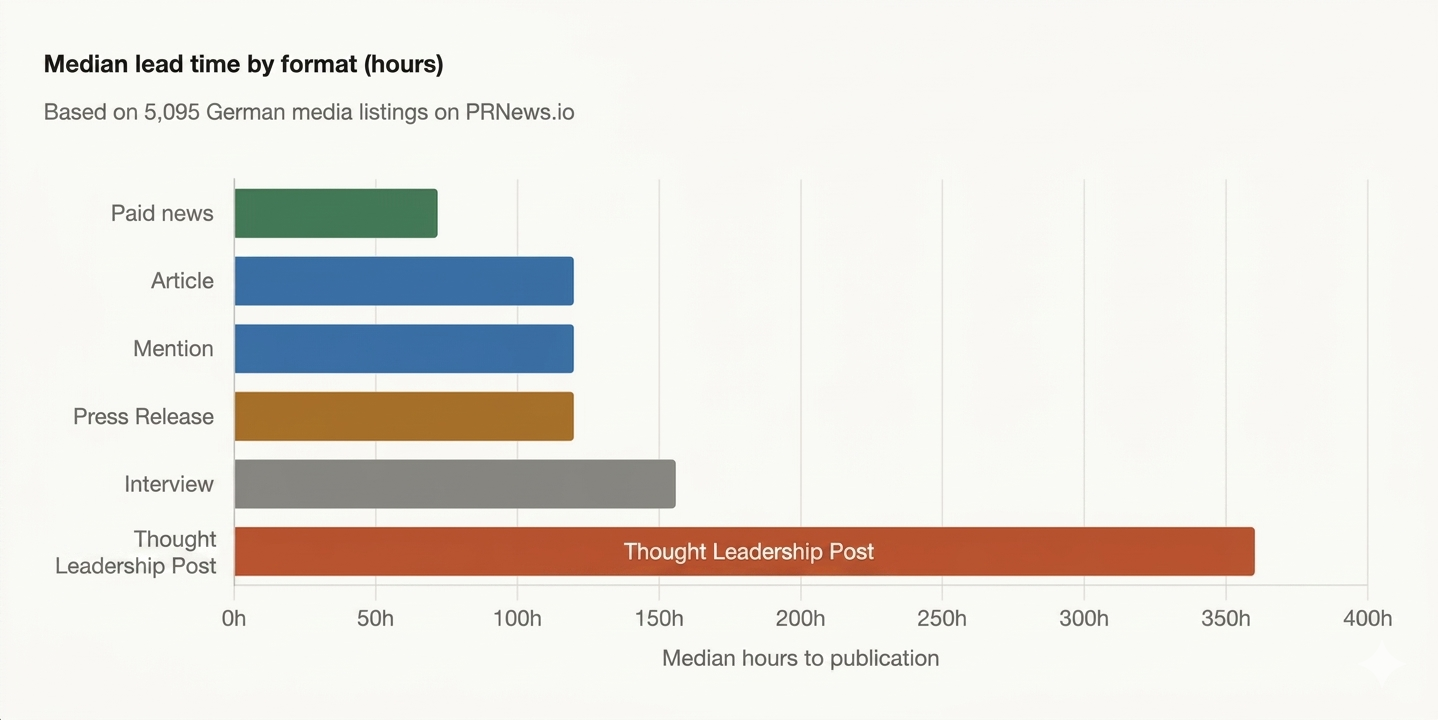
Lead time — the window between submission and publication — is one of the most underestimated variables in PR planning. Miss it and a product launch lands after the news cycle. Rush it and editorial quality suffers. Here’s what the data shows across 5,095 German media listings.
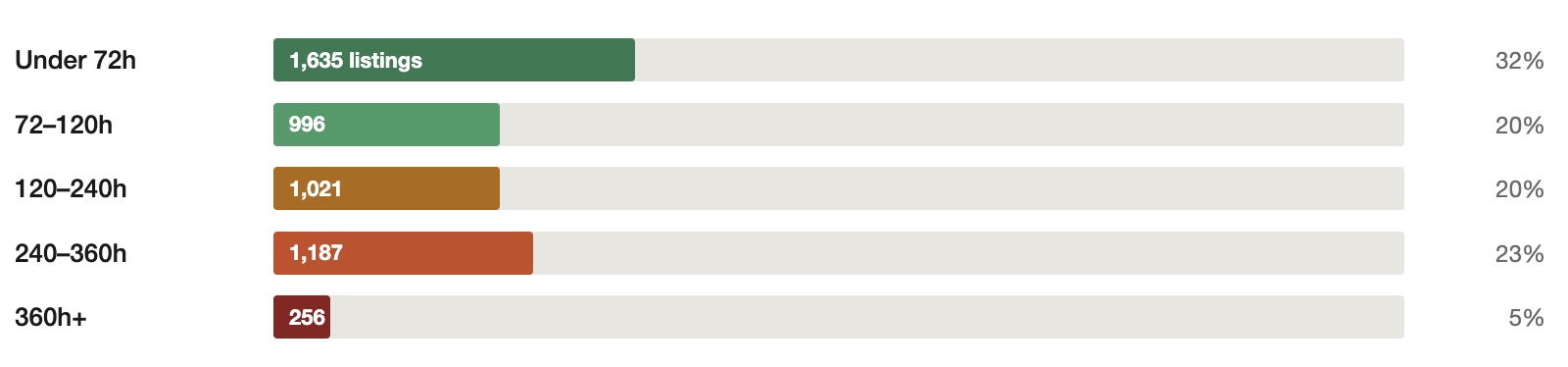
Lead time distribution across all German outlets
More than a third of all placements can go live within 72 hours. But thought leadership posts tell a different story — 90% of them require 360 hours (15 days) or more.
Planning benchmarks — what to tell your team
-
72h
Realistic minimum for paid news and mentions; ideal for reactive PR around breaking news cycles.
-
5–7 days
Standard for articles (120–168h) — achievable at most mid-tier outlets.
-
10 days
Required (240h) for major regionals like HNA.de, Freie Presse, Blick.de.
-
15–21 days
Budget (360–504h) for BILD, WELT, Focus Online, and all thought leadership post placements.
Focus Online has the longest observed lead time in the dataset at 720 hours (30 days).
Why German lead times are longer than other European markets
Several structural factors inflate German editorial timelines compared to, say, the UK or Polish markets:
Two-step editorial review
Many quality outlets require both a topic approval and a post-draft review cycle, adding 3–5 days to the standard process.
Legal compliance review
Germany’s press law (Presserecht) and defamation standards are strict. Outlets often have in-house lawyers who review commercial content before publication, especially for health, finance, and legal verticals.
“Anzeige” placement rules
Legally labeled content must be visually distinguishable from editorial. This requires additional layout and design sign-off that adds workflow steps.
Collective bargaining in larger newsrooms
At major outlets like BILD or WELT, commercial content workflows involve multiple departments (commercial, editorial, legal) with defined turnaround SLAs that cannot be accelerated for external clients.
Holiday blackouts
German labor law protects extensive public holidays (up to 17 days in Bavaria). Major campaigns scheduled around November–January or Easter week routinely experience 20–30% longer actual lead times than nominal figures suggest.
Seasonality and timing: when to plan your German campaign
| Period | Risk level | Notes |
|---|---|---|
| January–February | Low | Post-holiday reset; fastest processing times of the year |
| March–April (Easter region) | Medium | Public holidays vary by state (Bavaria vs. Berlin); add 3–5 days buffer |
| May–June | Low | Strong period; many Ascension / Whit Monday holidays but advance-bookable |
| July–August | High | Summer editorial skeleton crew; lead times often double at quality outlets |
| September–October | Low | Best overall window for campaigns targeting German business decision-makers |
| November (pre-Christmas) | Medium | High commercial competition for editorial slots; book early |
| December | High | Most outlets freeze commercial content after the 15th; almost nothing publishes between Dec 24–Jan 2 |
“If your campaign has a hard launch date, thought leadership posts at top-tier outlets like Tagesspiegel or FAZ.net require a 15-day minimum runway — no exceptions. Budget accordingly or choose a faster format.”
Section 03
Unlabeled vs. sponsored: what “Anzeige” costs — and what it’s worth
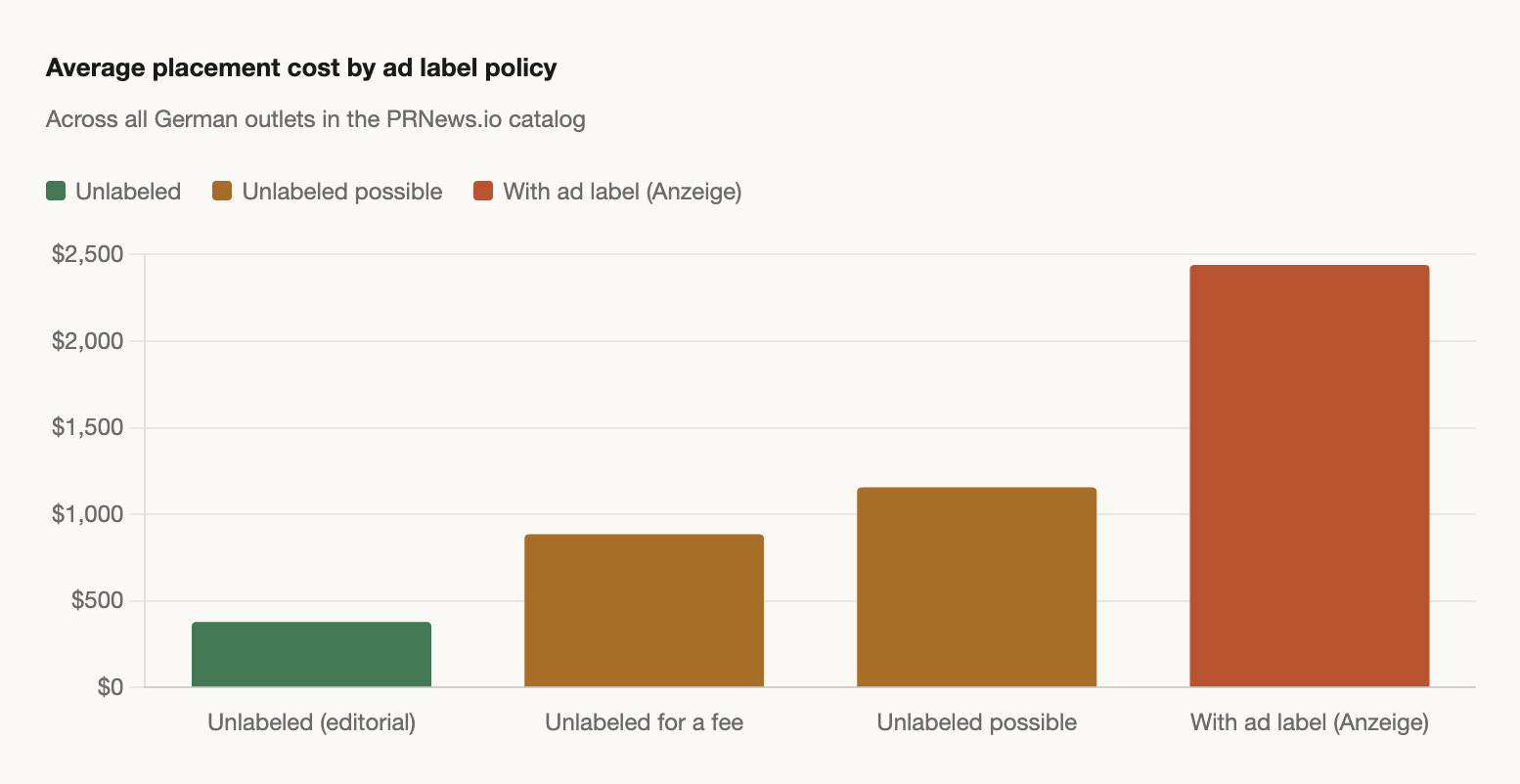
Germany has some of Europe’s strictest editorial transparency norms. The word “Anzeige” (advertisement) is legally required on commercial placements at most major outlets. But the data reveals a spectrum that marketers often misunderstand — and a pricing gap that’s impossible to ignore.
| Metric | 🟢 Unlabeled placement | 🔴 With Anzeige label |
|---|---|---|
| Average cost | $378 | $2,440 |
| Median cost | $227 | $1,183 |
| Share of listings | 53% | 29% |
| Typical format | Article, Mention | Article, Contributor Post |
| Typical DR range | DR 10–50 | DR 60–90 |
| SEO value | High | Moderate |
| Reader trust signal | Editorial | Commercial |
Why labeled placements cost 6× more
The premium isn’t arbitrary. Outlets that require the “Anzeige” label are almost exclusively Germany’s top-tier publishers — BILD, T-Online, WELT, Focus Online, Tagesspiegel — with domain ratings of 85–90 and audiences in the tens of millions. The label requirement is the editorial policy of high-integrity newsrooms, not a deterrent.
Mid-tier outlets with DR 20–50 are more likely to offer unlabeled placements — which explains both the lower cost and the higher SEO link equity per dollar. These outlets don’t have the same editorial firewall, and their linking policies tend to be more flexible (dofollow vs. nofollow).
Strategy implication
For brand awareness campaigns, labeled placements at high-DR outlets deliver reach and legitimacy. For SEO link building, unlabeled placements at mid-tier outlets deliver better cost-per-DR-point. Smart campaigns use both tiers in parallel.
Advertisers today usually want more than just a backlink or a quick publication. They care about visibility, trust, SEO, and whether the article stays relevant for readers over time.
In the last one or two years, the cooperation between brands and publishers has become more practical and direct. Briefings are clearer, labeling as “sponsored” is taken more seriously, and both sides usually know better what they expect from the collaboration.

CEO bei klamm.de
The “unlabeled is possible” tier — your negotiation window
873 listings (17% of the catalog) sit in a middle category: “unlabeled is possible.” These outlets — averaging $1,155 per placement — offer editorial-style presentation for an additional fee, or leave the decision to the editor. This is the category where campaign managers can often negotiate presentation, especially for financial or lifestyle content that resembles organic editorial.
Section 04
Germany’s media categories: where the volume lives
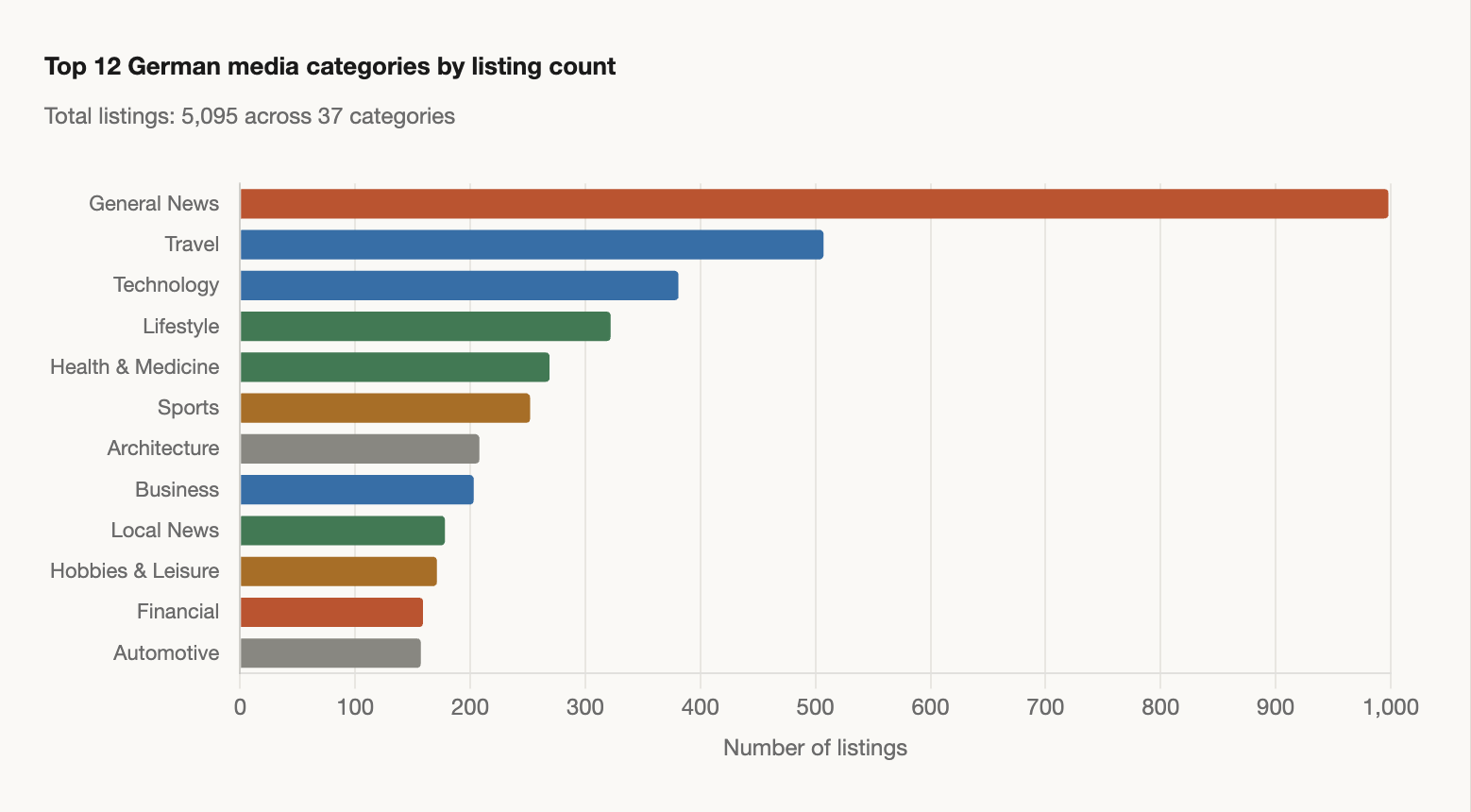
The German catalog spans 37 content categories. General News and Travel dominate by listing volume, but niche categories often deliver better targeting at lower cost.
Category strategy notes for German market entry
Section 05
The PR manager’s Germany buying guide: matching budget to objective
| Objective | Format | Budget range | DR target | Lead time | Key outlets |
|---|---|---|---|---|---|
| Mass brand awareness | Article | $8K–$64K | DR 85–90 | 15–30d | BILD, T-Online, Focus Online |
| SEO link building | Article / Mention | $100–$500 | DR 20–50 | 3–5d | Mid-tier regionals, niche portals |
| Financial news | Press Release | $415–$981 | DR 61–75 | 5d | Finanz Nachrichten, ad-hoc-news |
| Reactive PR | Paid News | $150–$400 | DR 25–40 | 1–3d | News aggregators, regional portals |
Section 06
3 things the data tells us about German media buying in 2026
“Anzeige” is not a penalty — it’s a quality signal
Germany’s labeled placements average 6× the cost of unlabeled ones. That premium reflects outlet quality, not a disadvantage. For trust-building in regulated sectors (finance, health, legal), the Anzeige label at a DR 85+ outlet may deliver more credibility per euro than cheap unlabeled placements at low-DR sites.
“The biggest mistake international brands make when entering the German market is underestimating the ‘Anzeige’ requirement. It’s not a stigma — it’s a legal and editorial standard that our readers actually trust. Labeled content that is genuinely useful performs better in our analytics than unlabeled content that feels forced.”

Board Member @ PRNEWS.IO
Press releases: the highest ROI format nobody talks about
At $8.73 per DR point, press releases outperform every other format on pure SEO cost efficiency. The constraint is editorial qualification — but financial, corporate, and newsworthy tech announcements that meet editorial standards can unlock DR 60–89 outlets at a fraction of article pricing.
The mid-tier DR 40–70 zone is Germany’s best-value sweet spot
With 3,000+ listings in this range, mid-tier German media offers the best combination of domain authority, reasonable cost ($400–$1,500), manageable lead times (120–240h), and category diversity. For most B2B and consumer brands, a portfolio of 5–10 mid-tier placements delivers better ROI than one premium placement.
Section 07
Calculate your German media budget in 10 seconds
A budget calculator built from 5,217 real, bookable listings in the PRNEWS.IO German media catalog — not estimates. Pick a goal below and get a real number.
What’s the goal of this campaign?
Target industry (optional)
| Your Germany campaign estimate | |
|---|---|
| Format to ask for | — |
| Typical budget | — |
| Domain Rating target | — |
| Lead time | — |
| Outlets like these | — |
Based on 0 of 5,217 catalog listings.
Looking ahead
German media in the AI era: transformation, lawsuits, and GEO
Germany’s media market has become one of the world’s most interesting laboratories for AI-era publishing strategy. While some markets are waiting to see what happens, German media giants are acting — either by integrating deeply into AI ecosystems, or by building legal and editorial barricades around their content.
Axel Springer: “If you can’t beat them, charge them”
The publisher behind BILD, Die Welt, Politico, and Business Insider became the first major media group globally to sign a large-scale commercial deal with OpenAI. Instead of blocking AI crawlers (as The New York Times did), Axel Springer chose direct integration: when ChatGPT users ask about current events, responses draw on Axel Springer content and link back to source articles. CEO Mathias Döpfner has said openly that AI has the potential to fully replace journalists who do aggregation, layout, and technical editing — and Axel Springer has already cut hundreds of editorial jobs at BILD and Die Welt as part of an AI-driven restructuring.
“We are excited to have shaped this global partnership between Axel Springer and OpenAI – the first of its kind. We want to explore the opportunities of AI empowered journalism – to bring quality, societal relevance and the business model of journalism to the next level.”

CEO of Axel Springer
What this means for sponsored content buyers
Axel Springer’s deal with OpenAI is early-stage Generative Engine Optimization (GEO) in action. Brands placing sponsored content in Axel Springer properties gain indirect exposure not just to the outlet’s direct audience but potentially to AI-generated answers that draw on that outlet’s content. The sponsored content ecosystem is beginning to extend beyond the page.
The shift from SEO to GEO/AEO in Germany
German media strategists were among the first in Europe to raise alarms about Google SGE (Search Generative Experience) and Perplexity’s Zero-Click impact on traffic. German users are highly rational and efficiency-oriented — they readily accept AI-summarized answers without clicking through to the source. This is already reducing organic referral traffic at major outlets.
How German outlets are adapting
-
Schema.org micro-markup at scale
Structured data has become a top editorial priority, making content easily parseable by AI engines.
-
Brand mention optimization
Instead of keyword ranking, content is now crafted so LLMs associate the outlet’s brand with authority in specific niches.
-
Opinion and analysis as the AI-proof format
Since AI can rephrase facts easily, German publishers are doubling down on exclusive interviews, expert commentary, and investigative depth that models cannot generate from scratch.
-
Fully automated regional micro-sites
AI now independently aggregates weather, traffic, local sports results, and police reports into published articles at some regional outlets, with no human editor.
The legal coalition: Corint Media vs. AI companies
While Axel Springer integrates, a significant bloc of German publishers — united under the Corint Media association — is pursuing the opposite strategy: demanding licensing fees from LLM developers for use of German-language content in AI training. Germany is also pushing at EU level for the AI Act to require tech companies to disclose all data sources used in model training. For the regional press in particular, this is framed as a survival issue: if AI can absorb German linguistic culture and local facts without compensation, smaller outlets simply cannot sustain independent journalism.
Camp A: Integrate
Axel Springer, Hubert Burda, Bertelsmann — building proprietary internal AI platforms for journalists, signing commercial deals with OpenAI, deploying automated editorial agents for routine content types.
Camp B: Resist
Corint Media consortium — pursuing licensing revenue from AI companies, lobbying the EU AI Act, restricting crawler access. Framing unique German-language content as a protected cultural and commercial asset.
Ready to start? Place your content in German media today. Browse 5,095 vetted German outlets on PRNews.io — filter by format, DR, lead time, and category. Or let our team build your campaign from scratch.