The ribbon gets cut at ten. A TV crew that half-promised to come is at a house fire two towns over, and by Thursday the opening has been covered by one outlet, the brand’s own Instagram. That same week headquarters lands a trade feature about the system’s growth. Nobody in the new store’s zip code will read it.
That is franchise PR in one morning: one brand, two audiences, and coverage that has no passport. The industry’s own trade body now spends five million dollars telling Americans that franchises are local businesses. If the lobby has to spend that much, the point is not yet made.
TL;DR
- Franchise PR is three programs: recruit franchisees nationally, earn customers locally, and keep one unit’s bad day from becoming the brand’s.
- Coverage stays where it is printed. Forty units need forty local programs, built on templates from headquarters and stories from the owners.
- Most markets have no reporter left, but the business journal, the city magazine list and the TV lifestyle desk remain. Each has its own door and deadline.
- Money talk belongs in the disclosure document. Quote only what Item 19 already says.
- Count unique stories per market, never syndications. Four in five franchisees own one unit and judge PR by their own town.
What is franchise PR?
Franchise PR is public relations for a business with one brand and many independently owned locations. It runs three programs at once: development PR that recruits buyers through trade media, local PR that earns coverage in each unit’s market, and a reputation program for the day a single unit makes news. Ordinary PR has one audience. Franchise PR has two customers and a regulator.
The first program is the one agencies sell, and it is judged by signed franchise deals. A fine program. It just does not send a customer through the door in Tampa. The second is where the International Franchise Association has put its money. Its Franchise Means Local campaign launched in October 2025 on one statistic: 81% of franchisees own and operate only one unit. Those owners do not read the trade feature. They read their own town.
Why does a franchise need PR in every market?
Because coverage does not travel, and that is now a number. The largest independent study of local AI citations to date found that of every hundred businesses an AI assistant recommended across fifty American cities, two were named in more than one. Pluspoint then traced which pages AI assistants rely on when they name a local business across seven industries in five cities. Every deciding page was local. A Dallas magazine’s list picked the Dallas dentists and a Miami guide picked the Miami clinics, and none of those pages had ever mentioned Houston. Print a story in Dallas and it does nothing for the Houston location. Houston is not offended. It simply never heard.
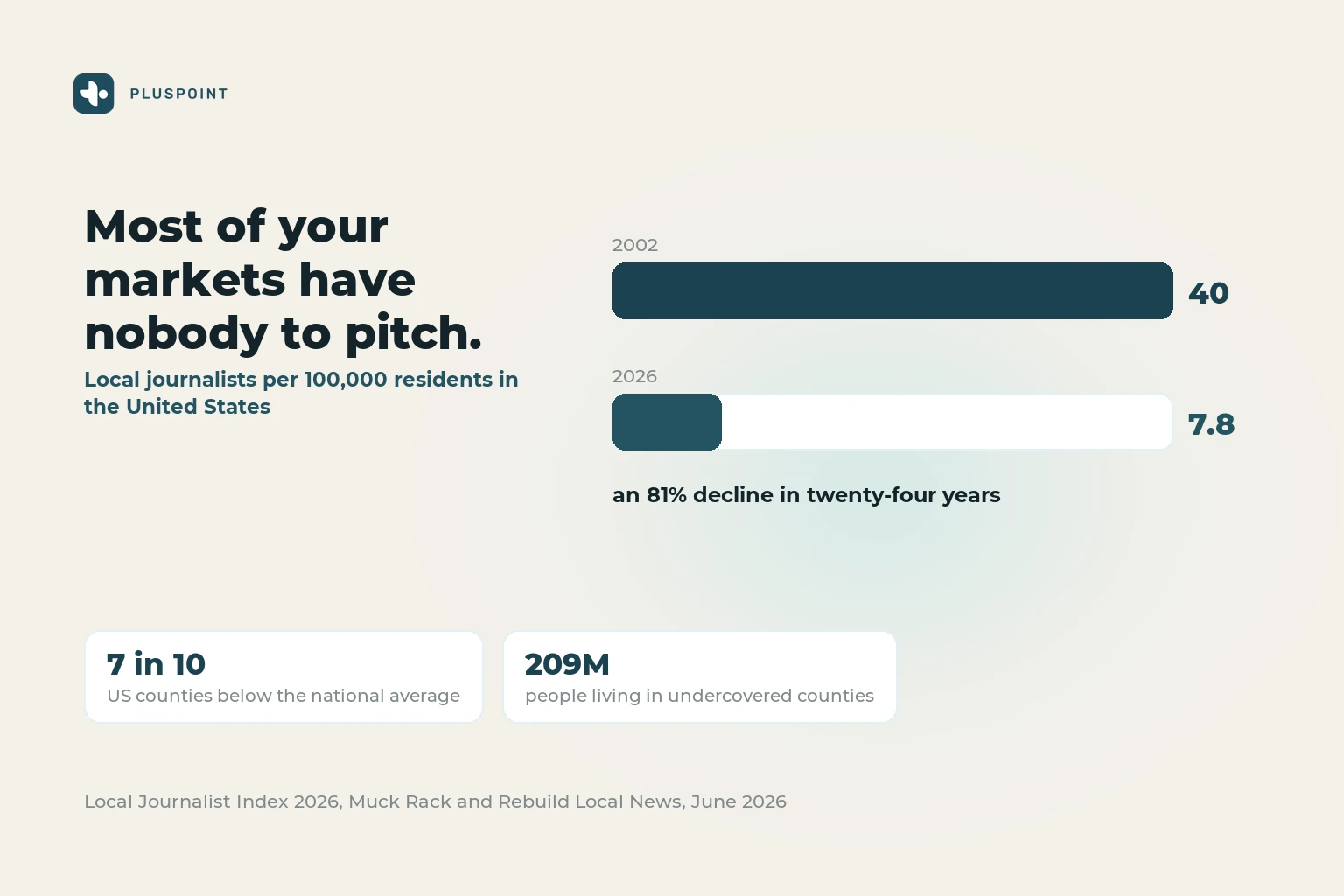
The people who could carry a story between markets are mostly gone. Rebuild Local News counts 7.8 local journalists per 100,000 residents in its 2026 Local Journalist Index, down from about forty at the start of the century. Your Denver location shares its reporter with roughly 12,800 other people who also have news.
Which local channels still exist, and how do you get into each?
Fewer reporters does not mean fewer doors. It means different ones, and each has its own key.
| Channel | What it runs | How a franchise gets in | Cost |
| The Business Journals, 44 markets | Awards lists and a paid new-to-market listing | Nominate on the calendar. Every list closes on a fixed date | Lists free. A listing is $495 |
| Axios Local, 35 cities | A morning newsletter with a quarterly list of new openings | Email the city reporter before opening with the address, date and owner | Free |
| City magazines | Peer-voted annual lists of top dentists, doctors and restaurants | One-month nomination windows. D Magazine’s Best Dentists only lists dentists already in its directory | Free by rule |
| Local TV, 210 markets | Morning and lifestyle segments that stay online for months | Offer something to film. Producers book weeks ahead | Earned is free. Paid slots are labeled |
| Patch, 16,400 communities | Hyperlocal news and newsletters | Post the opening yourself | Free, or $79 a month to be featured |
| Nextdoor, one in three US households | Neighbor recommendations, not news | Claim the page before opening and answer every thread | Free |
| Regional paid placement | Articles in city outlets where no earned page was coming | PRNEWS.IO’s marketplace filters outlets by city. A placement in the wrong market is a placement nowhere | From a few dollars per outlet |
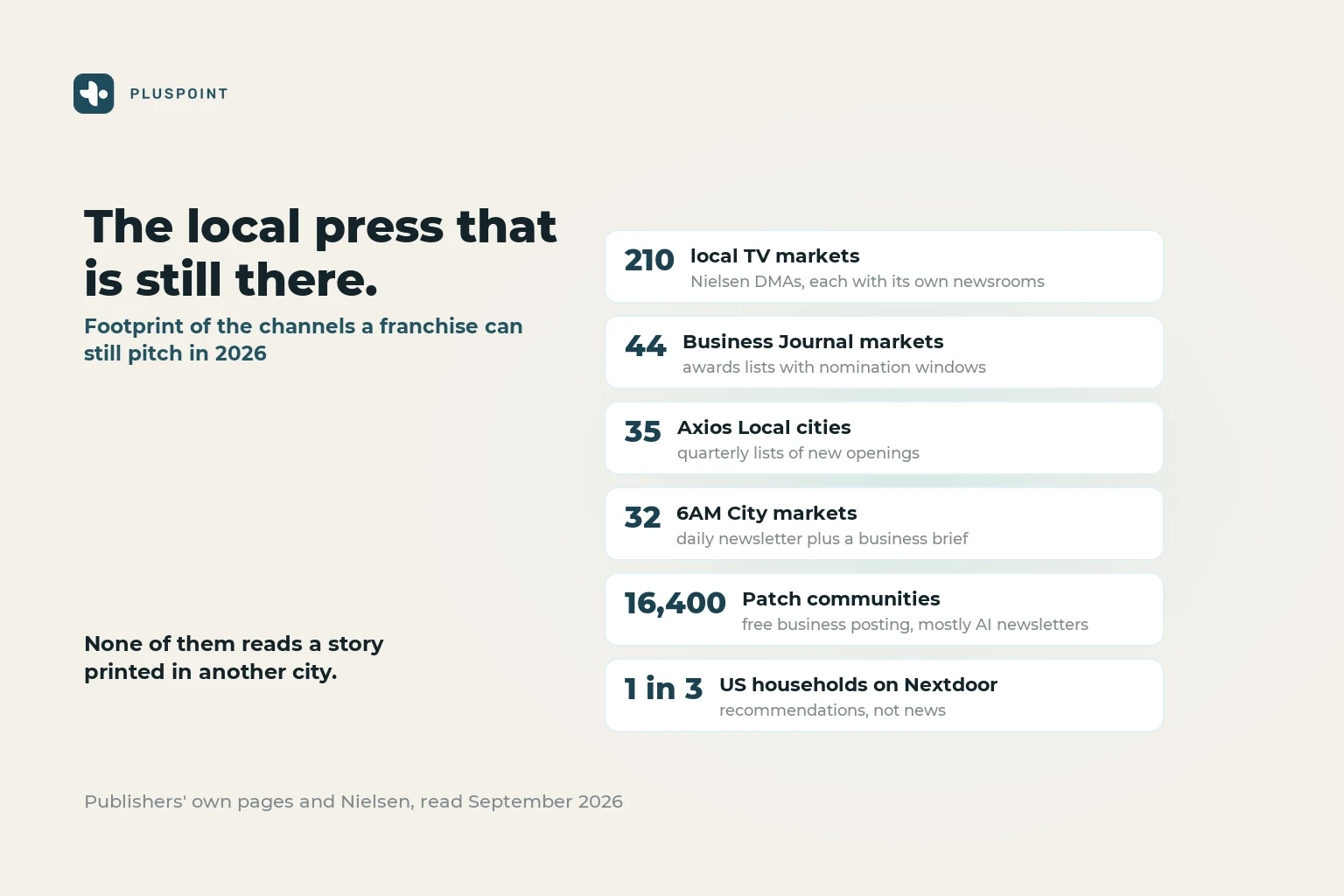
Two rows decide a year. The business journal will announce your arrival for $495, which is the going price of being new in a town that has run out of reporters. And dentists missing from the magazine’s directory cannot be nominated at all. A forty-unit system with nobody tracking that has forty ways to miss it.
How do you pitch a franchise story to local media?
Shorter than you think, and closer to home than you think.
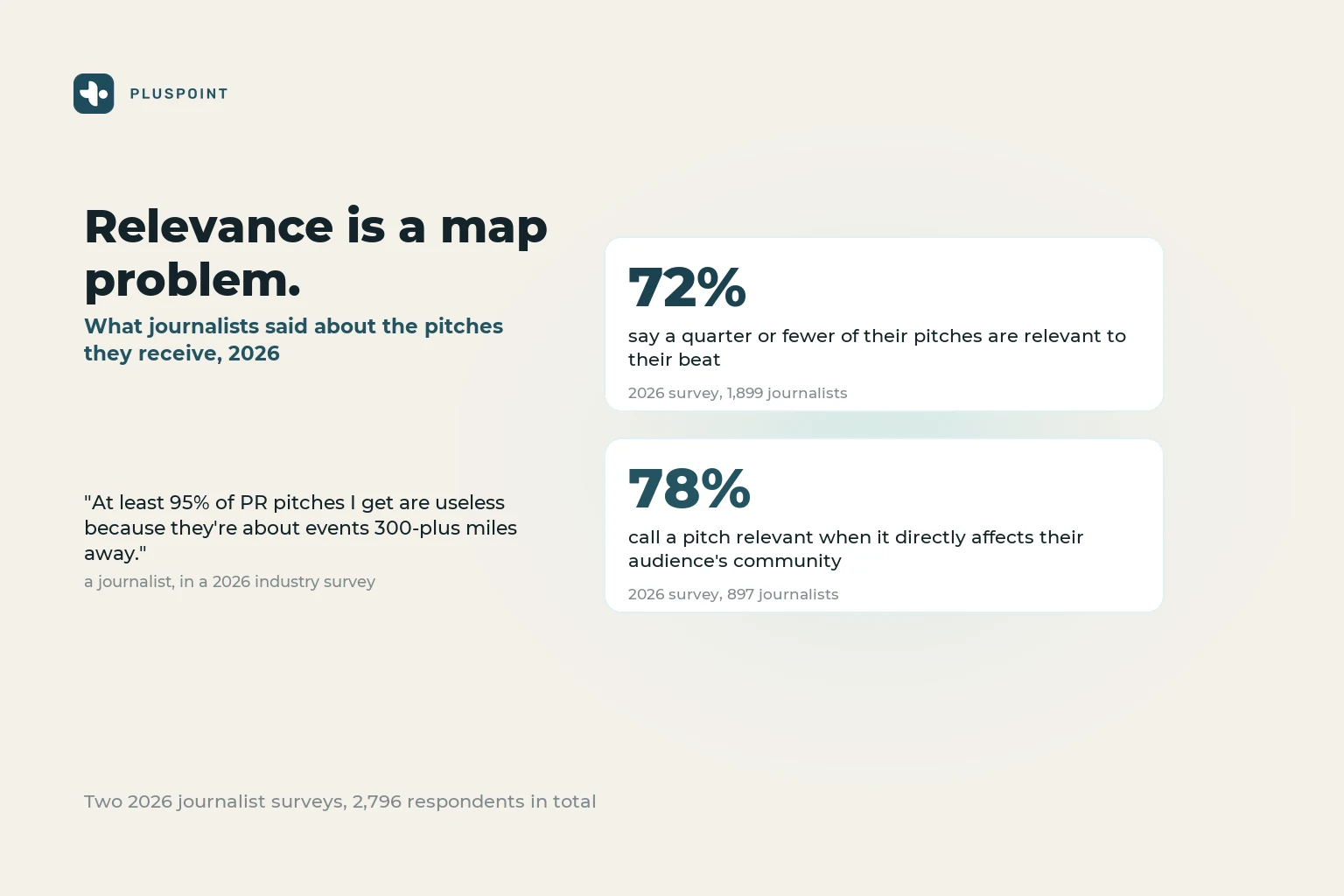
In a 2026 survey of 1,899 journalists, most said they receive more than fifty pitches a week and delete them first for being off their patch. One respondent wrote what every franchise PR team should print above its desk: “At least 95% of PR pitches I get are useless because they’re about events/people 300-plus miles away on the other side of the state.” A second survey found the same from the other side: journalists call a pitch relevant when it directly affects their audience’s community, and want it under 200 words by email before noon.
So a franchise pitch is local by construction. The subject line names the neighborhood and the first sentence names the owner. Four angles do most of the work:
- The owner. Who they are and why this town. Two former employees who met at a Steak and Ale and now own the brand’s first Southern franchise earned a trade feature on that alone.
- Local data the system already holds. What this city orders that no other city does.
- Jobs and community. The hiring count, the school sponsorship, the charity tie-in. Dull to headquarters, front page to a Patch editor.
- The list. A nomination or a win. Local lists are the one story that arrives with its own publication date.
The angle that does not work is the one most systems send. “We opened a location” is a fact. So is the weather. A former reporter reviewing a failed pitch on Reddit put the rule in one line: “The story isn’t the drug, it’s the life it just changed.” For a franchise the store is never the story, and the owner almost always is.
The whole pitch fits in 120 words. A subject line with the neighborhood and the date. One sentence on who the owner is and why here, then a single local number. When the owner is free this week. A link to photos, and nothing attached.
What should headquarters ship to every franchisee?
Everything the unit cannot build alone, and nothing that pretends to be from somewhere.
Headquarters owns the machinery and the unit owns the story. Failed programs confuse the two: every local release written from Atlanta, or a logo file and good luck. The toolkit sits in between.
| What headquarters ships | Why | Who owns it after opening |
| Boilerplate with the “independently owned and operated” line built in | Consistent facts for journalists and AI assistants, and the line counsel wants everywhere | HQ writes, units paste |
| Spokesperson policy | Many franchise agreements bar owners from talking to press without written approval. One filed in 2025 says exactly that | HQ sets, units follow |
| Release templates with local fields | Owner, address, date, hiring count, community partner. The story lives in the fields | Units fill |
| Photo and b-roll kit | Local TV says yes to what it can film | HQ shoots the brand, units shoot the owner |
| Per-market media list | The business journal editor, the Axios reporter, the magazine list owner, the TV producer | HQ builds, units use |
| List-deadline calendar | Every nomination window in every market | HQ tracks, units nominate |
| Crisis card | Who speaks, who does not, the first-hour holding statement, who answers the reviews | Both, rehearsed |
| Listings, reviews and local posts | The card beside every local answer has to match the story. Pluspoint is a local marketing platform for multi-location brands that keeps listings, reviews and local posts consistent across every unit from one dashboard, the part of the toolkit that runs every day rather than at opening | HQ runs, units reply |
A unit can do the one thing headquarters cannot: be from somewhere. The owner who sponsors the under-elevens and knows the Axios reporter’s name has a story about the block, and no template writes it.
What does a grand-opening PR timeline look like?
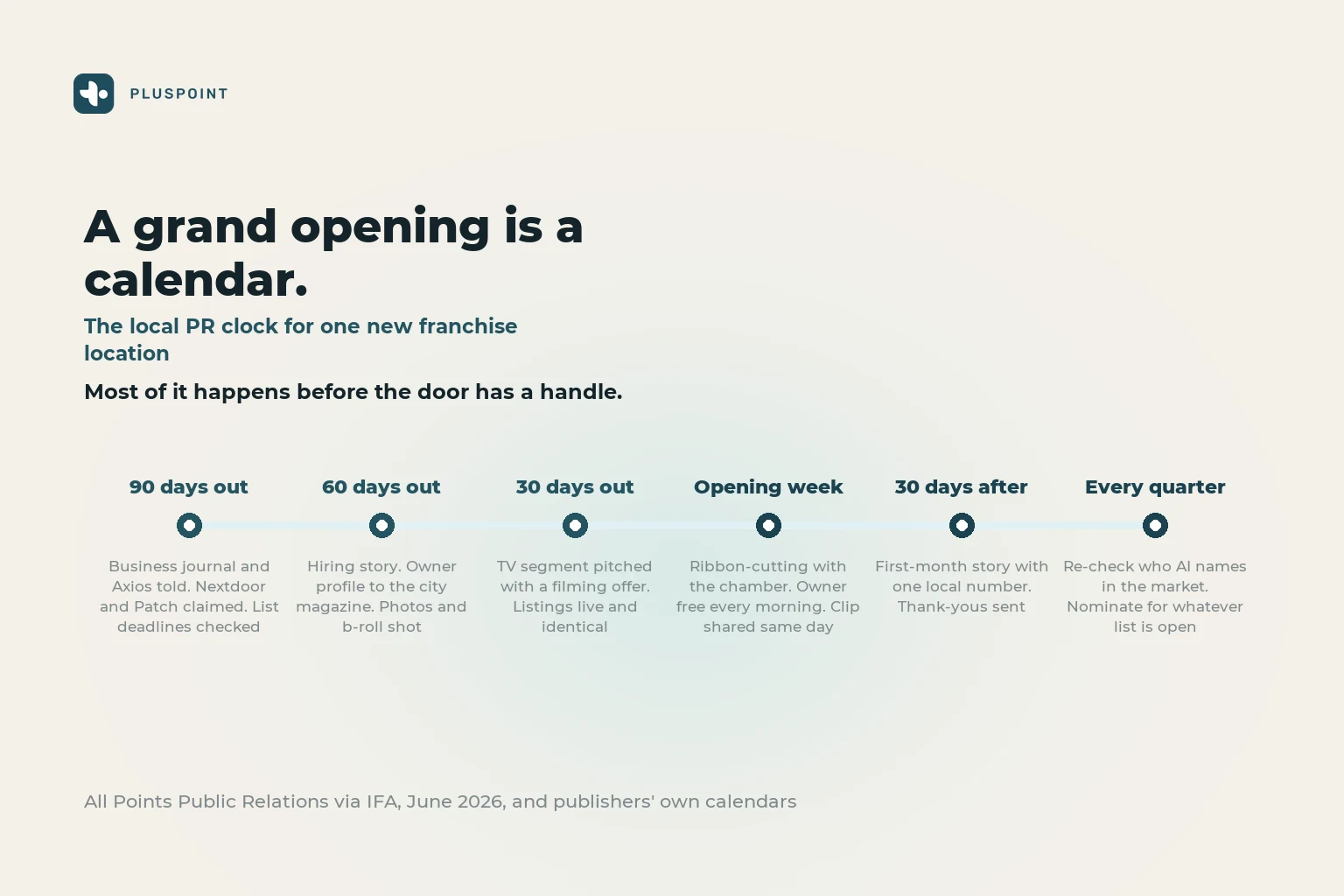
A ribbon-cutting is a photo. A grand opening is a calendar, and most of it happens before the door has a handle.
The IFA’s June 2026 guidance to franchisors is to begin outreach before construction finishes, with a story that answers “why this market and why now.” Channels set the rest of the clock. Axios refreshes its openings list quarterly, business journal lists close on fixed dates, and a TV producer booking Valentine’s segments in early February has already said no to Christmas.
| When | What runs | Who owns it |
| 90 days out | Market-entry story to the business journal and Axios. Claim Nextdoor and Patch. Check every list deadline | Franchisor, franchisee named |
| 60 days out | Hiring story with the jobs count. Owner profile pitched to the city magazine. Photos and b-roll shot | Franchisee, on HQ templates |
| 30 days out | TV segment pitched with a filming offer. Community partner announced. Listings live and identical everywhere | Both |
| Opening week | Ribbon-cutting with the chamber and one local official. Owner available every morning. Coverage shared the day it publishes | Franchisee |
| 30 days after | First-month story with one local number. Thank-you to every outlet that came | Franchisee |
| Every quarter | Re-check who the AI assistants name in that market. Nominate for whatever list is open | HQ, per market |
PRNEWS.IO’s own analysis of content gaps that keep brands out of AI answers explains the last row. An AI answer has two speeds. The live part updates in weeks, and the part baked into the model moves over quarters, and only when the same facts repeat across many pages. A market is planned in quarters, not in press releases.
What can franchise PR not say?
Anything about money that is not already in Item 19, and anything about a franchise sale in a state that wants to see the ad first.
The FTC Franchise Rule treats any statement of sales or profit made to a prospective franchisee as a financial performance representation, “including a representation in the general media.” Its compliance guide draws the line on audience rather than medium. A bona fide news story is not a representation. But a franchisor that reprints the flattering article in its sales materials has made a general media claim, and every number in it now needs a place in Item 19. The regulator does not read your coverage the way a prospect does. It reads it the way a regulator does, which is worse.
The rule bites on more than earnings. In March 2026 the FTC settled with Xponential Fitness for $17 million over claims that included a six-month opening timeline that typically took more than a year. An opening date in a press kit is a claim, and someone will keep the press kit.
| Say it | Do not say it |
| The unit count, the markets, the owner’s story, the jobs | Average unit sales, margins or payback periods, unless Item 19 carries them |
| “This location is independently owned and operated by [owner]” | Anything from headquarters that announces or directs a franchisee’s hiring, firing or wages |
| “Franchise opportunities available,” with the state legend where required | A development release in California, Maryland, Minnesota, New York, North Dakota or Washington before the state has it on file |
| Opening dates you have hit before | Opening dates you hope to hit |
What happens when one unit becomes the story?
The contract says the unit is independent. Nobody told the internet.
Three cases from the last nine months show the shape of it. In December 2025 an employee at a Cinnabon in Wisconsin posted a racist rant on a Friday, and the corporate statement came on Sunday, saying “the franchise owner” had fired him. In January 2026 a Hampton Inn in Minnesota refused federal agents’ bookings, and Hilton terminated the franchise the next day. And from May 2026 a dispute at one Bricks & Minifigs store in Oregon went viral on YouTube, after which stores across the network “experienced harassment, threats and other disruptions.” None of them had anything to do with it.

The protocol is short and has to be rehearsed, because the first hour is decided by whoever is holding a phone. One voice, which is the oldest rule in franchise crisis work. Two statements in a fixed order, the owner for the store and then headquarters for the brand, with headquarters describing what the owner did rather than doing it. A twenty-four-hour clock, since Cinnabon’s forty-eight cost it a news cycle of “no comment.” And the reviews desk stays open, because a viral clip reaches the unit’s Google profile within the hour and the sister units’ profiles by morning.
How do you measure franchise PR?
Per market, in unique stories, and twice.
A PR office asked on Reddit in December 2025 whether one wire story that lands on a hundred station sites is one hit or a hundred. The best answer in the thread was a format: “5 unique articles (30 syndications).” A franchise counts exactly that way, per city, because a segment syndicated to forty markets was still filmed in one and the other thirty-nine owners can tell.
Per unit, four numbers do the job: unique local stories in the quarter and list placements, then whether a local AI answer named the unit and review velocity in the month after coverage. Add two per system: trade placements and the franchise inquiries they produced. Ask each AI question twice on two engines, since a single run measures noise, and start with the weakest market. The strong market flatters the program and the weak one invoices it.
What does franchise PR cost?
Less than the marketing fund already collects, if the fund is spent on it. Most systems take one to two percent of unit revenue for a national fund and require another one to three percent spent locally, and the documents that define local spend routinely list public relations.
Local PR is mostly time and relationships, which is why the owner’s calendar is the scarce budget. The paid parts are small and public: $495 for a business journal listing and $79 a month for a featured Patch presence, a few dollars per outlet on PRNEWS.IO, and nothing for the magazine lists.
The expensive line is the one nobody budgets: someone at headquarters tracking forty list deadlines, forty media lists and forty AI answers. That is an operations cost, not a media cost.
What the standard franchise PR advice gets wrong
“One national story lifts every location.” It lifts franchise sales, which is what it is for. The businesses named in more than one city in the fifty-city study were century-old national chains. Everyone else is local or invisible.
“A press release is PR.” A release is a document. It becomes PR when a reporter in the unit’s market turns it into a story, and only that story counts.
“The franchisee will handle local PR.” Four in five franchisees own one unit and run it. In a 2026 benchmark of 26,000 franchisees, marketing support scored lowest of every area measured. When an owner asked Reddit in July 2026 what to do before opening day, none of thirty replies mentioned the press. Ship the toolkit or accept the silence.
Method and sources
Pluspoint’s seven-industry measurement ran on 1 September 2026, one customer-voice question per industry across five US metros with live web search on. Cross-city figures are from Steady Demand’s August 2026 fifty-metro analysis. Channel footprints and prices are from the publishers’ own pages, read 2 September 2026. Journalist figures are from two 2026 industry surveys of 1,899 and 897 journalists, and regulatory text from 16 CFR 436 and the FTC’s compliance guide. Quotes are verbatim and dated where cited.
Frequently asked questions
What is franchise PR?
Public relations for a brand with many independently owned locations. It runs three programs: recruiting franchisees nationally, earning local coverage for each unit, and protecting the brand when one unit makes news.
Who should run franchise PR, the franchisor or the franchisee?
Both, with a clean split. Headquarters owns the national story plus the toolkit and the deadline calendar, and the owner supplies the local story and the relationships.
How do you get local press for a new franchise location?
Pitch the owner rather than the opening to the business journal and the Axios reporter and the TV lifestyle desk, under 200 words and before noon. Then nominate for every list with a window.
Can a franchisor talk about sales figures in the press?
Only figures already in Item 19 of its disclosure document, and never in material aimed at prospects. A news story is not a representation. Reprinting it in sales materials makes it one.
How do you measure franchise PR?
Per market and in unique stories rather than syndications. Add list placements and review velocity after coverage, and check whether local AI answers name the unit.