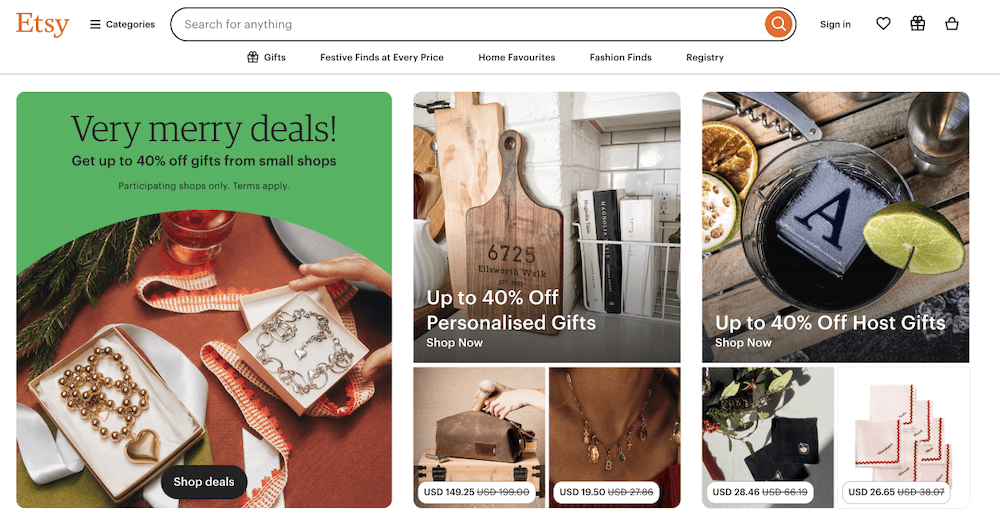
If you are considering selling on Etsy, you should know that the marketplace works differently from other platforms in the industry. Rather than allowing branded product retailing, you can sell craft and vintage goods. Despite strict product rules every retailer should follow, Etsy SEO is a separate topic you should master to ensure your offers get noticed in Etsy search and Google.
Etsy SEO is a strategy for optimizing your shop and product listings to appear prominently in Etsy search results. By aligning your listings with Etsy shoppers’ keywords and search behavior, you can improve visibility and leverage Etsy’s built-in audience to drive free traffic.
This guide provides practical tips on how to boost Etsy SEO and optimize your shop pages and listings for Google. Let’s dive in!
Etsy SEO Types
The ultimate goal of SEO (search engine optimization) is to make your data findable for potential customers. SEO helps boost the visibility of your shop and item listings in search engines like Google, Bing, and Yahoo.
When it comes to Etsy SEO, there are two primary types of optimization you should know about:
- Etsy SEO refers to making your shop pages findable in Etsy search.
- Google SEO covers optimization techniques intended to make your offers findable in Google search.
While making your listings findable in search giants like Google is essential, ensuring your shop’s pages appear in the marketplace’s search is vital.
Importance of Etsy SEO:
- Free Traffic: Organic search results mean visitors can find your listings without paid ads.
- Sustainability: Well-optimized listings continue attracting traffic over time.
- Competitive Advantage: Effective SEO can help your shop stand out even in saturated categories.
How Etsy’s Search Algorithm Actually Works in 2026
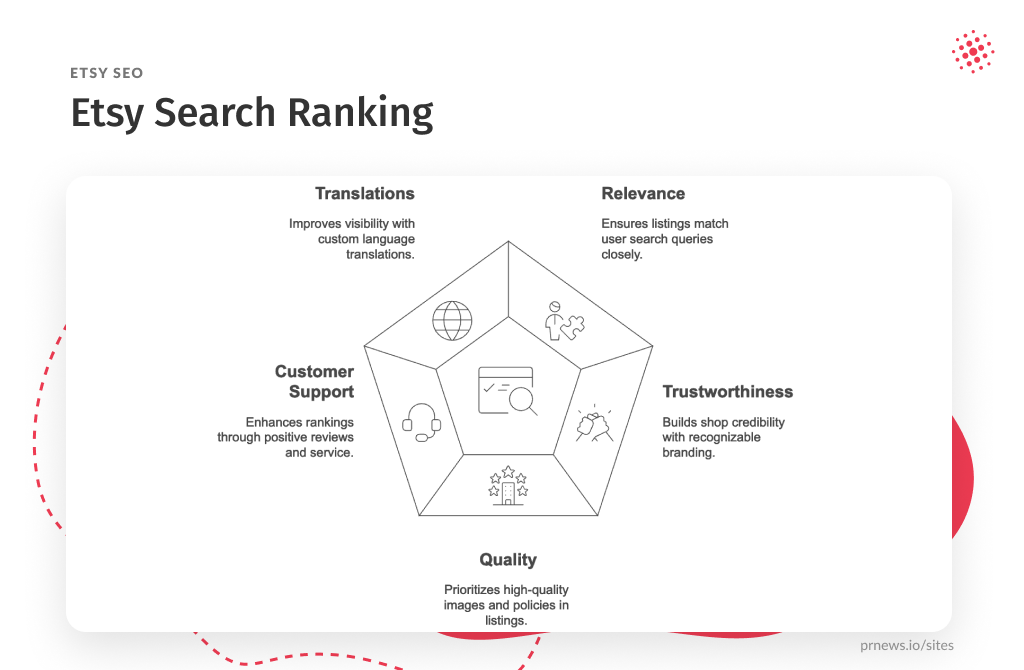
Etsy’s algorithm doesn’t just match keywords to listings — it runs every search query through a three-stage pipeline designed to surface the listings most likely to convert, not just the ones with the most keywords crammed into the title.
Understanding this pipeline is the foundation of any effective Etsy SEO strategy.
Stage 1 — Query Matching (The Eligibility Gate): The algorithm scans your listing’s title, tags, categories, attributes, and description to determine if your listing even qualifies to appear in results. In 2026, this scan is no longer purely keyword-based. Natural language processing (NLP) now identifies semantic relationships between terms, so “ceramic mug” and “stoneware coffee cup” are treated as related intents even without an exact-phrase match.
Stage 2 — Listing Quality Score (The Ranking Engine): Once your listing enters the eligible pool, its rank is determined by its Listing Quality Score (LQS) — a composite of how buyers interact with it. Clicks, favorites, add-to-cart actions, and completed purchases all feed this score. The algorithm uses this data to create a feedback loop: high-converting listings get shown more; listings with traffic but no sales hit a ceiling fast.
Stage 3 — Personalization (Context-Specific Ranking): Two shoppers searching for “gold earrings” will see different results. The algorithm layers in each buyer’s browsing history, past purchases, preferred price points, and device type to tailor the results. This is why rankings feel inconsistent — because they genuinely are, depending on who’s looking.
In short:
- Matching: Etsy examines the titles, tags, descriptions, and categories in your listings to determine relevance to search queries.
- Ranking: Once listings are matched, Etsy uses ranking factors, such as conversion rate and quality scores, to determine which listings appear at the top.
The Death of Keyword Stuffing: Etsy SEO Titles in 2026
For years, the standard Etsy title looked something like this: “Gold Earrings, Dangle Earrings, Boho Earrings, Birthday Gift for Her, Earrings for Women, Minimalist Jewelry.” That strategy is now officially penalized.
In early 2026, Etsy released new guidance calling for titles under 15 words and approximately 140 characters, structured like a natural product name rather than a keyword dump. The reasoning is partly algorithmic (NLP can now infer context without the pile-up) and partly practical: over 60% of Etsy traffic is mobile, and only the first 40–45 characters of a title are visible in the mobile search grid.
Front-load what matters. Your primary noun — what the item actually is — belongs in the first 40 characters, followed by your top two or three descriptors (color, material, style), with a unique value proposition at the end. Subjective filler words like “beautiful” or “perfect” are essentially invisible to the algorithm and should be moved to the description.
The most common mistake I see is sellers treating their title like a tag cloud. In 2026, the algorithm reads titles the same way a buyer does — and buyers don’t want to parse a comma-separated list. Write a title you’d say out loud, and you’re already ahead of most of your competition.
Etsy Seller Handbook, 2026 Title Guidance UpdateTags, Categories, and Attributes: The Non-Redundant Approach
One of the most wasteful habits in Etsy SEO is repeating the same keywords across every metadata field. Categories, attributes, and tags each serve a distinct purpose in the algorithm — and treating them all as “more places to put keywords” leaves indexing capacity on the table.
Here’s how to think about each field:
- Categories function as your “14th tag.” If you list a product under “Nail Stencils,” you don’t also need a tag for that exact phrase. The category already handles it.
- Attributes are category-specific details like color, material, style, and occasion. They feed the sidebar filters buyers use to narrow their search. A listing with complete attributes gets visibility in filtered results that keyword-only listings miss entirely.
- Tags should expand context, not repeat the title. Think: who it’s for, when it gets used, and the aesthetic it fits. “Handmade soy-scented candle” as a tag outperforms “candle” because it has lower competition and higher buyer intent.
The optimal tag strategy in 2026 focuses on long-tail keyphrases — three to five words that reflect how a real buyer would search at the moment of intent, not the broadest possible category label.
Visual SEO: Photography and Video as Direct Ranking Factors
Visuals aren’t just about looking good. In 2026, image and video quality directly influence your Listing Quality Score through their impact on click-through rate and time-on-page. The “Search Visibility Dashboard” — a new native tool Etsy rolled out in 2026 — actively flags listings with poor visual quality and links that flag to reduced search placement.
The primary thumbnail is your most critical asset. It needs to be high-contrast, on a neutral background, with the product filling 70–80% of the frame. That’s not an aesthetic preference; it’s the configuration that performs best in high-speed mobile scrolling, where buyers make a click-or-skip decision in under a second.
Beyond thumbnails, video has become effectively mandatory for competitive listings. A short listing video — showing the product in use, demonstrating scale, or highlighting texture and movement — keeps buyers on the page longer. That dwell time is a positive signal to the algorithm, and it directly correlates with higher conversion rates, especially for jewelry, textiles, and functional goods where movement matters.
| Image Type | Best Practice | Why It Matters for SEO |
|---|---|---|
| Primary Thumbnail | High-contrast, neutral background, product fills 70–80% of frame | Drives CTR in mobile search — the #1 early-stage ranking signal |
| Lifestyle Shot | Product shown in real-world context or in use | Helps buyers visualize ownership, boosting conversion rate |
| Detail / Macro | Close-ups of texture, stitching, or material quality | Reduces purchase anxiety; lowers return rates and negative reviews |
| Size Reference | Product next to a hand, coin, or common object | Prevents “smaller than expected” complaints that tank review scores |
| Listing Video | Up to 100MB; show movement, scale, or functionality | Increases time-on-page — a rising ranking signal in 2026 |
The $6 Shipping Rule and Pricing Strategy
If there’s one algorithmic change that surprised sellers most in 2026, it’s the shipping penalty. Etsy now actively deprioritizes US domestic listings with a shipping price above $6. The platform is competing directly with Amazon-style fulfillment expectations, and it’s using search ranking as the lever to nudge sellers toward more buyer-friendly logistics.
There are three practical responses:
- Shipping Absorption: Fold your shipping cost into the item price and offer free shipping. This is the cleanest solution and performs best psychologically with buyers.
- Flat-Rate Capping: Set a flat rate at $5.99 or lower and absorb the difference on heavier orders. Works well for shops with predictable weight ranges.
- The $35 Threshold: Use Etsy’s Free Shipping Guarantee for orders over $35. Individual item shipping can remain higher if buyers are likely to bundle.
On pricing more broadly, “Shop Velocity” — the frequency of sales over a given period — has become an indirect ranking factor. Shops that sell consistently are seen as more reliable by the algorithm and earn better placement over time. This means pricing strategy isn’t just about margins; it’s about keeping sales moving. For print-on-demand sellers especially, aiming for a 40% profit margin after Etsy’s 6.5% transaction fee, $0.20 listing fee, and payment processing costs is the standard benchmark to work toward.
If you’re building a brand that extends beyond Etsy — press releases, product launches, niche media coverage — PRNNEWS.IO offers press release distribution designed to drive traffic from editorial sources that Etsy’s algorithm can’t give you. Getting covered in a relevant niche publication creates backlinks and direct referral traffic that operates entirely outside the platform’s ranking system.

Shop Authority: Reviews, Response Rates, and the Star Seller Standard
Your individual listing SEO is amplified or throttled by your overall shop health. Etsy’s updated Customer Service Standards set a floor that every seller must stay above to maintain visibility — and falling below it doesn’t just reduce rankings, it can lead to selling restrictions.
The four metrics to track obsessively are:
- Message Response Rate: Keep it above 95%, responding within 24 hours (the first message in a thread doesn’t count).
- On-Time Shipping with Tracking: Ship within your stated processing time. At least 80% of orders should have tracking uploaded.
- Review Rating: Maintain 4.8 stars or higher. If you have more than 40 reviews, fewer than 10% should be three stars or below.
- Case Rate: Unresolved buyer disputes must stay under 0.5%.
In 2026, Etsy updated how review ratings are calculated. While the platform now shows buyers your full lifetime review count, the algorithm uses a recency-weighted average — where the impact of a review decreases by half every year. This means a batch of negative reviews from two years ago matters far less today than how you’re serving customers right now.
Gift Mode and Persona-Driven SEO
Over 50% of searches on Etsy are now gift-related, and the platform’s response was to build “Gift Mode” — an AI-powered discovery tool that matches listings to specific gift recipients and occasions based on title, tags, and attributes. This is a fundamental shift from reactive search (buyer knows what they want) to proactive discovery (buyer needs ideas).
To rank in Gift Mode, generic tags like “gift for mom” are no longer enough. The algorithm needs persona signals: who specifically is this for, what’s the occasion, what aesthetic does it represent, and what emotional intent does it serve?
Practical examples of persona-driven phrasing: “gift for minimalist dad,” “1st anniversary gift for husband,” “thinking of you small treat.” These aren’t just emotional — they’re the specific phrases buyers type when they’re in discovery mode rather than purchase mode, and they carry strong buying intent.
The Top Etsy SEO Tools for 2026
Professional sellers rarely rely on guesswork. The gap between hobbyist and high-volume Etsy seller is largely a tools gap — specifically, the ability to make keyword and product decisions based on real data rather than intuition.
The most commonly used tools in 2026 and what they’re actually good for:
- eRank — Best for beginners. Offers keyword explorer, listing audits, and a listing grade that flags specific optimization gaps. Budget-friendly and approachable.
- Marmalead — Better for seasonal planning. Its 12-month trend forecasting helps established shops build inventory 3–6 months ahead of peak demand.
- EverBee — Best for market research. Revenue estimates for any listing let you validate product ideas before investing in inventory or design time.
- InsightAgent — Best for technical sellers. AI-powered listing optimization with real-time sales data; useful for catching trends 2–3 months before they saturate the market.
- Sale Samurai — Best for print-on-demand and high-volume sellers. Advanced niche filters and bulk upload tools built specifically for POD workflows.
Etsy’s own native tools have also expanded. The Search Visibility Dashboard is now the first place to check when a listing underperforms — it flags specific issues (high shipping, keyword stuffing, image quality) with explanations. The Marketplace Insights beta tool lets you track up to 50 keyword searches week-over-week and compare search volume against active listing count — essential for spotting low-competition opportunities.
Spring and Summer 2026 Trend Keywords to Work Into Your Listings
Sellers who align their listings with rising search trends see conversion rates three to five times higher than the baseline. According to Etsy’s Spring/Summer 2026 Seller Trend Report, these are the movements driving the highest search volume growth right now:
- The Soft Stitch Era: Handmade textures and heritage crafts are surging — searches for “embroidered straw bags” rose over 20,000%, and “handmade jumpers” jumped 294%. Keywords to use: “artisan-inspired,” “handcrafted aesthetic,” “visible mending,” “small batch feel.”
- Everyday Exhibits: Personal gallery walls and expressive home decor — “wall art decor” up 110%, “polka dot phone cases” up 835%. Keywords: “gallery wall set,” “curated print collection,” “statement wall decor.”
- The Analog Revival: Tactile keepsakes and journaling culture — “journal charms” up 479%, “memory journals” up 189%. Keywords: “memory keeping,” “journaling lover gift,” “bookish aesthetic.”
- Botanical Bride / Gothic Romance: Split wedding aesthetics with massive search volume — “bridesmaid baskets” up 4,200%, “stained glass wedding signs” up 200%. Keywords: “garden wedding,” “wildflower bride,” “gothic wedding,” “moody decor.”
Incorporating these trend-aligned terms into your tags and descriptions doesn’t require overhauling your inventory — it’s often a matter of updating existing listings with the vocabulary your target buyers are already using.
How to Optimize Your Etsy Shop and Listings for Google
Optimizing your Etsy listing and shop pages for search engines is vital to your listing setup routine. Besides working on tags and choosing categories that will match your potential customer’s search intention, making your offers findable in Google is vital.
Before starting your Etsy SEO optimization for Google, consider two major things:
What sets your product apart? Offering something unique is the first step in attracting buyers and driving sales. Consider focusing on your product’s elements or features that competitors lack. Your findings will be especially useful when describing your items and shop pages.
What keywords would you use to find your product if you were a customer? Like optimizing your items for Etsy search, using keywords in product titles, image alt texts, and descriptions is essential for improving your Etsy shop page’s findability through Google or any other search engine.
Refining Keywords
- Use Etsy’s search analytics to identify high-performing keywords from existing listings.
- Apply successful keywords to other listings to capitalize on their visibility.
After clearly defining answers to the questions above, proceed with Etsy SEO optimization for Google search. Generally speaking, optimize your shop pages and listings. We will start with the best practices for Etsy shop page SEO, which will help your content get noticed.
Beyond Etsy SEO: The Power of Backlinks
Alongside the foundational SEO techniques within Etsy, there are external strategies that can also improve a shop’s visibility on search engines like Google. One powerful approach is to incorporate backlinks — links on other sites that lead back to your Etsy shop. Here’s how to enhance your Etsy SEO by gaining high-quality backlinks, including how to leverage PRNEWS.IO to improve your store’s findability across platforms.
Backlinks are links from external sites that direct traffic to your Etsy shop. When other sites link to your shop, it signals to search engines like Google that your page contains valuable content, potentially improving your search engine rankings.
Types of Backlink Sources:
- Add links to your Etsy page on your own website, social media accounts, and blogs.
- Links shared by customers, such as in reviews on forums or social media posts, can significantly boost authenticity.
- Gained when your shop or products are featured in online articles, these links hold high value and are more impactful.
PRNEWS.IO is a digital service that helps brands acquire backlinks from reputable news outlets and media sites. By publishing articles that feature your Etsy shop, you can gain high-quality backlinks that drive traffic and support your SEO efforts.

How PRNEWS.IO Works for Etsy Sellers:
- PRNEWS.IO assists in creating relevant, engaging articles tailored to your shop and products.
- The platform publishes your content across a network of authoritative news outlets, allowing for backlinks from trusted sources.
- Backlinks from well-known publications increase your shop’s visibility and attract organic traffic.
While earning “natural” backlinks through customer reviews and social media mentions is ideal, services like PRNEWS.IO offer structured opportunities to reach an even wider audience.
Best Practices:
- Regularly update backlinks on your channels, ensuring that your shop remains visible across platforms.
- Backlinks are most effective when they’re embedded in high-quality, informative content.
- Gaining links from various sites — blogs, social media, news outlets — maximizes reach.
Conclusion: Build for Integration, Not Isolation
The overarching lesson of Etsy SEO in 2026 is that no single tactic wins on its own. A perfectly optimized title doesn’t help if your thumbnail doesn’t earn the click. Great photography doesn’t convert if your shipping price triggers a penalty. Five-star reviews don’t matter if your Listing Quality Score is tanking because you’re attracting browsers, not buyers.
The sellers who consistently rank and sell in 2026 are the ones who treat optimization as a system — metadata, visuals, logistics, pricing, and shop reputation working together. They use data tools to validate decisions before committing inventory, they monitor their Search Visibility Dashboard weekly, and they adjust to trend shifts before those trends saturate.
If you’re also building brand presence beyond the platform — through media coverage, guest content, or editorial placement — PRNEWS.IO is worth exploring. Publishing a guest post or distributing a press release through PRNews.io puts your story in front of PR and marketing audiences who can amplify your brand in ways that Etsy’s algorithm simply can’t.
Start with one section of this guide, implement it fully, and measure the results before moving on. That’s how durable Etsy SEO gets built — not all at once, but one compounding improvement at a time.

FAQs: Etsy SEO
What is Etsy SEO and why does it matter in 2026?
Etsy SEO refers to the process of optimizing your listings so they appear higher in Etsy’s search results. In 2026, this goes beyond keywords — it encompasses your listing’s visual quality, shipping price, shop review score, conversion history, and even how well your product fits Etsy’s AI-powered Gift Mode. Without active SEO, even genuinely great products can remain invisible in a marketplace with millions of active listings.
How many keywords should I use in an Etsy title?
Etsy now recommends titles under 15 words and around 140 characters. Rather than packing in as many keywords as possible, focus on a clear, natural product name that front-loads your core noun in the first 40 characters (for mobile visibility). The algorithm’s NLP now infers related terms — you don’t need to list every variation.
Does free shipping really affect Etsy search rankings?
Yes, directly. As of early 2026, any US domestic listing with a shipping price above $6 is actively deprioritized in search results. The simplest fix is to fold shipping costs into your item price and offer free shipping. For items where that’s not feasible, capping at $5.99 flat or using Etsy’s $35 free shipping guarantee are the main alternatives.
How important are Etsy reviews for search visibility?
Critical. Reviews affect your Listing Quality Score through improved conversion rates, and your shop’s overall rating is a direct input into search placement. Maintain a 4.8+ star average and keep three-star-or-below reviews under 10% of your total. Etsy’s 2026 update means recent reviews are weighted more heavily than older ones — so current service quality matters most.
What’s the best Etsy SEO tool for a beginner?
eRank is widely recommended for beginners — it’s affordable, offers listing grades that explain specific optimization gaps, and has a keyword explorer built around real Etsy search data. As your shop grows, layering in Marmalead for trend forecasting or EverBee for product validation will give you a more complete picture.
How can I rank in Etsy Gift Mode?
Gift Mode uses AI to match listings to specific recipient types and occasions. To rank in it, move beyond generic tags like “gift for her” and adopt persona-specific language: “gift for minimalist dad,” “1st anniversary gift for husband,” or “thinking of you small treat.” These phrases match the exact language buyers use when they’re in discovery mode, which is when Gift Mode serves them results.
Can press releases help my Etsy shop get more visibility?
They can — especially for driving traffic that operates independently of Etsy’s internal algorithm. A well-placed press release in a niche craft, design, or lifestyle publication creates backlinks and direct referral traffic from audiences already interested in what you make. If you’re launching a new product line or hitting a milestone, PRNews.io offers accessible press release distribution with flexible pricing and reach across thousands of media contacts — a useful complement to your Etsy SEO strategy, not a replacement for it.